
Florida homeowner checklist
How to Check a Florida Roofer’s License and Insurance Before Hiring
Check three things before signing: the roofer’s Florida license, current workers’ compensation coverage and commercial general liability insurance. Match the names to your proposal and verify the records through DBPR, Florida’s coverage database and the issuing insurance agent.
Sources and example checked .
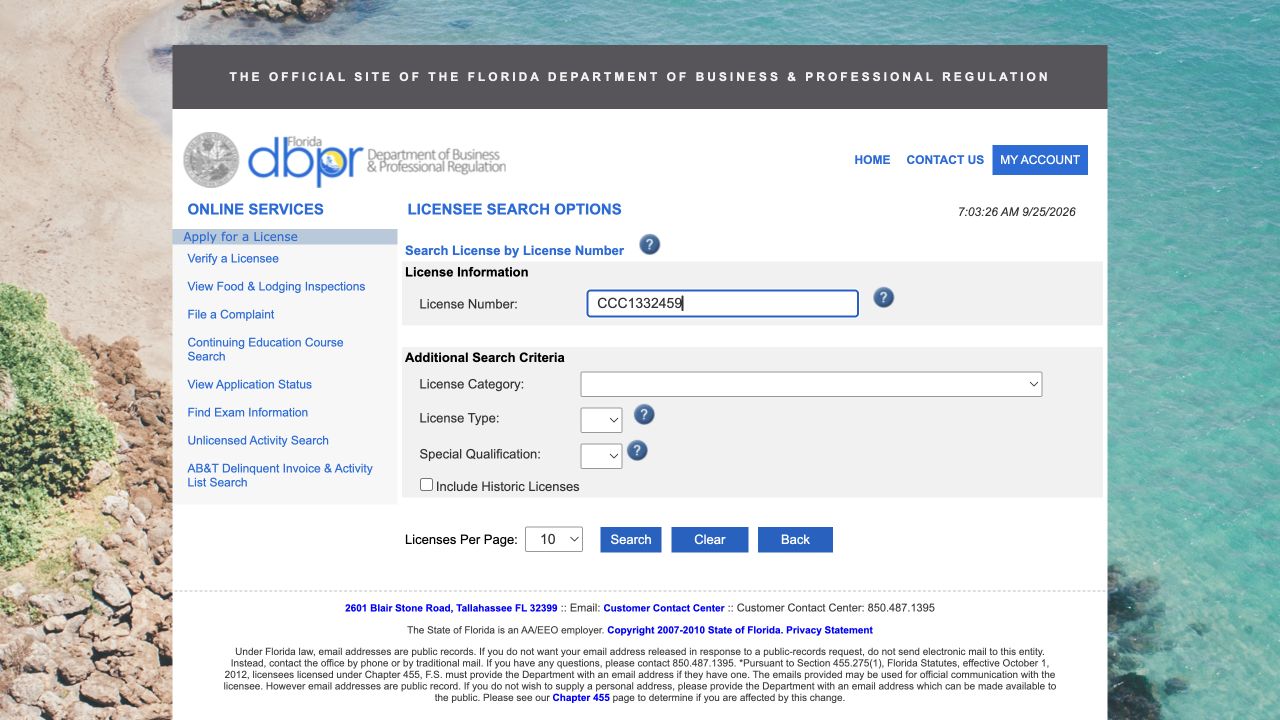
1Search the roofing license in DBPR
Ask the roofer for their full Florida roofing license number, then open the official DBPR license search (opens in a new tab). Using the license number helps avoid confusing businesses with similar names.
- Select Search by License Number, then choose Search.
- Enter the contractor’s full license number and choose Search again.
- Open the individual roofing-license result to read the detailed record.
For a dated example, search CCC1332459. On September 25, 2026, DBPR listed MORA, MARTIN JR as the primary name and M & M ROOFING AND CONSTRUCTION CORP as the DBA, with a Certified Roofing Contractor license, Current,Active status and an August 31, 2028 expiration. Open that DBPR record (opens in a new tab) and check it again before hiring.
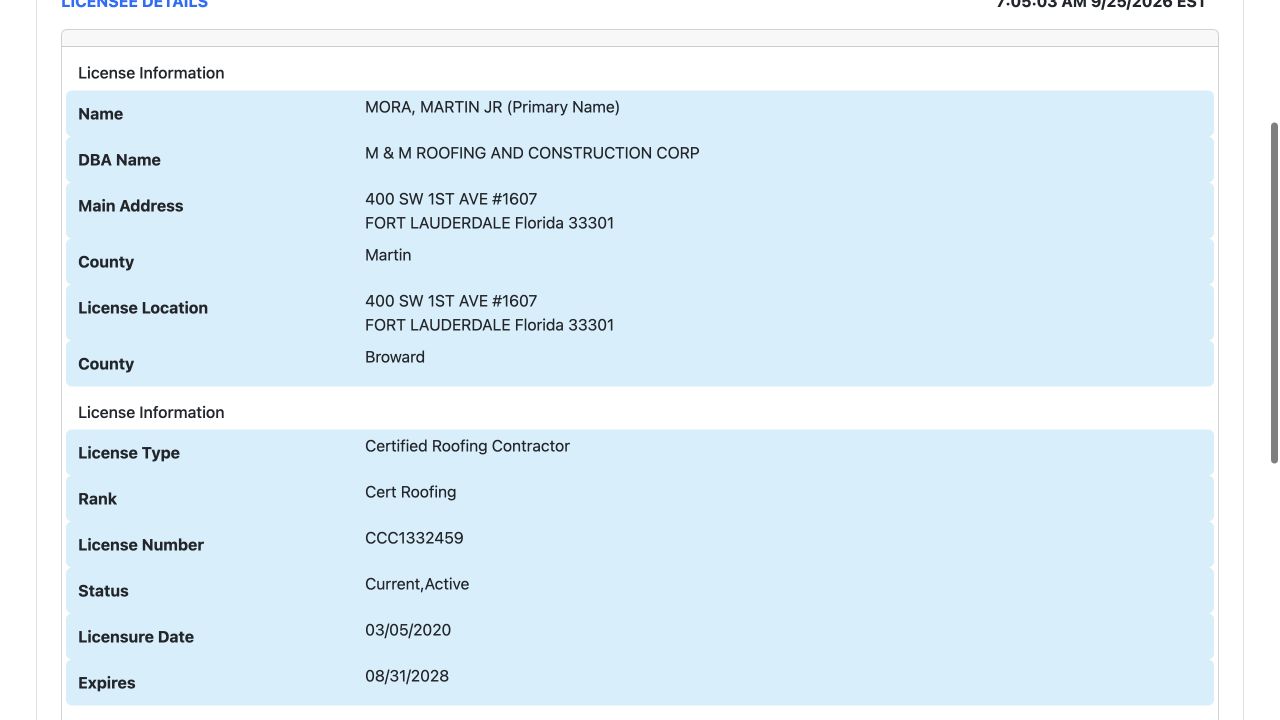
2Match the business and read the whole status

Compare the business details in the license record with the written proposal.
Stock photo: Michael Burrows / Pexels (opens in a new tab)
Connect the qualifier and business shown by DBPR to the company on the proposal. A qualifier is the licensed person qualifying the business; you are not checking whether every employee has a separate contractor license. If the names differ, ask for an explanation and verify it using DBPR’s business information (opens in a new tab).
Check the roofing license type, the complete status, expiration date and any available disciplinary information. “Current,Inactive” is different from “Current,Active”; do not stop after reading the first word. Ask DBPR about an unclear status or record.
A state-certified contractor can work statewide within the license’s scope. A registered contractor has local limits; confirm authority for your property with the local building department. The DBPR construction FAQs (opens in a new tab) explain these distinctions. This license check does not verify current insurance.
3Ask for the company details and both certificates
Ask for the legal company name, any “doing business as” (DBA) name, the roofing license number and the qualifier’s name. Request a current workers’ compensation certificate and a commercial general liability certificate. A business card saying “licensed and insured” does not give you enough information to check either policy.
You can ask any roofing contractor, including M&M, for these certificates of insurance (COIs) before hiring. Have the insurance agent send them directly so you can verify the coverage. Keep them with the written estimate, along with the date you checked the records. Florida’s homeowner contractor-fraud guide (opens in a new tab) is a useful starting point.
A request you can copy
Before we finalize the roofing proposal, please send your legal company name, any DBA name and Florida roofing license number, plus a current workers’ compensation certificate and commercial general liability certificate. Please have your insurance agent send the certificates directly and provide the agent’s contact details. If you use subcontractors, an employee-leasing company or an exemption, please explain who will perform the work and provide the relevant coverage or exemption information. Please also ask your agent whether I can be included as an additional insured under your general liability policy for this project. I can provide my legal name and project address; please send the applicable endorsement or policy provision and confirm any conditions I must meet.
Know what to ask for
What does a certificate of insurance look like?
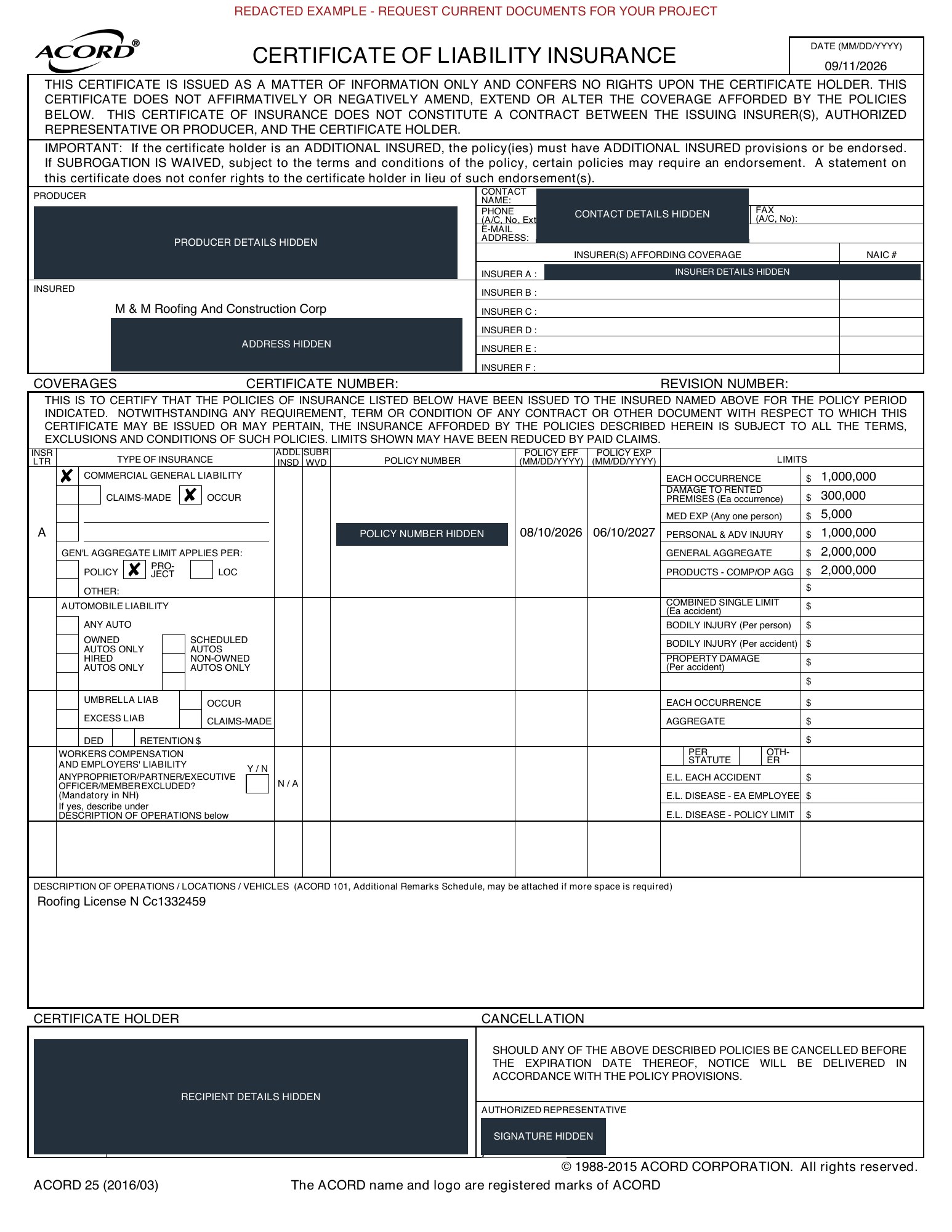
These two M&M examples show the documents you can request from a contractor. Both use a certificate-of-liability-insurance heading, so read the completed coverage rows and notes to see which insurance is actually listed.
General liability certificate
Workers’ compensation certificate
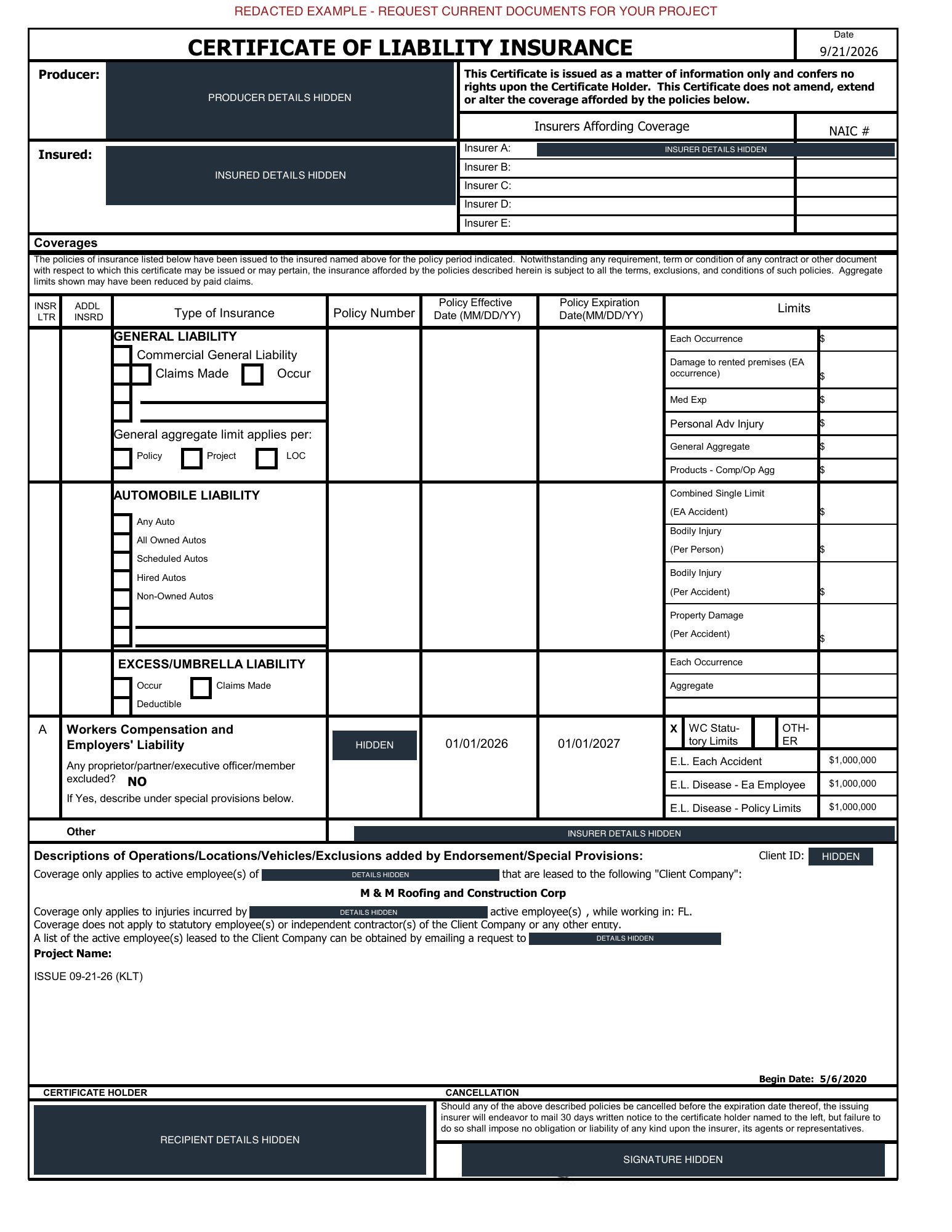
Redacted examples for reference. Producer, insurer and employee-leasing company details, policy numbers, certificate-recipient details and signatures are hidden. M&M’s name and the coverage fields remain visible. Request fresh, complete certificates for your project and confirm them with the issuing agent; these examples do not establish current coverage or additional-insured status for you.
4Verify workers’ compensation separately
Florida construction employers generally need workers’ compensation coverage with one or more employees, subject to applicable exemptions. See the state’s coverage requirements (opens in a new tab). Ask who employs the crew, including any subcontractors or professional employer organization (PEO)/employee-leasing company.
In Florida’s Proof of Coverage database (opens in a new tab), select Employer Name and enter at least three characters; the employer city can narrow your search. Match the employer, carrier and policy information to the certificate. Check effective, expiration and cancellation dates for the planned work; a past policy result is not proof of coverage today.
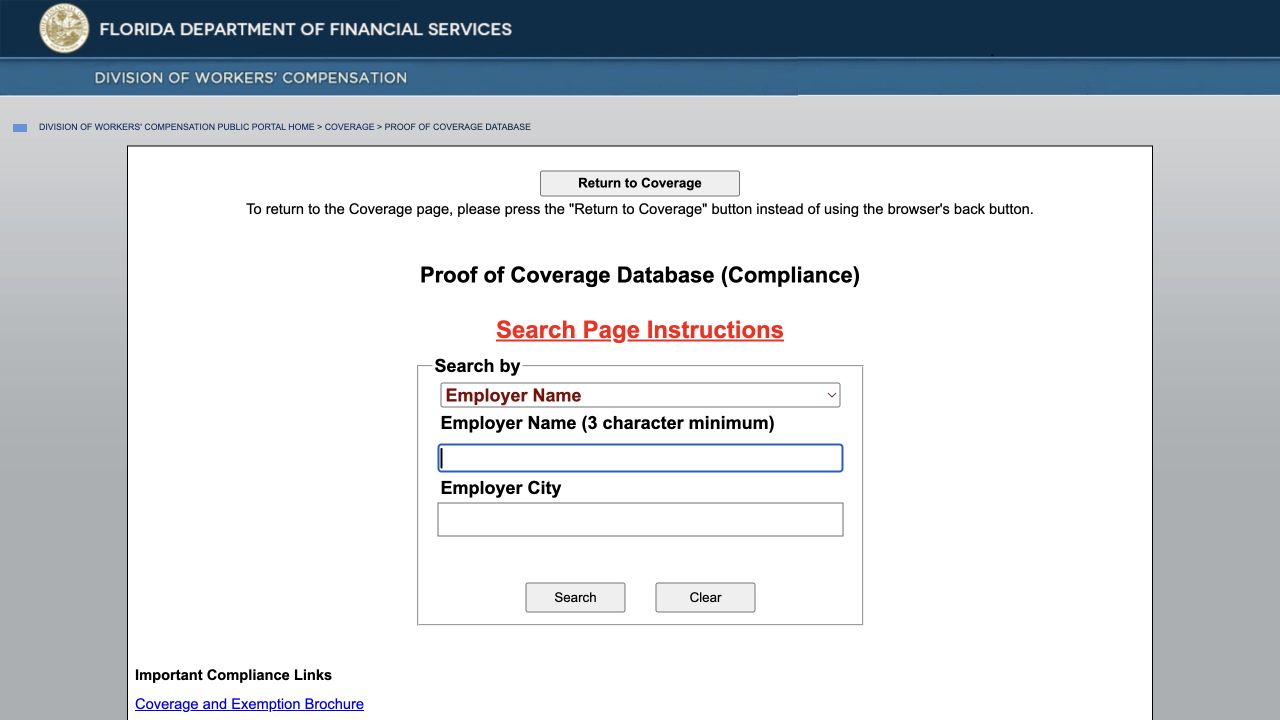
If someone presents an exemption, use the official exemption search (opens in a new tab) to check the named individual, company and dates. An owner’s exemption does not cover an entire crew. For leased workers, contact the PEO to confirm the people assigned to your project are reported and accepted under its coverage. Resolve uncertain records with the agent or Division of Workers’ Compensation.
5Have the agent confirm general liability coverage

Call the issuing agent to confirm coverage and clarify the policy details.
Stock photo: Mizuno K / Pexels (opens in a new tab)
Workers’ compensation and commercial general liability address different risks. On the liability certificate, review the named insured, insurer, policy dates, coverage type and limits. The insured business should connect clearly to the contractor in your agreement.
Find the issuing agent’s contact details independently, such as through the agency’s official website, and ask the agent to confirm the certificate and policy’s current status. Describe your proposed roofing work and ask whether roofing operations, exclusions or other restrictions affect coverage for that work. Request clarification of unfamiliar terms.
A certificate summarizes insurance; it is not the policy and does not expand coverage. Florida DFS explains certificate-of-insurance limits (opens in a new tab).
Can the property owner be added as an additional insured?
Yes, you can ask the contractor to arrange additional-insured status under its general liability policy for your roofing project, subject to the policy’s terms. Give the agent the property owner’s legal name and project address before work starts. This can provide protection for certain liabilities connected to the contractor’s work.
Request the applicable endorsement or policy provision and written confirmation that it applies to you. Some policies use a blanket endorsement with conditions (opens in a new tab), such as a written contract. Ask whether coverage applies while work is underway, after completion, or both, and have the agent explain the limits and exclusions.
Certificate holder and additional insured mean different things. Listing your name in the certificate-holder box alone does not make you insured. A workers’ compensation certificate does not provide this homeowner additional-insured protection either. See Travelers’ explanation of certificates and additional-insured status (opens in a new tab).
6Close the gaps before signing or paying

Review the proposal and supporting records together before signing or paying.
Stock photo: Kindel Media / Pexels (opens in a new tab)
Put the proposal beside the records and check the names, dates and scope together. Pause if a number belongs to another business, the status is unclear, dates have expired or the contractor will not provide the requested documents. Save the explanations and updated records, and recheck if the project starts later or the crew arrangements change.
- License and qualified business match the proposal.
- Workers’ compensation or applicable exemption records match the people and employer involved.
- The agent has clarified current liability coverage and any relevant restrictions.
- The written scope explains materials, permits, payment stages and responsibilities.
For the next comparison, use our Fort Lauderdale contractor guide, explore roof replacement services and review the project gallery. Apply the same document checks to any contractor you consider, including M&M.
Common homeowner questions
Where do I check a Florida roofing license?
Use DBPR’s official license search and open the roofing license detail. Match the qualifier and business to your proposal, then read the full status and expiration date.
Does every person on the roofing crew need a separate license?
No. Employees can work for the properly licensed contractor; the important checks are the contracting business, its qualifier and the arrangements for the people doing the work.
Does an active license prove current insurance?
Check insurance separately. Request current workers’ compensation and general liability certificates, then verify the employer, dates and relevant coverage through the official records and issuing agent.
Does a workers’ compensation exemption cover the whole crew?
No. Verify the named individual, company and exemption dates, and ask how the other people working on your roof are covered.
Can a homeowner be added as an additional insured for a roofing project?
You can request additional-insured status under the contractor’s general liability policy. Provide your legal name and project address before work begins, and have the agent confirm eligibility, the applicable endorsement or policy provision, and its conditions. Ask whether protection applies during the work, after completion, or both. A certificate alone does not create that coverage.
Am I insured because my name is on the certificate?
Being a certificate holder does not automatically make you an additional insured. Ask the issuing agent about the policy terms and any endorsement needed for that status.
What if the company names do not match?
Ask for a written explanation and verify the relationship before signing or paying a deposit. A similar name or familiar logo is not enough to connect different businesses.
Official sources
Checked September 25, 2026. The links within each step lead to the live records and guidance: DBPR license search, construction FAQs and business information; Florida DFS coverage and exemption searches, employer requirements, homeowner guidance and insurance-certificate guidance; and Travelers’ certificate guide. The redacted certificate examples were supplied by M&M.
Your roofing project
Get a free roof estimate
Tell M&M about your property and the work you are considering. Use your document checklist when discussing the proposal and preparing for the project.