
Material review · Mechanically attached fire-resistant roof deck protection
GAF VersaShield Review: What This Fire-Resistant Roof Layer Actually Does
VersaShield belongs in the conversation when a roof needs a specific fire-resistant layer. Understanding that role helps you compare estimates without confusing it with peel-and-stick waterproofing or an uplift upgrade.

GAF VersaShield
Mechanically attached fire-resistant roof deck protection
What belongs beneath your new roof?
Compare the underlayment and complete roof assembly for your home.
The short answer
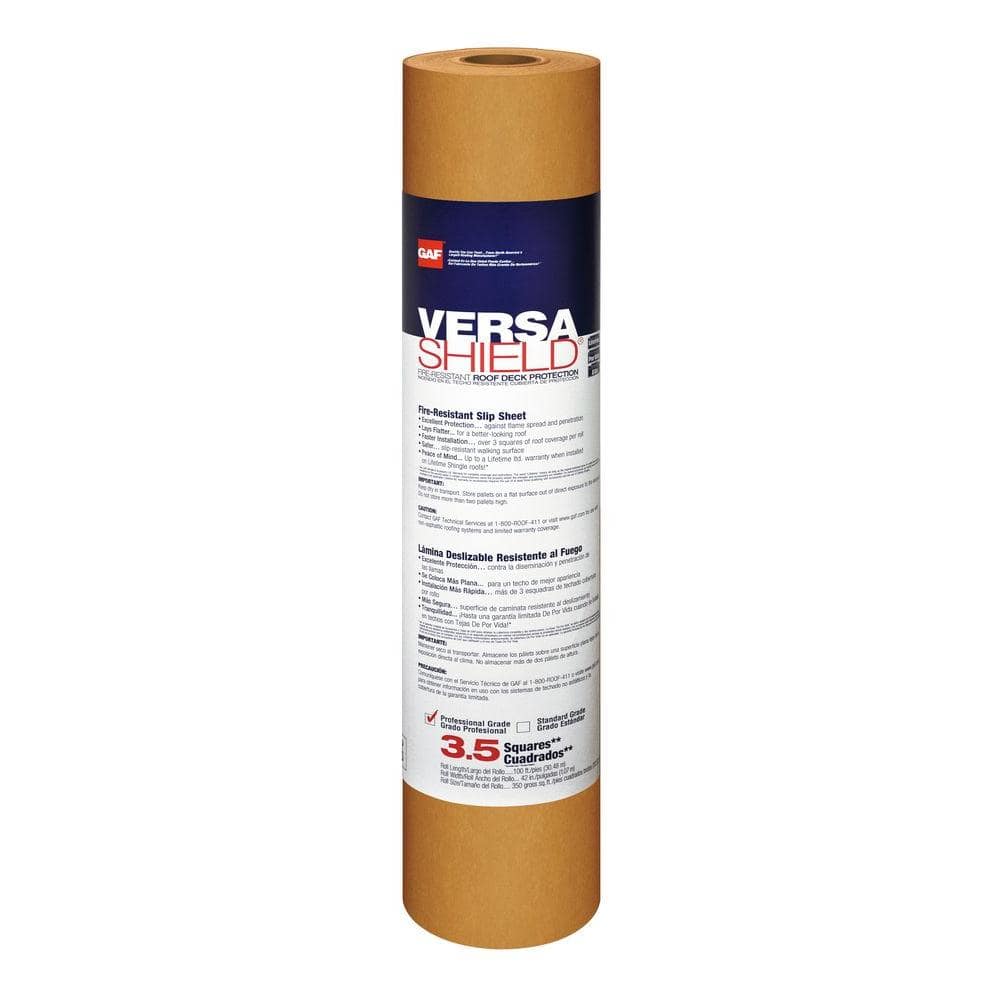
VersaShield is a mechanically fastened fiberglass layer used in approved roof assemblies where fire performance matters. It is not a peel-and-stick membrane, and the roll by itself does not give a roof a Class A fire rating. For a homeowner, the useful question is whether the complete proposed roof needs this layer—and whether the estimate identifies the correct fire listing, fastening and weather-protection details.
Beyond the name on the roll
What GAF VersaShield brings to the roof
Fire performance belongs to the whole roof
The covering, deck and number of VersaShield layers must match a tested assembly. A product brochure’s fire-resistance claim does not establish the classification of every roof built with it. Ask for the listing that matches your proposed roof.
The “3.5” describes roll coverage
A VersaShield roll measures 42 inches by 100 feet: 350 square feet, or 3.5 roofing squares, before overlaps. That number is not a thickness, pressure rating or fire classification. Laps and required layers reduce the area one roll actually covers.
No transferable uplift number
Current documents do not publish a VersaShield maximum design pressure to graph against peel-and-stick membranes. Other GAF products share a Florida approval family, but their pressure values belong to their own assemblies. Absence of a number does not mean zero strength.
Two useful specifications
Thickness and wind resistance at a glance
Material thickness
Not listed
The reviewed NOA, Florida evaluation and GAF sheet do not state the membrane thickness. VersaShield is a mechanically attached fire-resistant layer; its required layers and approved roof covering matter.
Assembly wind resistance
No standalone psf rating listed
Listed allowable design pressures
The reviewed approvals do not assign VersaShield a standalone numeric pressure. Follow the approved roof assembly and prescribed mechanical fastening.
See the assemblies, installation and sources →Pressure ratings apply to the specific deck and installation listed in each approval. They are not wind speeds or a rating for the entire roof. Thickness alone does not determine wind resistance.
Does it fit your roof and your location?
Broward and Miami-Dade are in Florida’s High-Velocity Hurricane Zone (HVHZ). Palm Beach and Martin County are outside that zone. The applicable approval, roof covering and installation must agree.
Broward & Miami-Dade · HVHZ
A roofing component accepted through NOA 26-0807.06 when the complete roof assembly permits it.
The NOA requires approved mechanical fasteners and minimum 4-inch headlaps. Confirm the specific covering approval; a general manufacturer material list is not blanket permission.
Outside HVHZ
FL10626.2-R31 lists asphalt shingles, metal, slate and wood. It does not list VersaShield for mechanically attached or adhesive-set tile.
The report provides prescriptive attachment details for non-tile applications. Its separate HVHZ family report does not list VersaShield; use the product’s own NOA for that jurisdiction.
Review the complete metal roof assembly, including required underlying layers. Metal roofing options →
What the approval actually measures
How much uplift can the approved assembly resist?
An honest review needs to separate fire performance from wind resistance. These documents answer different questions, and one cannot stand in for the other.
No standalone pressure number to chart
No VersaShield numerical maximum design pressure is listed in the current NOA or reviewed Florida evaluation. We therefore do not show an uplift bar or rank it against adhered membranes. The roof still needs code-compliant attachment, and its finished covering must satisfy the project’s wind design.
Match GAF accessories to the selected shingle system. Shingle roofing options →
Material testing · Source checked October 27, 2026
Beyond wind pressure: how does the sheet perform?
Tear resistance, tensile strength and vapor permeance describe different jobs. Here is what the reviewed documents actually report for GAF VersaShield Fire-Resistant Roof Deck Protection.
Tear resistance
Clarification neededHow well the sheet resists a tear spreading. Test methods can pull or tear the material in very different ways.
ASTM D1922 · grams (grams-force in D1922)
Source label needs clarification
Machine direction400 grams
Cross-machine direction550 grams
The current sheet lists these ASTM D1922 figures under a second “Tensile” label. That labeling discrepancy needs clarification before we chart or rank them as tear resistance.
Manufacturer technical data sheetGAF VersaShield sell sheet RESGN222-0323 · p2
Tensile strength
Numeric specificationHow much pulling force the sheet carries before reaching its reported maximum load. This is a material test, not a roof uplift rating.
ASTM D146 / ASTM D828 · lb/in width
Manufacturer value · basis unspecified
GAF lists pulling strength along and across the sheet. It does not say whether these are minimum or typical results, and its test methods differ from the other membranes here.
Manufacturer technical data sheetGAF VersaShield sell sheet RESGN222-0323 · p2
Vapor permeance
Numeric specificationHow readily water vapor passes through the sheet. A lower perm value means less vapor passes through; it does not automatically mean a better roof.
ASTM E96 · perms
Published minimum permeance
GAF specifies at least 3 perms, indicating more vapor passage than low-perm peel-and-stick sheets. VersaShield is a fire-resistant deck-protection product with a different role.
Manufacturer technical data sheetGAF VersaShield sell sheet RESGN222-0323 · p2
What the NOA and Florida approval establish
NOA 26-0807.06 and Florida non-HVHZ evaluation identify ASTM D226 Type II material compliance but publish no numerical tear/tensile/permeance results for VersaShield. The Florida HVHZ family evaluation does not list this product. Use the separate current NOA for HVHZ.
The approval determines permitted uses and installation. Where it does not publish these laboratory values, the cards identify the original manufacturer sheet as the source. A manufacturer value is not relabeled as an NOA test result.
How to compare these numbers
MD means the direction along the roll; CD or XMD means across it. Match the method, units, direction, conditioning and whether a figure is a minimum, maximum or typical result. A published minimum is a floor—not proof of a product’s highest strength.
Use the exact approved assembly for wind-pressure comparisons. Vapor permeance is a roof-design consideration, and M&M’s installation experience adds context to the laboratory figures.
Compare underlayment options for your roof →The details worth discussing before installation
What should a fire-resistant assembly include?
A useful submittal identifies the tested roof covering, the deck beneath it, the number of VersaShield layers and the installation detail. Those choices work together. Changing the covering or reducing the required layers can change the fire classification.
The Miami-Dade NOA expressly excludes fire classification from its approval. GAF directs readers to the applicable tested assembly listings. Ask for the exact fire listing alongside the wind approval; “Miami-Dade approved” alone does not answer both questions.
Does it replace a peel-and-stick water barrier?
VersaShield is mechanically attached and has no peel-off adhesive backing. Its role should be shown in the complete roof detail rather than substituted for a specified self-adhered membrane. GAF also states that it is not waterproof and should not serve as the temporary roof.
One non-HVHZ Florida pathway pairs sealed deck joints with mechanically attached VersaShield. It uses at least 3¾-inch approved joint strips, with end and T joints butted rather than overlapped. VersaShield then has minimum 4-inch side laps and 6-inch end laps. This is a defined assembly, not simply a loose roll over plywood.
What holds the sheet in place?
That same non-HVHZ detail requires minimum 0.083-inch annular-ring or deformed-shank nails with nominal one-inch caps. Fasteners must pass through the sheathing or penetrate at least ¾ inch into it. Spacing is 12 inches between overlaps and 6 inches at overlaps.
Metal caps are required where ultimate design wind speed reaches 170 mph. The report also specifies cap thickness: 32-gauge metal, 0.010-inch power-driven metal, or 0.035-inch plastic at its outside edge where plastic is permitted. These prescriptive details are not a published psf rating.
How long can it stay exposed?
Use the 30-day maximum in the current Miami-Dade NOA and Florida evaluation. GAF’s literature also discusses 60-day UV stability, but that does not extend the approval’s exposure limit or make the sheet a dependable temporary weather covering.
The similarly named VersaShield Solo is a separate slip-sheet product and has no permitted weather exposure under this NOA. Keep the product name consistent across the estimate, delivered rolls and approval paperwork.
What should be named in your estimate?
A useful proposal identifies the materials and the installation that will be inspected—not simply “underlayment included.” Ask for:
- Exact VersaShield product, distinct from VersaShield Solo.
- Complete roof fire listing and required layer count.
- Wind approval, deck preparation and fastening detail.
- Separate water-protection details and covering schedule.
Choose the layers together
M&M Roofing can help you compare underlayment options with the roof covering, deck condition and attachment your project needs.
Plan my roof replacement →Continue comparing roof materials
Shingle roofing options
Match GAF accessories to the selected shingle system.

Homeowner questions about GAF VersaShield
Does VersaShield make any roof Class A?
No. Fire classification depends on a tested complete roof assembly. The deck, covering, number of layers and installation must match its listing. The VersaShield Miami-Dade NOA specifically does not include fire classification.
Can I use it beneath foam-set tile?
The reviewed non-HVHZ Florida report does not list VersaShield for adhesive-set or mechanically attached tile. Do not treat a general product brochure as permission for that application. Select a tile underlayment and attachment assembly specifically approved for the project.
Why is there no pressure chart for VersaShield?
The current product documents do not assign it a numerical maximum design pressure. They provide component acceptance and prescriptive fastening instead. Borrowing a pressure value from another GAF product would misrepresent what was evaluated.
Your roof, your approved assembly
Get a roof estimate with the details included
Tell M&M Roofing about your home and the roof covering you are considering.
Start with the approvals
The NOAs and Florida Product Approval reports are the primary evidence for the installation limits and ratings above. Manufacturer literature provides the additional product and warranty information. These documents describe approved conditions; they are not endorsements.
- Primary approval: NOA 26-0807.06 · approved September 24, 2026; expires February 7, 2032
Identity and installation p. 2; fire disclaimer, exposure and limitations p. 3. - Primary approval: FL10626.2-R31 · non-HVHZ evaluation
Coverings p. 4; exposure p. 6; prescriptive assembly p. 7. - Manufacturer: GAF VersaShield product and assembly information
Fire-listing and conditional warranty guidance. - Manufacturer: GAF VersaShield installation instructions
Product role and temporary-roof limitations; Florida approval details remain controlling.
Technical summaries help compare proposals. The full current documents and the project’s approved plans control installation.