
Material review · Tile & approved metal roof systems
Polystick TU PLUS: the protection beneath your roof
What makes Polyglass TU PLUS a useful tile-roof underlayment, where it can also fit beneath metal, and which approval details belong in your estimate.

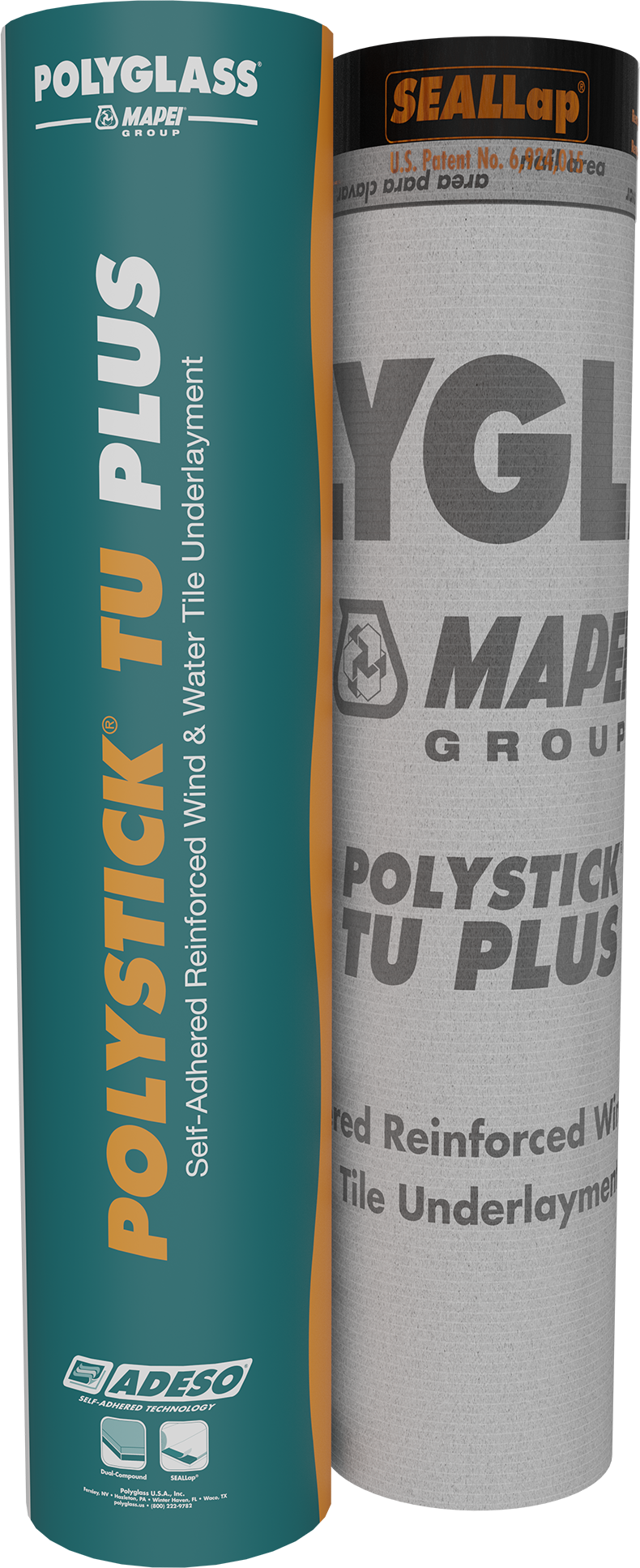
Polystick TU PLUS
Self-adhered underlayment with a fabric surface and internal fiberglass reinforcement.
Plan the layers beneath your new roof
Ask for the underlayment, attachment method and roof covering to be named in your written estimate.
The short answer
TU PLUS is a good option to compare when you want a bonded waterproofing layer beneath a tile roof.Its fabric surface works with listed tile foams, and its reinforcement helps it tolerate tile handling. It also has approved metal applications. The important choice is the complete installation: what it sticks to, how the laps and fasteners are handled, and which roof covering goes above it. Ask your roofer to identify that assembly in the estimate.
The layer you stop seeing when the roof is finished
Look beneath the finished surface
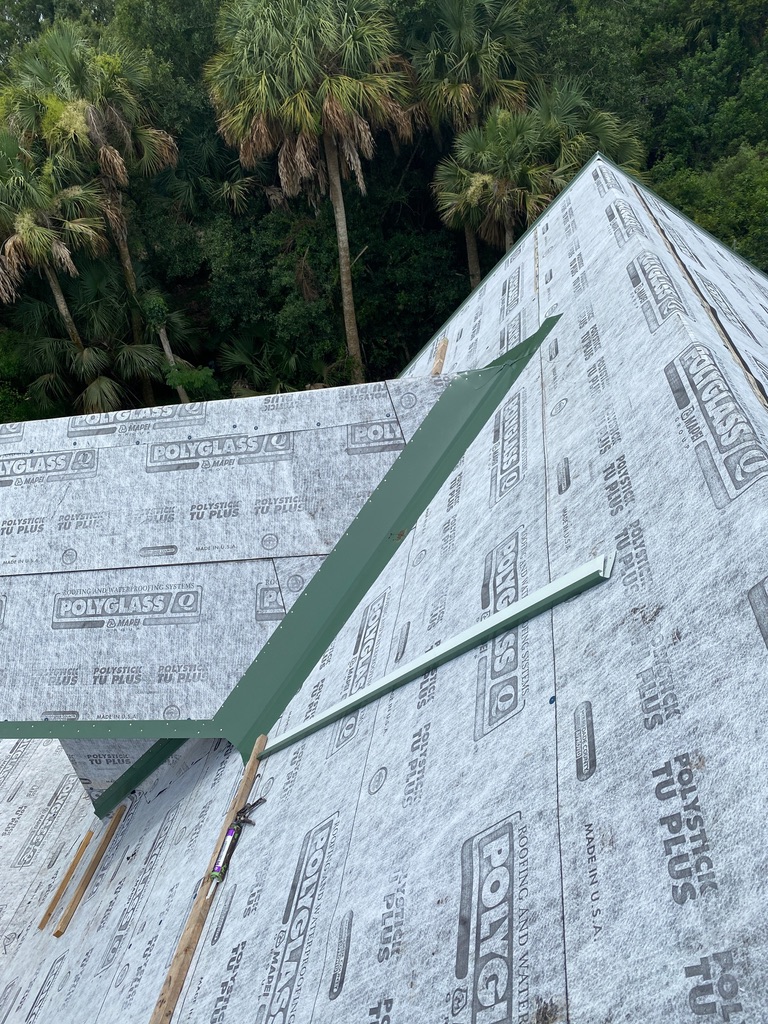
This close-up shows the membrane during construction, before the finished roof hides the laps, valleys and transitions. Those details are part of the water protection you are paying for.
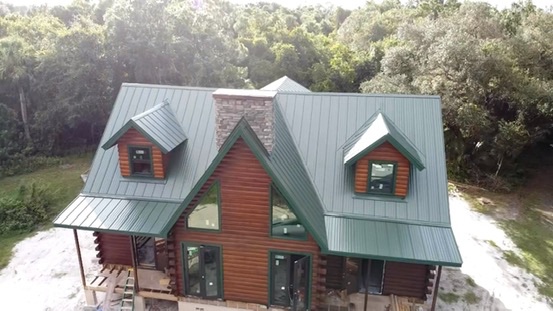
The same project became an Evergreen metal roof using Dynamic Metals panels on a cabin-style home. See the Indiantown new-construction roof projectfor the complete photo story. The visible product markings identify the membrane in this photograph; a photo alone does not establish the full approved roof assembly.

Why consider it?
Three useful qualities for a tile roof
Tile sheds much of the rain, but a roof also needs a properly detailed water barrier underneath. TU PLUS is designed for that role in approved clay- and concrete-tile systems, including foam-set and mechanically attached installations.
A bonded water barrier
The self-adhered underside bonds to the specified substrate. Properly sealed laps and flashing details help keep water that gets beneath the covering from reaching the sheathing.
A surface made for tile attachment
The polyester fabric face works with the tile adhesives listed in its approvals. That gives the roofer several approved foam options to evaluate with your exact tile.
Reinforcement for roof work
An internal fiberglass mat and fabric surface provide reinforcement and puncture resistance. Sound decking, careful loading and correct installation still matter.
Product construction and intended uses: Polyglass TU PLUS data sheet, edition 09/26, page 1.
Our tile roofing service guideexplains how the tile, underlayment and attachment fit into the full roof.
Can TU PLUS go beneath metal as well as tile?
Yes, when the applicable roof assembly permits it.Outside the High-Velocity Hurricane Zone, Florida approval FL5259.2-R50 lists TU PLUS for metal roof coverings. The companion HVHZ report also lists metal, so it would be incorrect to describe TU PLUS as an outside-HVHZ-only metal underlayment.
Broward and Miami-Dade are the HVHZ counties. Palm Beach and Martin County, including Indiantown, are outside that zone. Location tells you which approval report to use; the exact panel, deck, attachment, fire listing and manufacturer instructions decide whether the proposed roof works together.
| Location | TU PLUS applications discussed here | What to verify |
|---|---|---|
| Outside the HVHZ | Mechanically attached tile, listed foam-set tile and approved metal coverings. | FL5259.2-R50, the exact covering approval and complete installation. |
| Broward & Miami-Dade | The HVHZ Florida report also lists tile and metal. The Miami-Dade NOA lists non-structural metal roofing. | FL5259.1-R50or the applicable NOA assembly, plus the covering and fire requirements. |
A heat rating is only one part of the decision
The current TU PLUS data sheet gives temperature resistance up to 265°F. That describes a material property; it does not approve every metal panel system or establish a fire classification. Ask your roofer to check the proposed metal assembly, not just the roll’s temperature rating.
Metal listing: non-HVHZ report Table 2 (p6) and §6.4.1 (p15); HVHZ report Table 2 (p5) and §6.4.1 (p11). NOA General Limitations 1, 2 and 10 (pp18, 21).
Planning metal? Compare the complete scope in our metal roofing guideand our Polystick MTS PLUS review.
The approval documents behind this review
These approvals cover a family of Polyglass products. A cover-page pressure or a familiar brand name is not enough: the contractor needs the row that names TU PLUS and matches the roof being built.
Miami-Dade NOA 25-0121.12
Approved March 20, 2025; expires September 13, 2027. The official record was approved and showed no superseding file when checked on October 25, 2026. Review the assembly, roof-covering limitations and applicable manufacturing location.
Florida Product Approval FL5259-R50
Approved February 10, 2026 under the 2023 Florida Building Code, 8th Edition. It has separate HVHZ and non-HVHZ reports with different systems and conditions.
Official Florida approval record· HVHZ report· Non-HVHZ report
Our guide to checking a roofing product’s NOA and Florida approvalexplains how to find the details that belong with your permit.
The installation changes the pressure rating
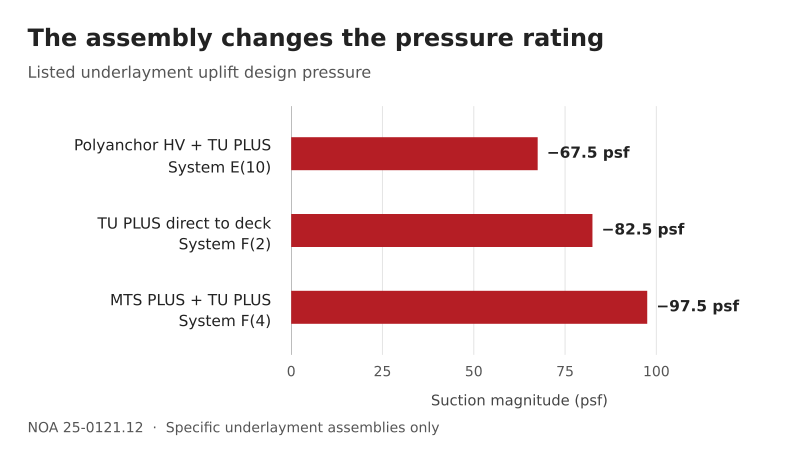
“How strong is TU PLUS?” needs a second question: installed over what, and attached how?These three tile-eligible examples come from the same Miami-Dade NOA. They use different layer arrangements, so they are not interchangeable specifications.
Read the values and installation conditions
| NOA system | Layer arrangement | Listed uplift pressure |
|---|---|---|
| E(10), p12 | Mechanically attached Polyanchor HV base sheet, then TU PLUS. | −67.5 psf |
| F(2), p15 | TU PLUS adhered directly to the specified wood deck. | −82.5 psf |
| F(4), p16 | MTS PLUS adhered to the deck, then TU PLUS. | −97.5 psf |
These examples use the NOA’s specified 15/32-inch, four-ply plywood or wood-plank deck and deck fastening. TU PLUS is back-nailed with the specified ring-shank nails and tin caps at no more than 12 inches on center. The base layers have additional attachment and lap requirements. The cited pages contain the full specification; changing a component can change the applicable rating.
Florida approval R50 has its own assembly tables and pressures. Do not combine a pressure from one document with an installation from another. The roofer must select a permitted assembly that meets your project’s design pressures; the tile and foam attachment are checked separately.
This chart does not compare TU PLUS with competing brands and does not rank tile foams. Tile-foam overturning resistance uses a different measure from underlayment uplift pressure.
Material testing · Source checked October 27, 2026
Beyond wind pressure: how does the sheet perform?
Tear resistance, tensile strength and vapor permeance describe different jobs. Here is what the reviewed documents actually report for Polystick TU PLUS.
Tear resistance
Numeric specificationHow well the sheet resists a tear spreading. Test methods can pull or tear the material in very different ways.
ASTM D5147 · lbf
Published minimum strength
The sheet gives the same minimum in both directions. This is a stated strength floor, not a measured maximum or proof that products sharing the minimum perform identically.
Manufacturer technical data sheetPolyglass Polystick TU PLUS product data sheet, edition 09/26 · p1
Tensile strength
Numeric specificationHow much pulling force the sheet carries before reaching its reported maximum load. This is a material test, not a roof uplift rating.
ASTM D5147 · lbf/in
Published minimum strength
The sheet gives the same minimum in both directions. This is a stated strength floor, not a measured maximum or proof that products sharing the minimum perform identically.
Manufacturer technical data sheetPolyglass Polystick TU PLUS product data sheet, edition 09/26 · p1
Vapor permeance
Numeric specificationHow readily water vapor passes through the sheet. A lower perm value means less vapor passes through; it does not automatically mean a better roof.
ASTM E96 · U.S. perms
Published maximum permeance
The sheet specifies no more than 0.1 U.S. perm. This is a limit, not an exact measured result. Cup method and test conditions are not stated.
Manufacturer technical data sheetPolyglass Polystick TU PLUS product data sheet, edition 09/26 · p1
What the NOA and Florida approval establish
Reviewed Miami-Dade NOA 25-0121.12 and FL5259-R50 HVHZ/non-HVHZ evaluations first. They identify products, material standards and approved installation assemblies but do not publish product-specific tear, tensile/maximum-load or vapor-permeance measurements. The material values shown here are manufacturer-published physical-property limits/results, not NOA wind pressures.
- Miami-Dade NOA 25-0121.12 — complete approval
- FL5259-R50 HVHZ evaluation — complete report
- FL5259-R50 non-HVHZ evaluation — complete report
The approval determines permitted uses and installation. Where it does not publish these laboratory values, the cards identify the original manufacturer sheet as the source. A manufacturer value is not relabeled as an NOA test result.
How to compare these numbers
MD means the direction along the roll; CD or XMD means across it. Match the method, units, direction, conditioning and whether a figure is a minimum, maximum or typical result. A published minimum is a floor—not proof of a product’s highest strength.
Use the exact approved assembly for wind-pressure comparisons. Vapor permeance is a roof-design consideration, and M&M’s installation experience adds context to the laboratory figures.
Compare underlayment options for your roof →Which tile foams are listed with TU PLUS?
The current NOA and Florida reports list all five of these underlayment/adhesive pairings. That is useful flexibility when selecting the tile system, but a “yes” in the compatibility table is not a strength score.

| Tile adhesive | Listed with TU PLUS | Read more |
|---|---|---|
| APOC Polyset AH-160 | Yes; the NOA names the HFC formulation. | AH-160 review |
| APOC Polyset RTA-1 | Yes | RTA-1 review |
| DuPont TILE BOND | Yes | TILE BOND review |
| DAP StormBond | Yes | StormBond review |
| DAP StormBond 2 | Yes | Tile foam comparison |
Sources: NOA p18; HVHZ Table 2A, p6; non-HVHZ Table 2A, p6.
Match the exact adhesive product and formulation to its current approval. The tile and adhesive documents determine the foam placement, amount and attachment resistance. Have the estimate name all three: underlayment, tile profile and adhesive.
Why do some documents say 180 days and others say 360?
The documents do not all give the same allowance. Exposure is the temporary period between installing the membrane and covering it with the finished roof. It is not the underlayment’s service life.
| Document | TU PLUS exposure allowance | Important condition |
|---|---|---|
| Miami-Dade NOA 25-0121.12, p19 | Normally 180 days. | The starred U.S. plant entries can receive an additional 180 days when an Executive Order is in place. The extension is conditional. |
| Florida R50 reports, Table 5 | Up to 360 days. | Use the applicable HVHZ or non-HVHZ report and the approval governing the permitted installation. |
| Polyglass data sheet, edition 09/26 | Up to 360 days. | Subject to local codes, listings and the authority having jurisdiction. |
Ask which approval and exposure limit applies to your job before relying on the largest number.Covering the membrane promptly and inspecting its condition are still good project-planning practices.
Sources: NOA General Limitation 6; HVHZ Table 5, p10; non-HVHZ Table 5, p14; current product data sheet.
Ask what is included below the tile
A useful estimate identifies the deck preparation, underlayment assembly, flashing and tile attachment—not just the finished color.
Get a roof estimate with the details →Installation details worth asking about
- Sound, clean and dry sheathing.Loose panels, protruding fasteners, moisture and debris need attention before bonding. Reinforcement does not repair rotten or unsuitable decking.
- The primer and base layer named in the assembly.TU PLUS can be direct to deck or part of an approved multi-ply installation. A second layer is not required in every approved system.
- Sealed laps and careful flashing.The data sheet gives minimum 3-inch side laps and 6-inch end laps, with specified cement at non-factory overlaps. A specific assembly can require more. Valleys, walls and penetrations deserve the same attention as the open roof area.
- Rolling and back-nailing.Self-adhered does not mean fastener-free. Full contact with the substrate and the assembly’s specified nails and tin caps are part of the installation.
- A tile-loading plan.The NOA calls for at least 48 hours before loading tile. Stack size, roof slope and the need for battens or loading boards also matter, particularly on steep roofs.
Sources: TU PLUS application instructions, p2; NOA installation requirements and application guidelines, pp17–22. The complete project specification controls.
The membrane must receive an approved roof covering. It is not a permanent exposed roof, and the NOA does not permit it as a direct recover over an old roof membrane.
For the order of approvals, dry-in, delivery and final inspection, see our Broward roof replacement timeline.
TU PLUS, TU MAX and MTS PLUS are different products
The similar names make estimates easy to misread. Ask for the full product name and the actual assembly, especially if a quote simply says “Polyglass peel-and-stick.”
| Product | Useful distinction | What to compare |
|---|---|---|
| Polystick TU PLUS | Fabric surface plus an internal fiberglass mat; current PDS lists 80 mils. | Tile-foam pairing, substrate, assembly and the exposure allowance that applies. |
| Polystick TU MAX | Another fabric-faced tile underlayment, with different construction and specifications. | Use its own assembly values. Greater thickness alone does not establish stronger attachment. Read the TU MAX review. |
| Polystick MTS PLUS | A metal-focused, film-surfaced product; also used as a base layer beneath TU PLUS in listed two-ply systems. | Do not treat its surface as interchangeable with TU PLUS for foam-set tile. Read the MTS PLUS review. |
Sources: Polyglass Polystick brochure, July 2026; TU PLUS data sheet; NOA F(4) two-ply assembly.
Ask which written warranty comes with the job
The TU PLUS data sheet states a one-year warranty against manufacturing defects that directly cause leakage unless a supplemental manufacturer warranty applies. Polyglass’s current warranty matrix lists additional options, including a 30-year material limited warranty and separate labor-and-material programs.
Some programs require eligible contractors, specific assemblies and job documentation. A listed 30-year two-ply non-prorated labor-and-material option is not automatic coverage for every TU PLUS installation. Ask for the warranty type, issuer and conditions in writing, along with the roofer’s workmanship coverage.
Sources: PDS warranty language, p2; 2026 Polystick warranty matrix. Warranty duration is not a guaranteed service life.
Homeowner questions about TU PLUS
Is TU PLUS a good underlayment for tile roofs?
It is a useful option for approved foam-set or mechanically attached tile assemblies. Its bonded underside, fabric face and reinforcement suit that work. The final choice still needs to match your deck, tile, attachment and design pressures.
Can it go under metal outside the HVHZ?
Yes, in the metal-roof applications allowed by Florida approval FL5259.2-R50 and the complete roof-system requirements. TU PLUS also appears for metal in the companion HVHZ report, so location alone is not the deciding factor.
Does TU PLUS need a second underlayment below it?
Not in every system. There are direct-to-deck assemblies and multi-ply assemblies. Ask which one is specified for your roof and why; do not assume two layers are required just because another project used them.
Is TU PLUS stronger than TU MAX?
There is no useful universal answer based on the roll name or thickness. Compare the pressure rating of the exact permitted assembly and the separate covering attachment. A thicker membrane does not automatically have a higher approved uplift pressure.
Can TU PLUS stay uncovered for a year?
Do not plan around a blanket one-year allowance. Current Florida R50 reports list up to 360 days; the Miami-Dade NOA normally lists 180 days with a conditional extension. Follow the document and local requirements governing your job, and inspect the membrane before covering it.
Will choosing TU PLUS lower my insurance bill?
A product name alone does not establish an insurance credit. A qualified inspector documents the home’s relevant features, and the insurer determines any applicable credits under the policy.
Sources checked October 25, 2026
- Polyglass Polystick TU PLUS product pageand September 2026 product data sheet— construction, tile applications, temperature resistance, installation and warranty baseline.
- Miami-Dade approval statusand NOA 25-0121.12— assemblies, roof coverings, foam compatibility, exposure and application conditions.
- Florida Product Approval FL5259-R50— official current approval record, with HVHZand non-HVHZevaluation reports.
- 2026 Polystick brochure— product-family differences and construction.
- 2026 Polystick warranty matrix— warranty types and eligibility conditions.
Approvals and manufacturer instructions can change. Confirm the current documents and complete assembly for your permit. This review explains the choices for homeowners; it does not replace the project’s design or installation specifications.