
M&M contractor assessment
Recommended when the exact approved tile assembly matches
AH-160 can provide strong attachment values while reducing reliance on fasteners through field tiles. It is not automatically stronger than every screw pattern or competing foam. The tile, plant, formulation, paddy size and placement, deck or batten configuration, and RAS 127 calculation all matter.
- Recommendation
- Conditional — strong when the exact approved assembly matches
- Main benefit
- Can reduce field-tile fastener penetrations
- Installation sensitivity
- High — mix, paddy, timing, surface, and equipment matter
- Evidence scope
- Assembly-specific NOA values, not a universal product rating
Application photos
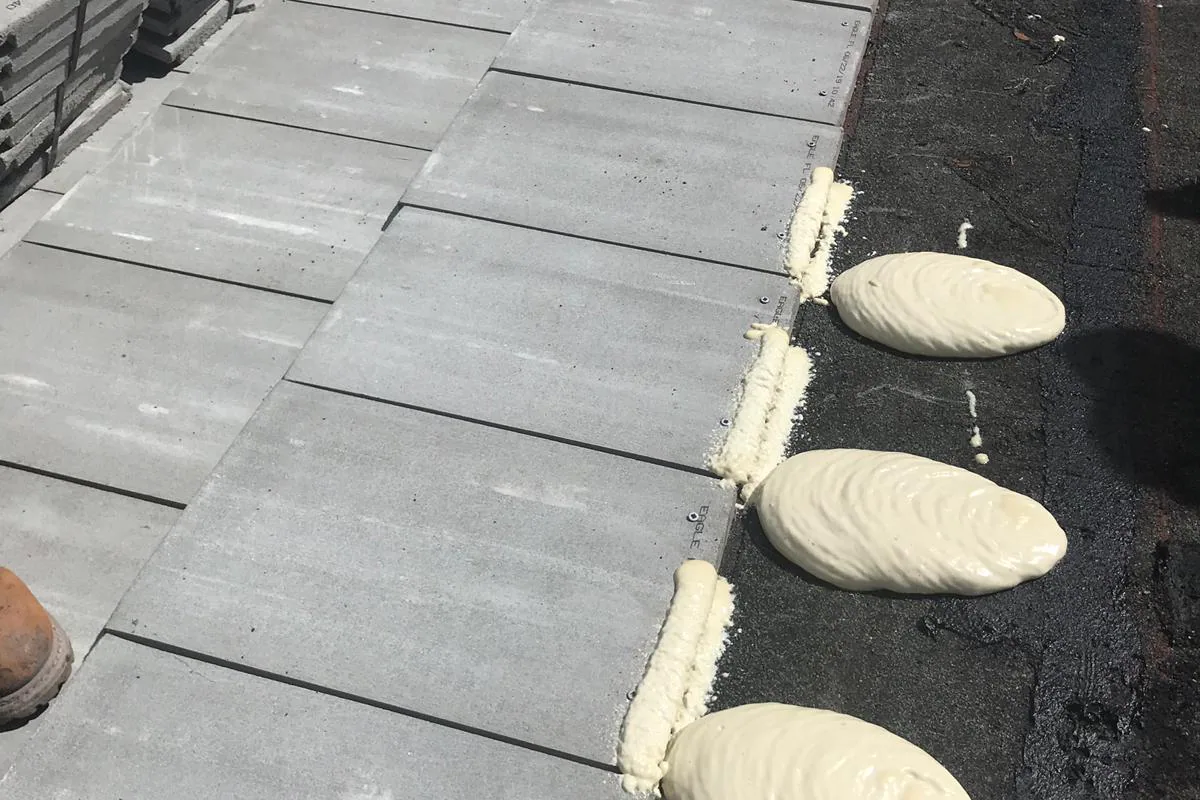
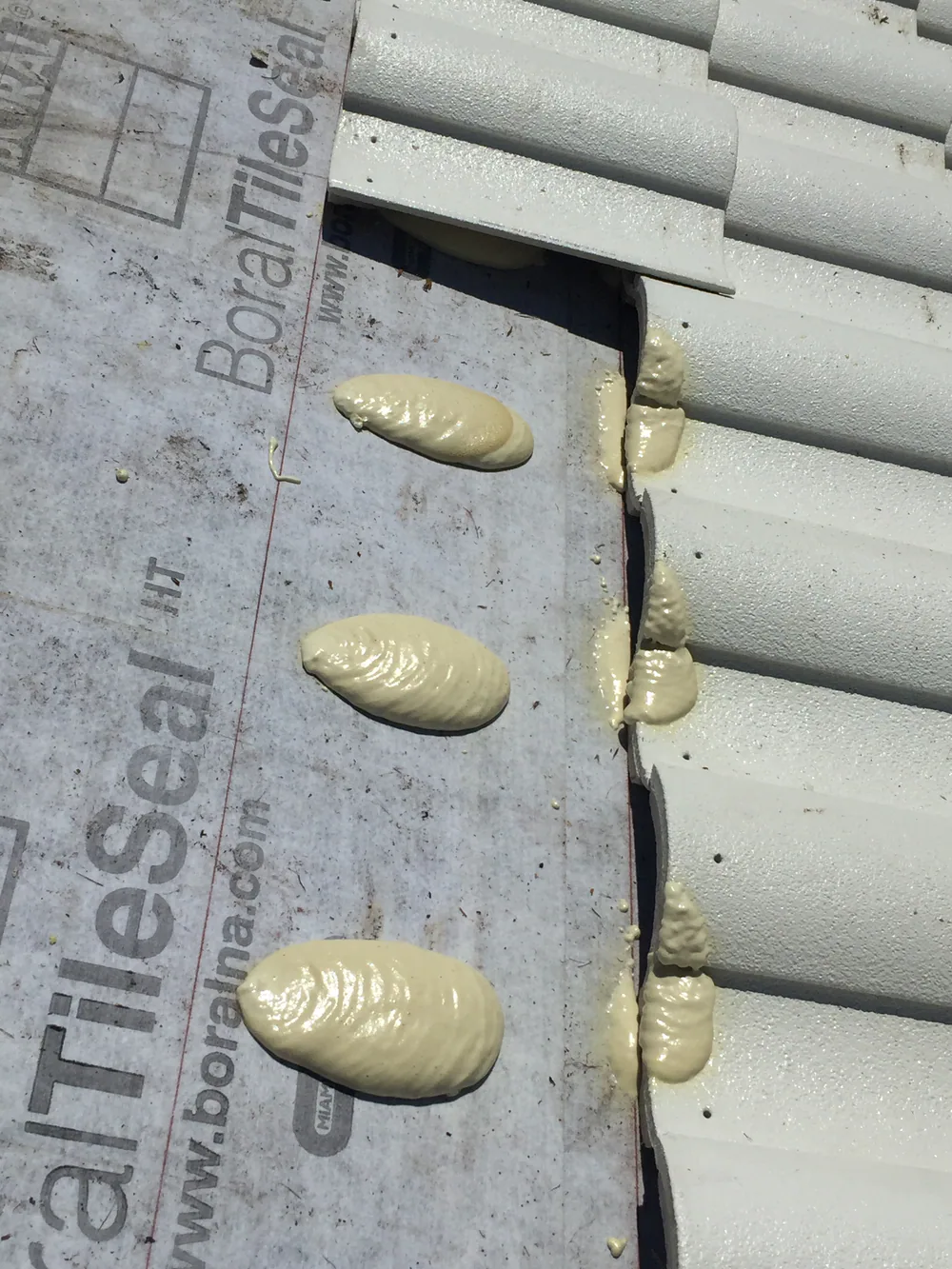
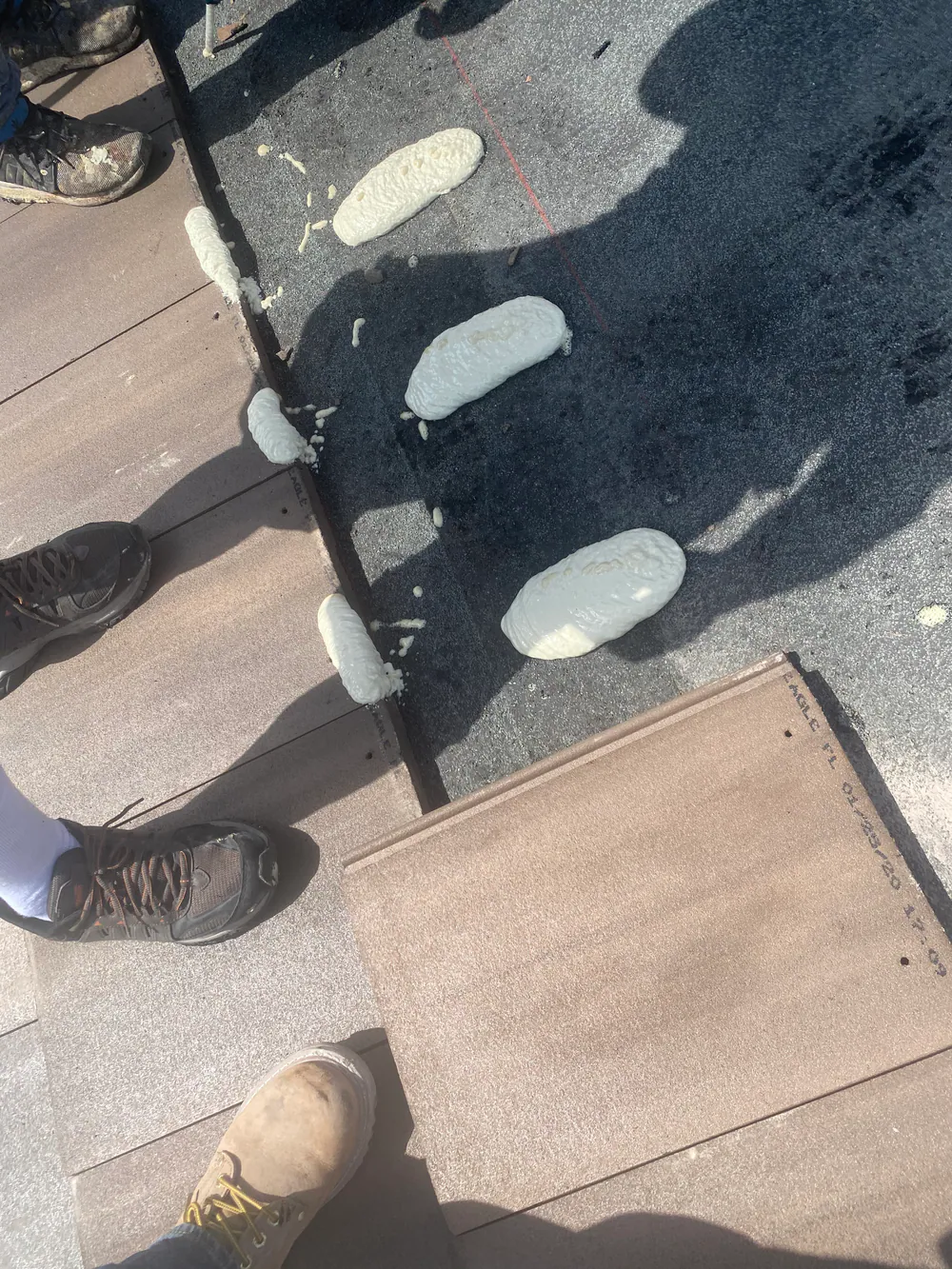
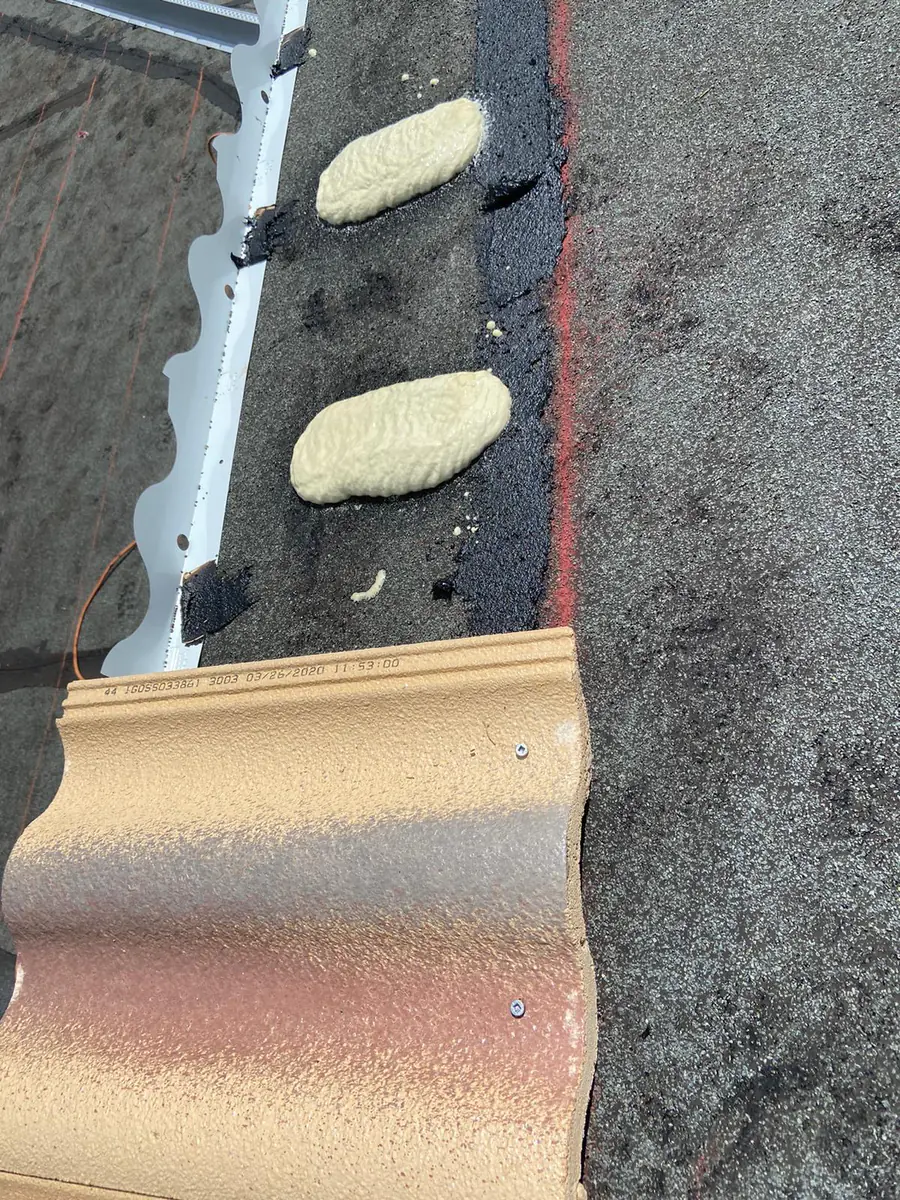
What Foam-Paddy Placement Looks Like on a Tile Roof
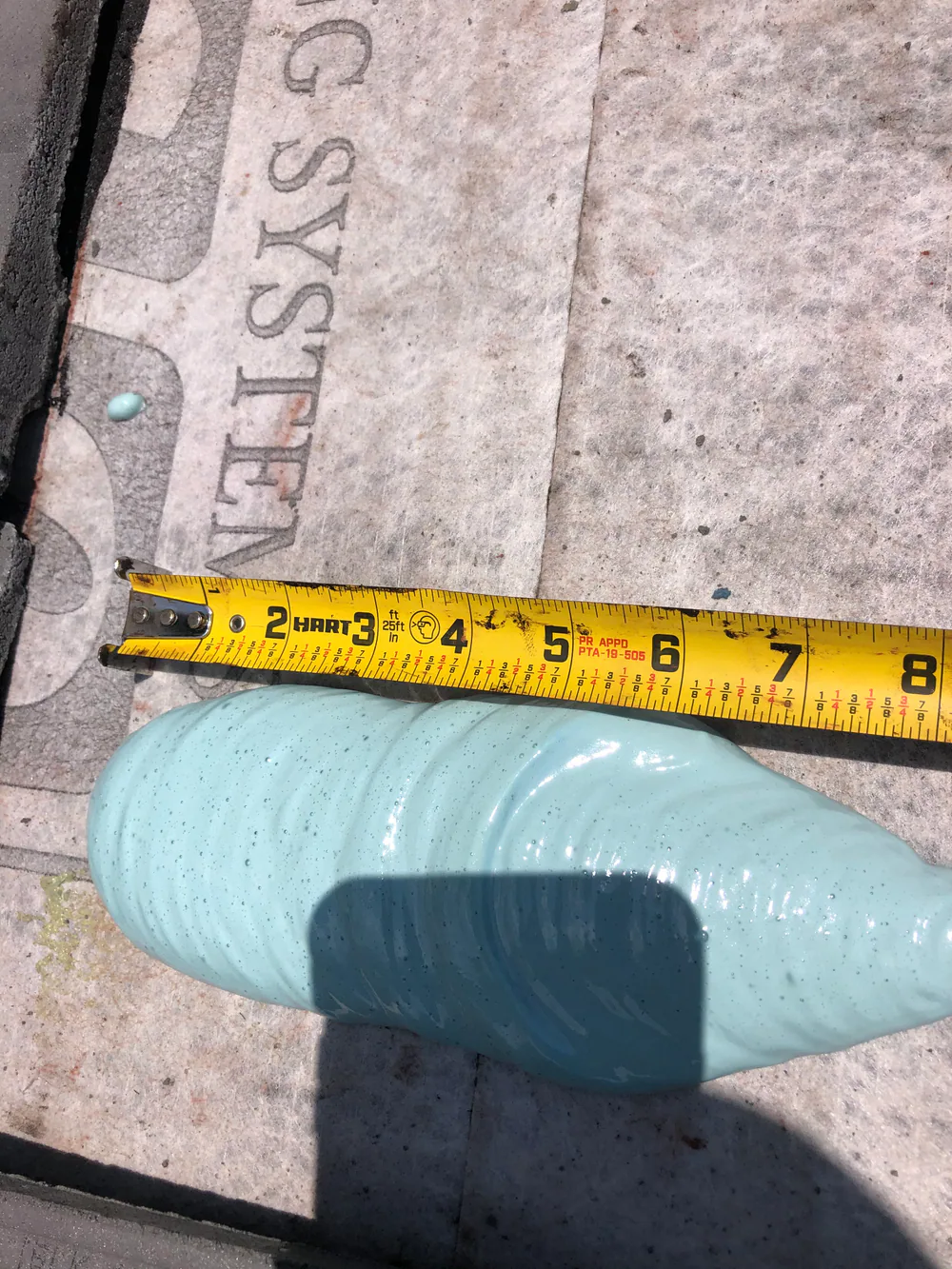
M&M confirms that every paddy shown in these Polyset application photos is a medium paddy, approximately 7 × 2 inches. Containers and formulation labels are not visible, so the images still do not identify the exact HFC/HFO formulation, gram weight, uplift value, or approval compliance.
Read the numbers correctly
What AH-160 Is—and What Mf Means
APOC Polyset AH-160 is a two-component, low-pressure polyurethane foam roof tile adhesive. Miami-Dade NOA 23-0614.01 covers HFC, HFO 1, and HFO 2 formulations as components for compatible flat-, low-, and high-profile tile systems.
The component approval does not provide one universal roof-uplift rating. The selected tile NOA supplies a minimum attachment-resistance moment, labeled Mf and measured in foot-pounds. That moment becomes one input in the project-specific RAS 127 calculation.
Mf is not pull-off force or wind speed.
Do not convert these values directly into pounds, psf, mph, or a hurricane category. They compare approved attachment configurations only when the tile and assembly conditions are kept specific.
AH-160 vs. Screws and StormBond 2 on Saxony 900
Current Miami-Dade NOA 24-0320.02 for Westlake Saxony 900 lists the following direct-deck screw and single-paddy values. At matched 24 g and 45 g paddy weights, AH-160 is listed above StormBond 2 in this specific system.
| Attachment | Approved configuration | Minimum Mf |
|---|---|---|
| Mechanical | One #8 screw, direct deck | 30.8 ft-lbf |
| Mechanical | Two #8 screws, direct deck | 51.7 ft-lbf |
| AH-160 | One 24 g paddy | 83 ft-lbf |
| StormBond 2 | One 24 g paddy | 62 ft-lbf |
| AH-160 | One 45 g paddy | 119 ft-lbf |
| StormBond 2 | One 45 g paddy | 93 ft-lbf |
This does not make AH-160 a universal winner. In the same approval's two-paddy, 8 g-per-paddy configuration, AH-160 is listed at 31.3 ft-lbf, below StormBond 2 at 59 and Tile Bond at 63. Paddy geometry can change the outcome as much as the brand name.
AH-160 vs. Screws and StormBond 2 on Barcelona 900
Current Miami-Dade NOA 24-1008.13 for Westlake Barcelona 900 shows a mixed result. The 63 g AH-160 row is numerically above the selected one- and two-screw rows, while the 24 g AH-160 row is below the two-screw direct-deck row.
| Attachment | Approved configuration | Minimum Mf |
|---|---|---|
| Mechanical | One #8 screw, direct deck | 20.7 ft-lbf |
| Mechanical | Two #8 screws, direct deck | 43.2 ft-lbf |
| AH-160 HFC/HFO 1 | One 24 g paddy | 39 ft-lbf |
| AH-160 HFC/HFO 1 | One 63 g paddy | 67 ft-lbf |
| StormBond 2 | One 30 g paddy | 63 ft-lbf |
| StormBond 2 | One 60 g paddy | 82 ft-lbf |
StormBond 2 has the higher listed single-paddy values in this tile approval. Because the AH-160 and StormBond paddy weights differ, these rows compare approved configurations—not adhesive efficiency per gram.
Benefits and Tradeoffs
Where AH-160 can help
- Can reduce mechanical fasteners through field tiles in compatible approved assemblies.
- Lists strong attachment-resistance moments in some tile and paddy configurations.
- Supports approved placement patterns for flat, low, high, and two-piece barrel profiles.
- Uses measurable controls for paddy weight, contact area, mix ratio, calibration, and placement time.
Where installation gets demanding
- Requires a factory-trained qualified applicator under the component NOA.
- The exact HFC, HFO 1, or HFO 2 formulation and paddy pattern must match the tile approval.
- Tiles must be placed into fresh adhesive within the specified one- to two-minute window.
- Surface condition, underlayment compatibility, temperature, and equipment calibration affect installation.
- The permitted assembly still needs project-specific RAS 127 calculations and may require field uplift testing.
Foam or mechanical attachment?
Where Screws Still Compete Well
Mechanical fastening remains a valid approved approach. It can avoid two-component mixing, calibration, material temperature, and short open-time controls. Its resistance can also change with deck thickness, fastener count, battens, clips, and headlap details.
Foam can reduce field-tile fastener penetrations, but it should not be marketed as a zero-penetration roof. Eaves, trims, nailers, clips, wire, or other approved details may still use mechanical attachment.
Assembly review
How a Contractor Chooses the Attachment Method
The comparison starts with the complete permitted roof system, not a brand-level strength claim. A project review should confirm:
- Exact tile model and manufacturing plant
- AH-160 formulation and approved paddy pattern
- Direct-deck or batten installation
- Deck thickness, condition, and compatible underlayment
- Required pressures for field, perimeter, and corner roof zones
- Fastener, clip, mortar, or foam values in the current tile NOA
Documented M&M experience
AH-160 on Documented Concrete Tile Roofs
M&M's Parkland project record identifies Polyset AH-160 with Barcelona 900 tile, and M&M confirms that installation used medium paddies measuring approximately 7 × 2 inches. The record does not identify the HFC/HFO formulation or paddy gram weight, so the project is not assigned to a particular row in the current Barcelona approval.
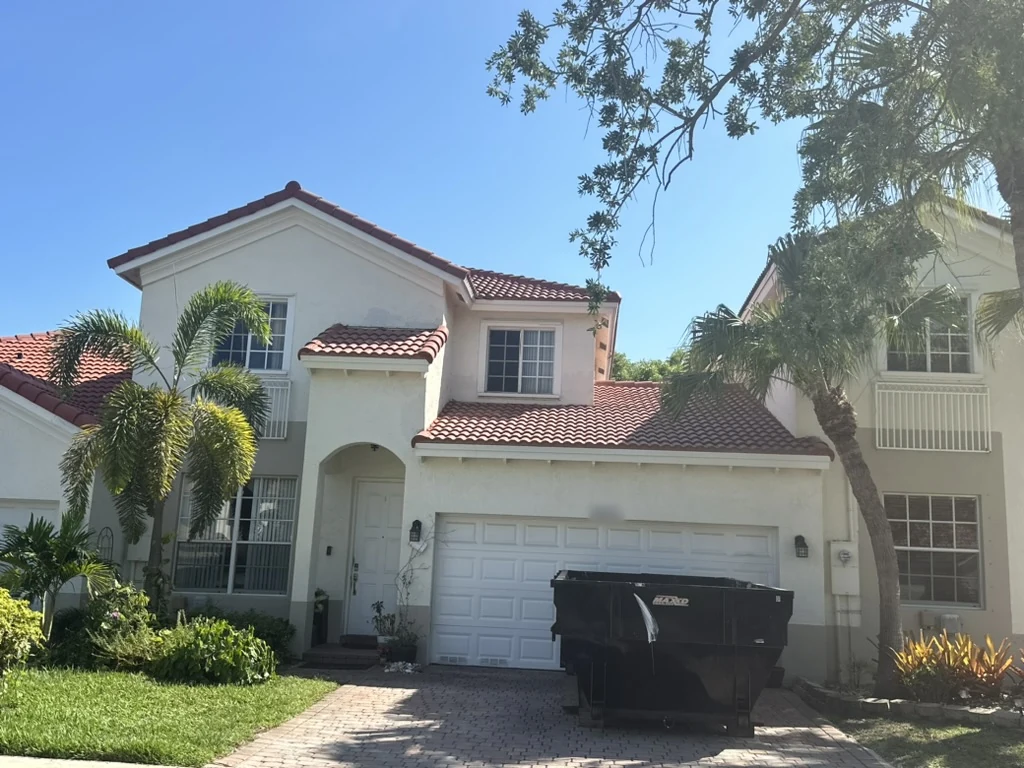
The separate Miramar townhouse record identifies AH-160 HFO with Villa 900 tile and a medium-paddy application. It does not supply paddy dimensions, weight, contact area, or project-specific pressure calculations, so those values are not inferred.
Real Miramar Townhouse Project
Villa 900 Concrete Tile Roof in Gold Dust Blend
See the direct-to-deck TU MAX underlayment, medium-paddy AH-160 adhesive application, finished tile, and shared-roof protection considerations documented for this attached townhouse.
View the Miramar Villa 900 case study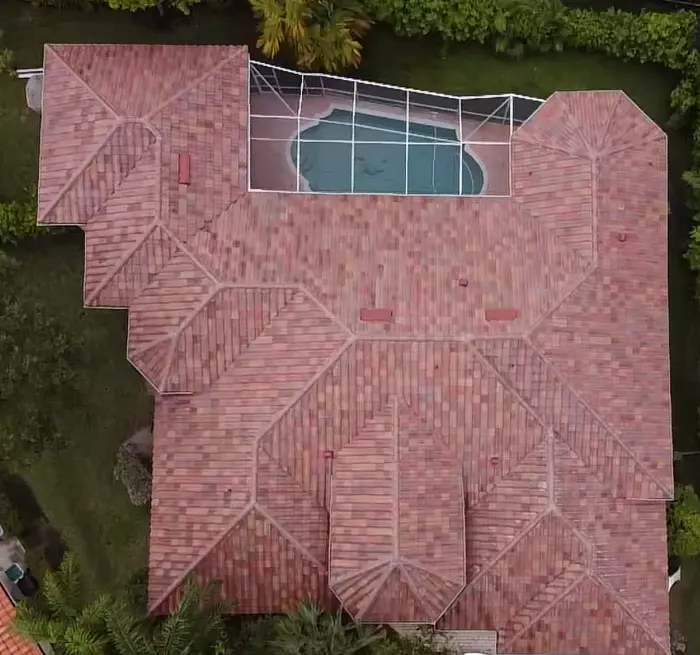
Real Parkland Project
Barcelona 900 Concrete Tile Roof Replacement
See the completed Avalon Beach Blend roof and the documented #30 felt, Polystick TU MAX, and Polyset AH-160 system details.
View the Parkland tile case studyAPOC Polyset AH-160 FAQs
What size Polyset paddies are shown in M&M's photos and used on the Parkland roof?
M&M confirms that every paddy shown in these jobsite photos is a medium paddy, approximately 7 × 2 inches. The documented Parkland Barcelona 900 installation also used the same medium paddy size. Paddy dimensions do not by themselves identify the HFC/HFO formulation or gram weight.
Is APOC Polyset AH-160 stronger than screws?
It can have a higher NOA-listed attachment-resistance moment than a selected one- or two-screw configuration, but not in every application pattern. The exact tile, manufacturing plant, deck or batten setup, AH-160 formulation, paddy placement, and RAS 127 calculation control the decision.
Is AH-160 stronger than StormBond 2 or Tile Bond?
There is no universal winner. AH-160 has higher matched-weight single-paddy values than StormBond 2 in the current Saxony 900 approval. StormBond 2 has higher listed values in the current Barcelona 900 single-paddy table and in selected two-paddy configurations.
Does foam attachment mean there are no roof-deck penetrations?
A compatible foam-set assembly can reduce field-tile fastener penetrations, but zero penetrations should not be promised. Eaves, trims, nailers, clips, wire, or details in the approved assembly can still require mechanical attachment.
What does Miami-Dade acceptance of AH-160 mean?
Miami-Dade Product Control lists AH-160 as an accepted roof-tile adhesive component under NOA 23-0614.01. The exact tile assembly must also have a current NOA listing the formulation and attachment value, and the installation and project calculations must meet all approval and code conditions.
Does AH-160 make a roof hurricane-proof?
No roofing material makes a roof hurricane-proof. Performance depends on the complete approved system, including tile, deck, underlayment, attachment pattern, roof zones, flashing, workmanship, inspections, and project-specific design pressures.
Official Technical Sources
Approval status and project conditions can change. These sources were checked August 27, 2026 and should be verified again for the permit and contract documents of a specific roof.