
M&M material review · Metal roofing
Polystick MTS Plus Review: High-Temperature Underlayment for Metal Roofs
Why we like MTS Plus for suitable metal roofs in Palm Beach County and the Treasure Coast—and when we choose XFR instead.
By M&M Roofing and Construction Corp
Published · Technical sources checked September 16, 2026
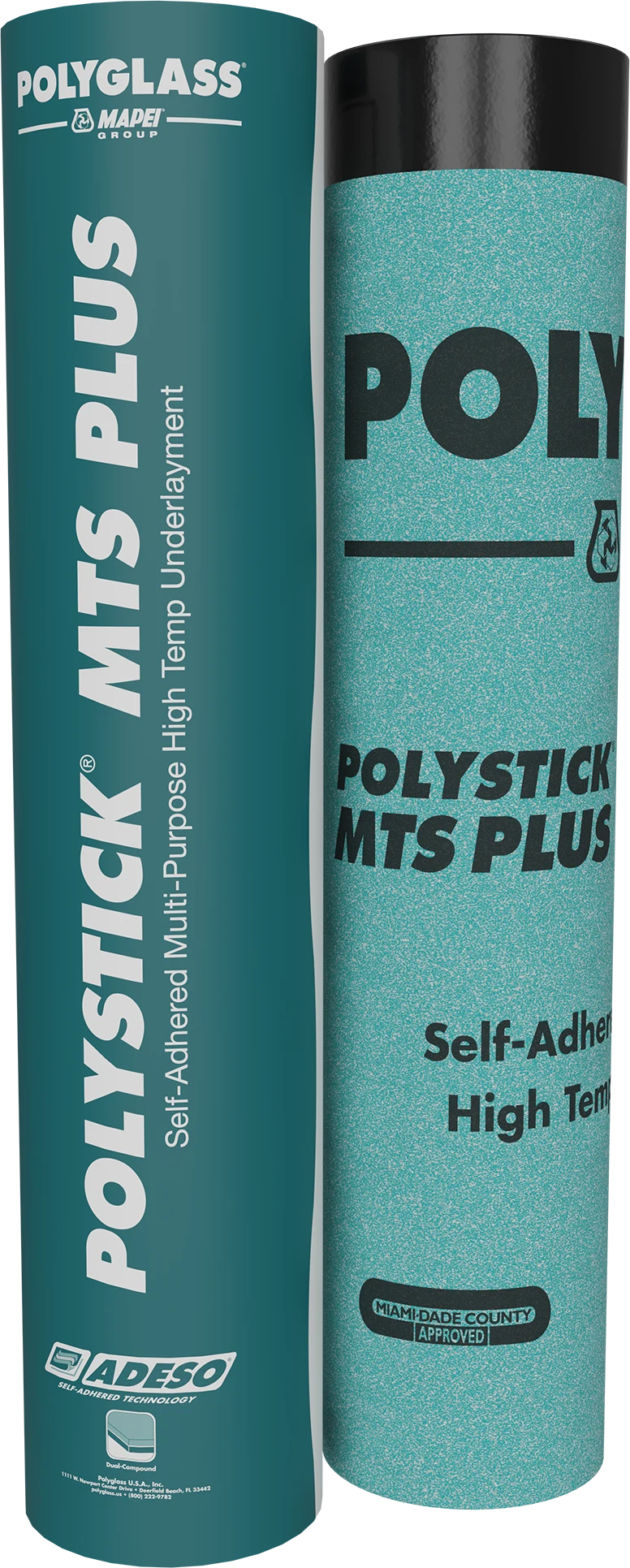
The contractor’s take
A strong waterproofing choice when the assembly is right
For many of our metal roofing projects from Palm Beach County north through Martin and St. Lucie, Polystick MTS Plus is an underlayment we are comfortable recommending. We like its high-temperature capability and self-adhered water protection, and it generally costs us less in material than Polystick XFR.
That is our purchasing and installation preference, not a claim that MTS Plus is better in every situation. If the approved roof needs an XFR-based fire-rated assembly, the lower material price is not a reason to substitute MTS Plus.
Built for hot roof coverings
Manufacturer-rated resistance up to 265°F.
A self-adhered water layer
Designed beneath the roof covering, not as the finished roof.
Good value, with conditions
Our choice starts with approval compatibility—not price alone.
Product capabilities: Polyglass MTS Plus product page. Cost preference: M&M’s experience; no fixed price or savings percentage is implied.
From our projects
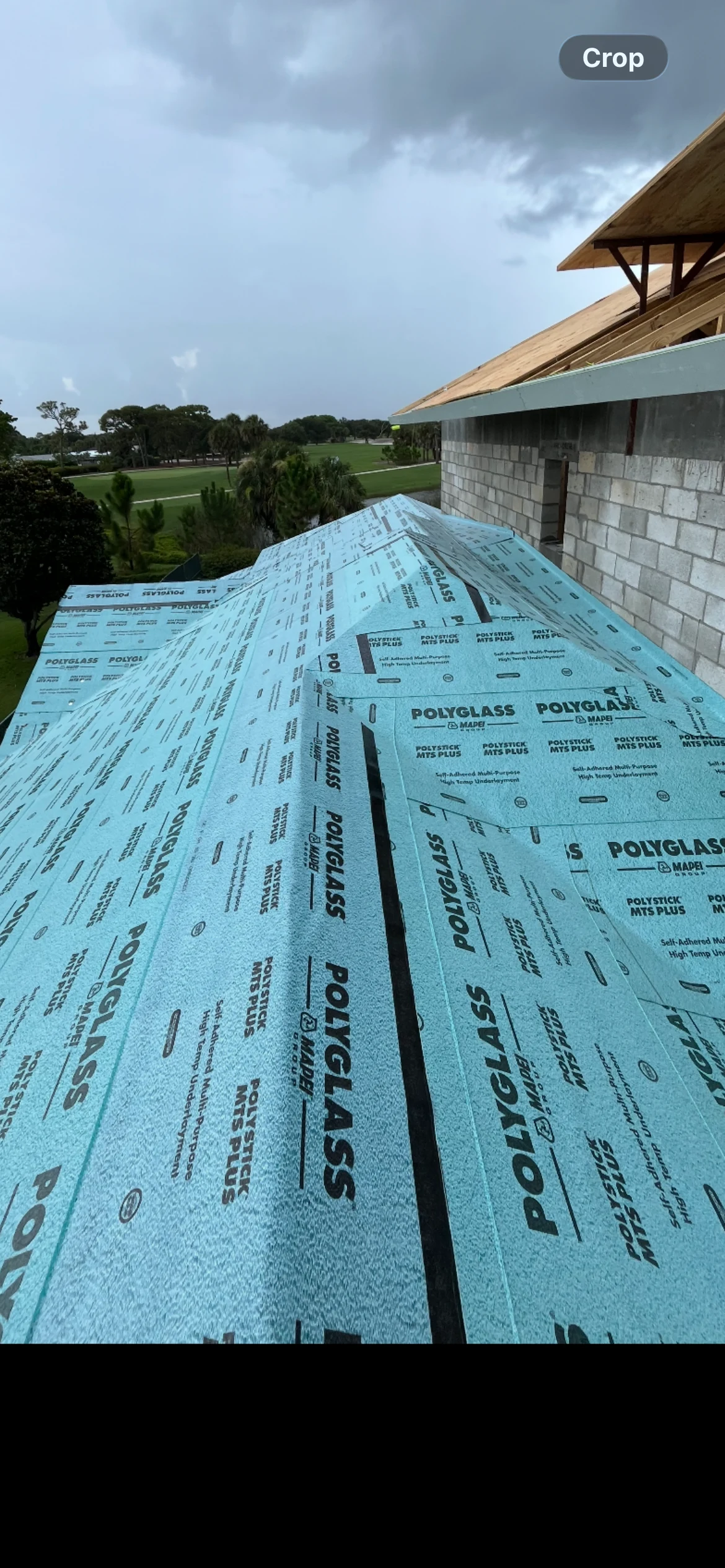
Polystick MTS Plus on the roof
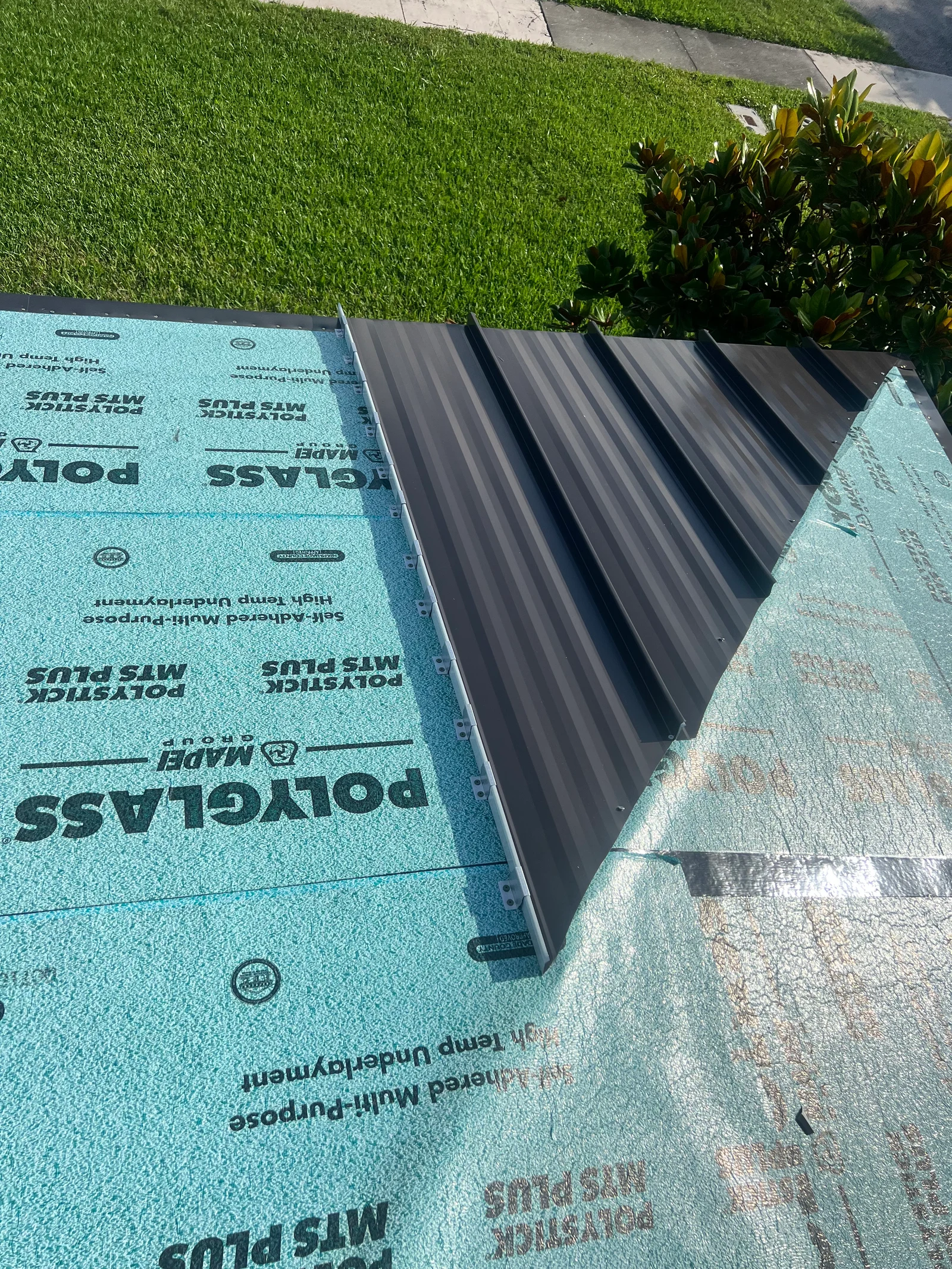
Inside the roll
Polystick MTS Plus specifications
MTS Plus uses Polyglass’s ADESO dual-compound construction: a modified-bitumen upper layer and an adhesive SBS underside protected by split release film. Its cavitated top film is designed for traction; roof fall protection is still essential. Manufacturer overview.
| Membrane | Self-adhered, fiberglass-reinforced modified bitumen |
|---|---|
| Nominal thickness | 60 mil (1.5 mm) |
| Roll dimensions | 65 ft 8 in × 39⅜ in (20 m × 1 m) |
| Approximate coverage | 200 sq. ft. net / 215 sq. ft. gross |
| Approximate roll weight | 74 lb (33.5 kg) |
| Temperature resistance | Up to 265°F |
| Temporary exposure | Up to 180 days; shorter local limits may apply |
| Application temperature | Air, deck and membrane: 40°F and rising |
| Side / end laps | 3 in / minimum 6 in |
| ASTM D1970 | Nail sealability and lap waterproof integrity: pass |
| Plywood adhesion, minimum | 2 lbf/ft at 40°F; 12 lbf/ft at 75°F |
| Vapor permeability, maximum | 0.1 perm (ASTM E96) |
Sizes and coverage are nominal/approximate. Lab properties are not a whole-roof wind rating or a guarantee against leaks. Read the complete product data sheet.
Our Florida approach
Palm Beach, Martin and St. Lucie: where it fits our work
We primarily use MTS Plus beneath compatible metal roofing in these counties and other suitable locations farther north. The practical question is whether this underlayment works with the specified deck, metal panels, fire classification and permit documents.
Broward and Miami-Dade are Florida’s High-Velocity Hurricane Zone (HVHZ). Our typical choice there is an appropriate Polystick XFR assembly. Outside the HVHZ, approvals and fire requirements still apply; crossing the Palm Beach County line does not automatically make any roof assembly acceptable.
For the covering above it, see our 1.5-inch mechanically seamed metal roof review, including how concealed clips attach the panels.
An important distinction
Miami-Dade approval is not the same as a Class A roof
MTS Plus is not categorically banned in Broward or Miami-Dade. Its current Miami-Dade NOA includes specified non-structural metal-roof applications. The same NOA explicitly excludes fire classification from its acceptance.
Class A describes a tested roof assembly—not an underlayment roll in isolation. Do not assume MTS Plus alone beneath metal over a wood deck provides Class A performance. A “UL Classified” mark by itself is not enough to make that conclusion.
Miami-Dade’s published guidance ties fire-class requirements to the building’s conditions and requires fire-directory listings for metal systems. It does not say that every metal roof in both counties must use XFR. Read the county’s fire-classification guidance.
We select XFR when its listed assembly meets the project’s needs. Even XFR is not a universal one-layer answer: Polyglass’s published Class A configurations differ for steel/copper and aluminum. The exact deck, panel material, layers and current fire listing must match. Polyglass fire-assembly reference.
Underlayment acceptance and compatibility: NOA 25-0121.12, pages 18 and 21. Final permit acceptance rests with the building authority.
Choose the system, then compare cost
MTS Plus vs. Polystick XFR
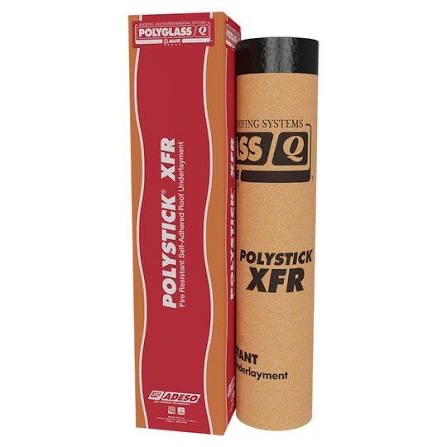
Polystick
MTS Plus
Our cost-efficient waterproofing option
Secondary water barrier with approved direct-to-deck installation
Lower material cost, with secondary water protection. For compatible metal-roof systems, MTS Plus generally costs us less in material than XFR, based on M&M’s purchasing experience. It can still serve as a secondary water barrier when installed directly to the structural deck as permitted by the approved assembly. Any insurance discount depends on the documented installation, inspection and insurer approval. Manufacturer SWR bulletin.
| Consideration | Polystick MTS Plus | Polystick XFR |
|---|---|---|
| What we choose it for | High-temperature waterproofing where the approved roof system allows it. | Waterproofing with a role in specific fire-classified roof assemblies. |
| Published heat / exposure limits | 265°F / up to 180 days | 265°F / up to 180 days |
| Thickness / net roll coverage | 60 mil / about 200 sq. ft. | 80 mil / about 150 sq. ft. |
| Class A fire rating | Never assume an MTS Plus-only metal-over-wood assembly is Class A. | Available in specific listed assemblies; one layer is not universal. |
| M&M material-cost experience | Generally costs us less in material for suitable jobs. | Higher material cost in our purchasing experience; selected when its assembly role is needed. |
| Insurance consideration | Potential SWR credit when the installation is eligible and documented. | Also conditional on the installation, inspection and insurer—not the brand name. |
Product comparison: 2026 Polyglass brochure. Fire configurations: XFR assembly reference. Insurance details are explained below.
Price each option by the installed square footage and required number of layers. Waste, deck preparation and additional components also matter. A less expensive roll is not necessarily a less expensive approved system.
Secondary water resistance
Can MTS Plus help with an insurance discount?
It may—but the credit is not automatic. Polyglass specifically includes MTS Plus in its SWR bulletin for installation directly to the structural roof deck where code permits. This is the documented installation route we discuss when a homeowner wants a secondary water barrier. Manufacturer SWR bulletin.
An approved installation over a base sheet is a different assembly. Do not assume it has the same insurance treatment; have the inspector and carrier evaluate the actual roof. Equally, do not assume that every peel-and-stick material earns a discount simply because it is self-adhered.
The current Florida wind-mitigation form, Rev. 04/26, records several SWR methods and warns that some listed items may not qualify for discounts. The inspector documents the condition; the insurer determines the applicable credit. No savings amount is guaranteed.
Keep the evidence before the panels cover it
- Clear photos of the prepared deck, membrane coverage and installation details
- Roll labels and an invoice naming the underlayment
- The roofing permit, approvals and final inspection records
- A completed wind-mitigation inspection and insurer confirmation
Citizens’ current documentation guidance is one insurer example, not a promise for every policy.
Heat resistance ≠ cooling
Does the color make the roof cooler?
We could not confirm a product-specific cooling or energy-savings benefit from MTS Plus’s color in the current manufacturer literature reviewed. Its published temperature limit tells us about heat tolerance; it is not a solar-reflectance value, insulation rating or predicted reduction in your electric bill.
We recommend MTS Plus for its underlayment role, not a cooling promise. If thermal performance is a priority, evaluate the exposed metal panel finish and the complete roof/attic design separately. Current technical data.
The details still decide the result
What we check before installing MTS Plus
Our review is a homeowner’s guide, not a substitute for the installation instructions or an engineered attachment schedule. The actual metal roof approval must accept the proposed underlayment arrangement.
- Deck and moisture conditions. Confirm a sound, suitable substrate and address ventilation or vapor-control concerns before choosing direct adhesion versus a base sheet.
- Preparation and bond. Use a clean, dry, smooth surface, maintain the specified laps and apply firm pressure. Do not treat it as a recover sheet over old roofing.
- Attachment and transitions. Follow the selected approval for covered backnailing, eaves, valleys, walls and penetrations. Self-adhered does not mean fastener-free.
- Covering compatibility. Check the panel manufacturer’s requirements and warranty terms before installation. Underlayment approval alone does not approve the finished roof.
See the manufacturer instructions and complete NOA. As one specific example—not a universal specification—NOA system F(1) lists MTS Plus directly over 19/32-inch plywood or wood plank with specified capped backnailing. Do not transfer that detail to a different deck or assembly.
For related reading, explore mechanical seam vs. nailstrip roofing or our XFR review.
Read the source documents
Product approvals and technical references
These are official manufacturer, government and insurer sources checked for this review. An approval is conditional—not an endorsement or permission to substitute components. Recheck current status and revisions for the permit date.
Florida Product Approval FL5259-R50 separates HVHZ and non-HVHZ applications. Its non-HVHZ substrate table includes OSB and Huber ZIP panels for MTS Plus; the HVHZ table lists plywood and Southern Yellow Pine but not OSB. Do not interchange the substrate or attachment details. Non-HVHZ report · HVHZ report.
There is no single wind-pressure number in this review: the approval covers multiple systems, and its highest listed pressure must not be presented as a generic MTS Plus metal-roof rating. Both evaluations also exclude fire classification.
- Polyglass MTS Plus product page
Product overview and original manufacturer product image.
- MTS Plus product data sheet — July 2025
Roll dimensions, ASTM properties and application instructions; pages 1–2.
- Polyglass 2026 Polystick brochure
MTS Plus and XFR features, system roles and comparison table; pages 4–7.
- Miami-Dade County, Florida NOA 25-0121.12 — expires September 13, 2027
Approved March 20, 2025. Direct-deck F(1): page 15. Fire exclusion: page 18. Covering compatibility: page 21. Read the complete NOA.
- Florida Product Approval FL5259-R50
Approved February 10, 2026, for the 2023 FBC. FL5259.1: HVHZ; FL5259.2: non-HVHZ. The application covers multiple products and systems.
- FL5259-R50 non-HVHZ evaluation / installation report
PEER-PLYG-002.A.R47, revised December 11, 2025. Substrate table and non-tile direct-deck provisions; read the complete report.
- FL5259-R50 HVHZ evaluation / installation report
PEER-PLYG-002.B.R19, revised December 11, 2025. HVHZ substrates, backnailing and limitations; read the complete report.
- Miami-Dade 2023 Florida Building Code roofing guidance
Fire-classification requirements and listed roof systems; page 34.
- Polyglass XFR fire-assembly brochure
Assembly-dependent Class A configurations; verify the current UL TGFU.R25992 listing for each project.
- Polyglass SWR Technical Bulletin 2010-01
Revised July 17, 2025; identifies MTS Plus and direct-to-structural-deck installation, subject to acceptance.
- Florida OIR-B1-1802 wind-mitigation form — Rev. 04/26
Section 8 documents secondary water resistance; the form warns that some listed items may not qualify for discounts.
- Citizens Wind Loss Mitigation Guide — Rev. 04/26
SWR documentation and sealed-roof-deck classification; page 15.
Homeowner questions
Polystick MTS Plus FAQs
Is Polystick MTS Plus a good underlayment for metal roofing?
We like it for compatible metal-roof systems because it combines a full-surface self-adhered waterproofing layer with high-temperature capability. Our recommendation is conditional on the deck, panel approval, required fire classification and installation details—not just the county or product name.
Where does M&M use MTS Plus?
We primarily select it for suitable metal roofs in Palm Beach, Martin and St. Lucie counties and other areas farther north. In Broward and Miami-Dade, we generally prefer XFR-based assemblies that satisfy the project's fire requirements. Neither choice replaces a project-specific approval review.
Is MTS Plus banned in Miami-Dade or Broward?
No blanket ban is established by the sources reviewed. The Miami-Dade NOA includes MTS Plus for specified applications, including non-structural metal roofing, while excluding fire classification from that acceptance. The complete roof must still satisfy its applicable wind, fire and compatibility requirements.
Does MTS Plus qualify for a secondary water barrier discount?
It may. Polyglass identifies direct-to-structural-deck installation, where permitted, as an SWR application. Have a qualified inspector document the installed system and ask your insurer to confirm any credit. A peel-and-stick product name alone does not guarantee savings.
Does its color help cool the house?
We could not verify a product-specific cooling or energy-saving claim in the current MTS Plus technical literature. Heat resistance is not heat reflectivity. We do not recommend buying this hidden underlayment for a promised reduction in indoor temperature or utility bills.
Is MTS Plus cheaper than XFR?
In M&M's purchasing experience, MTS Plus generally costs less in material. Quotes vary, and price per roll is not a like-for-like comparison because roll coverage and required layer counts differ. We compare the complete approved installation, not just the roll price.
Does self-adhered mean no nails or roof penetrations?
No. Some assemblies require covered backnailing, and metal-panel clips or fasteners still attach to the structure. The product is not a substitute for correct flashing, fastener detailing or an approved metal roof system.
Which underlayment belongs under your metal roof?
Tell us your property location and roofing plans. M&M can review MTS Plus, XFR and the assembly requirements for your project.
Call (954) 737-3171