
M&M contractor verdict
A strong choice when the permitted metal-roof assembly calls for fire resistance
For M&M, direct-to-deck Polystick XFR is our preferred underlayment method for compatible metal roof systems in Broward and Miami-Dade counties. It combines a fully adhered waterproofing layer with a documented route to a Class A assembly. It is not required by name on every roof, and it does not make an otherwise unlisted combination compliant. The exact home, deck, panel material, gauge and approved assembly decide whether it is the right choice.
- M&M preference
- Our preferred direct-to-deck underlayment method for compatible metal roofs in Broward and Miami-Dade
- Best feature
- Combines an ASTM D1970 waterproofing layer with a listed fire-resistant assembly path
- Florida SWR
- May support the fully adhered sealed-roof-deck category when documented and verified
- Main caution
- Class A belongs to the tested roof assembly, not to XFR as a stand-alone product
Direct-to-deck jobsite photos
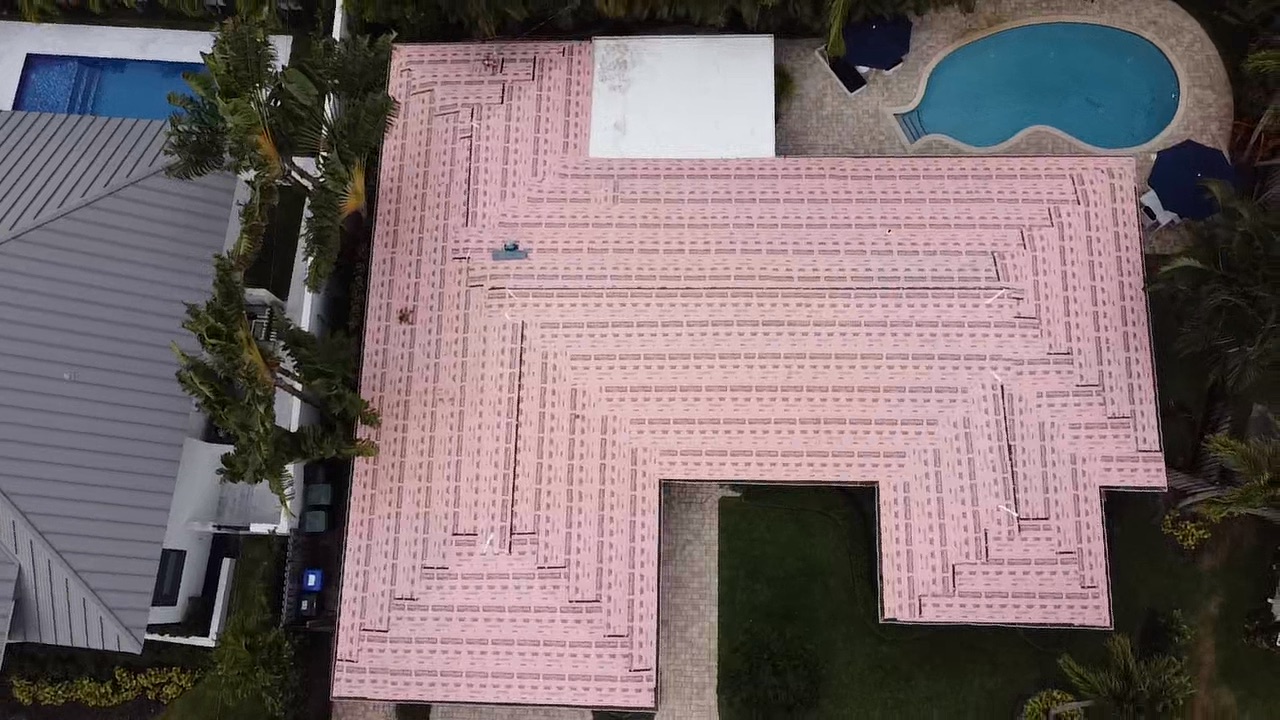
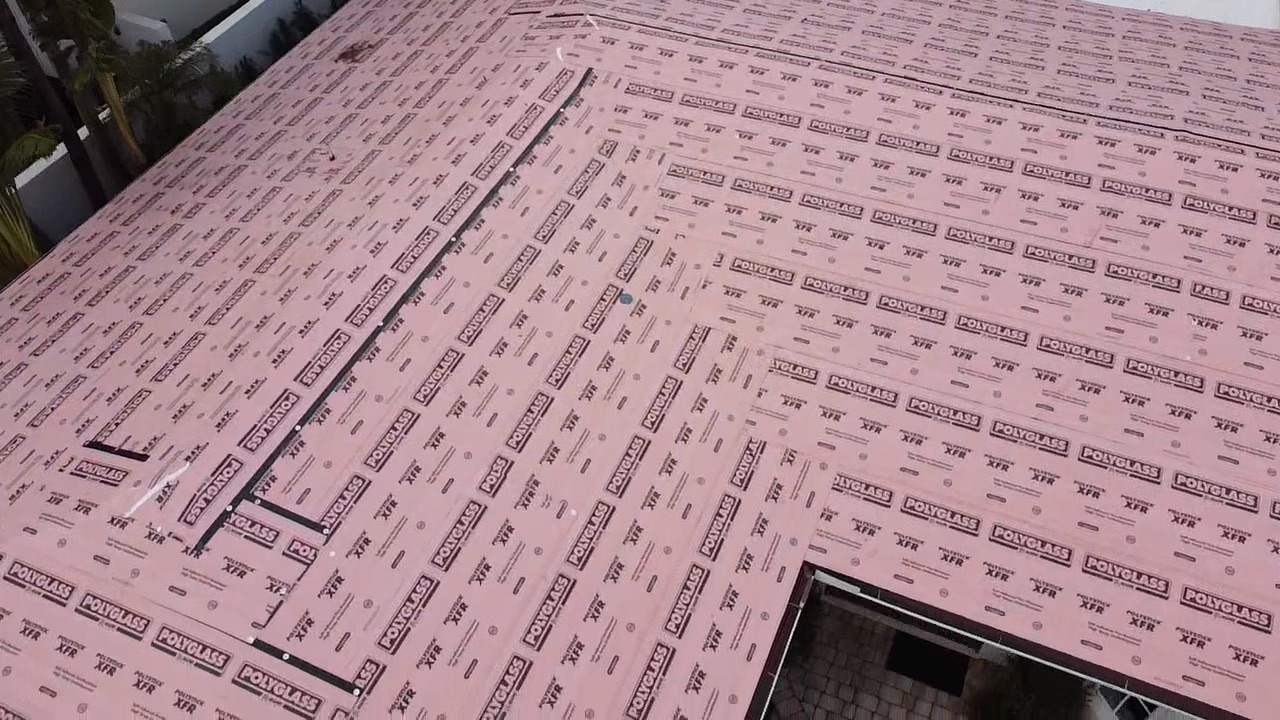
What Polystick XFR Looks Like Before Metal Panels Cover It
These are M&M field photos—not manufacturer renderings. They show a full-roof XFR dry-in and a covered backnailing detail, but photos alone do not establish the final wind or fire rating.

Product construction
What Polystick XFR Is
XFR is a fiberglass-reinforced, polymer-modified bitumen membrane. Its upper compound and Burn-Shield Technology are designed for fire and ember resistance, while the self-adhered SBS bottom compound bonds to an approved substrate after its split release film is removed.
Polyglass rates it for temperatures up to 265°F and identifies steel, aluminum and copper as typical high-temperature roof coverings. The top film is made for better jobsite footing, though no roof membrane should be treated as slip-proof.
Current product data
- Primary use
- High-temperature underlayment beneath metal roof coverings
- Roll size
- 49 ft 3 in × 39-3/8 in
- Coverage
- Approx. 150 sq. ft. net / 160 sq. ft. gross
- Roll weight
- Approx. 75 lb
- Nominal thickness
- 80 mil (2.0 mm)
- Temperature resistance
- Up to 265°F
- Maximum exposure
- 180 days, or less when limited by the AHJ
- Application temperature
- Air, deck and membrane at 40°F and rising
- Factory side lap
- 3 in
- End lap
- Minimum 6 in
The most important distinction
Class A Describes the Whole Roof Assembly
The Florida Building Code requires listed roof classifications to be tested under ASTM E108 or UL 790. Polyglass's PDS then identifies specific XFR configurations. A contractor must match the complete listing—not simply point to the words “Class A” on a product sheet.
| Roof covering | PDS summary | Second XFR ply |
|---|---|---|
| Steel standing seam or copper panels | UL-listed covering, 26-gauge minimum, over the listed combustible deck and XFR assembly | Optional in Polyglass's summary table; verify the exact UL TGFU.R25992 listing |
| Aluminum panels | UL-listed covering, 0.032-inch minimum, over the listed combustible deck | Required: the Polyglass Class A table shows a second XFR ply below the XFR underlayment |
| Asphalt glass-fiber shingles | UL-listed Class A shingles and a configuration matching the shingle manufacturer and listing | Shown as XFR in the PDS table; this metal-roof review does not substitute for a shingle assembly review |
What the PDS supports
XFR can help a combustible-deck metal roof achieve a Class A classification when the deck, layers, panel material, gauge and UL listing all match the tested configuration.
What it does not support
It does not support calling every XFR roof Class A. The current Miami-Dade NOA itself states that fire classification is not part of that product-control acceptance.
Benefits and Tradeoffs
Why M&M uses it
- Burn-Shield Technology is designed to improve fire and ember resistance within listed roof assemblies.
- The 265°F temperature rating is suited to heat generated beneath steel, aluminum and copper roof panels.
- The self-adhered SBS bottom compound creates a continuous bond to an approved prepared substrate.
- The current product data reports passing ASTM D1970 lap-waterproofing, nail-sealability and slip-resistance results.
- A cavitated top film improves jobsite traction and permits up to 180 days of temporary exposure, subject to the AHJ.
- Direct-to-deck use can support a sealed-roof-deck/SWR inspection pathway when the installed condition qualifies.
Where the assembly needs care
- XFR is fire-resistant, not fireproof, and the Miami-Dade NOA expressly says fire classification is outside that acceptance.
- One layer does not create a universal Class A roof; aluminum and some other assemblies require additional layers or specific components.
- The membrane is heavy—about 75 pounds per roll—and full adhesion demands a clean, dry, smooth deck.
- Self-adhered does not mean fastener-free; the current direct-deck NOA assembly includes covered backnailing.
- It cannot be installed directly over existing shingles or another roof covering as a recover membrane.
- The final metal panel, deck, fasteners, insulation and all approved assembly details still control permitting and performance.
XFR vs. Standard High-Temp Peel-and-Stick vs. #30 Felt
Underlayments can look interchangeable in a proposal while serving different tested assemblies. This is the practical comparison homeowners should ask a roofer to document.
The panel attachment method matters too. See our comparison of mechanically seamed and nailstrip metal roofs before selecting the complete roof assembly.
| Factor | Polystick XFR | Standard high-temp peel-and-stick | #30 felt |
|---|---|---|---|
| Primary purpose | High-temperature waterproofing plus a role in specific fire-classified metal-roof assemblies. | High-temperature water protection; fire-classification capability depends on its own tested listings and the complete roof assembly. | Traditional mechanically fastened underlayment; not a like-for-like high-temperature, fully adhered fire-resistance strategy. |
| Attachment to deck | Full-surface self-adhered bond, with covered backnailing where required. | Often self-adhered, but substrate, primer, laps and backnailing vary by product approval. | Mechanically attached in lapped courses with approved capped fasteners. |
| Class A claim | Available only in the specific ASTM E108/UL 790 assembly shown by Polyglass and the UL listing. | Do not assume it. Confirm that the exact underlayment and metal covering are in a current listed assembly. | Can be an anchor sheet in some listed assemblies, but felt alone does not establish the roof classification. |
| Florida SWR path | May qualify as fully adhered ASTM D1970 underlayment when direct to qualifying sheathing and verified. | May qualify when it is fully adhered, ASTM D1970-compliant, direct to qualifying sheathing and documented. | One standard layer does not qualify; the current form separately recognizes a compliant double-layer felt system. |
| M&M use | Our preferred fire-resistant underlayment for compatible Broward and Miami-Dade metal-roof assemblies. | Useful where the approved system needs high-temperature waterproofing but a different listed assembly applies. | A possible component in an approved system, but not our direct substitute for XFR's combined role. |
Current Florida form
Can Direct-to-Deck XFR Support an SWR Credit?
Potentially. Section 8 of OIR-B1-1802 (Rev. 04/26) lists fully adhered polymer-modified bitumen roofing underlayment complying with ASTM D1970 as one sealed-roof-deck/SWR method. XFR is listed to ASTM D1970 and can be applied directly to an approved deck.
A qualified inspector still has to verify the installation and supporting evidence, and the insurer decides any credit under its approved rating plan. XFR does not guarantee a discount or a fixed percentage.
For a wider look at panel types, wind performance and South Florida design considerations, read our Broward County metal roof guide.
Document the work before the metal conceals it
The 2026 form requires evidence for each marked mitigation attribute. A direct-to-deck membrane is easiest to document while the roof is open.
- Photos showing the repaired bare deck and XFR applied across the full roof
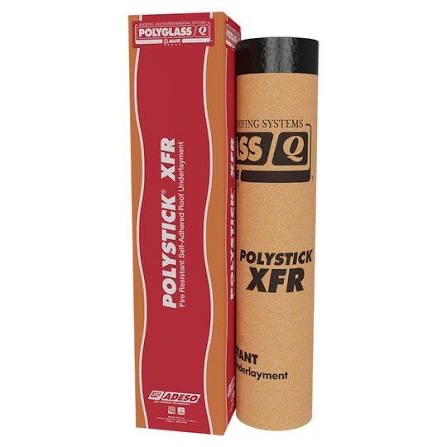
- Product box, wrapper or roll markings identifying Polystick XFR
- Contract or invoice naming the installed underlayment and metal roof system
- Roofing permit, final inspection, metal-panel approval and applicable fire listing
- Completed OIR-B1-1802 report from a qualified wind-mitigation inspector
Installation controls
What Makes a Direct-to-Deck XFR Installation Work
XFR does not correct a wet, dirty or unsuitable roof deck. The current PDS and NOA emphasize substrate preparation, laps, full-surface pressure, backnailing and compatibility with the final roof-covering approval.
- 1Confirm the exact metal panel approval, deck type, panel gauge and fire listing before ordering the underlayment assembly.
- 2Replace unsuitable decking and remove moisture, dust, debris, projections and loose material.
- 3Apply only when the roof deck, membrane and air temperature are dry, at least 40°F and rising.
- 4Start parallel to the eave and maintain the specified 3-inch side laps and 6-inch end laps.
- 5Roll or broom the full membrane surface and laps to create continuous contact with the substrate.
- 6Install covered backnailing, penetrations, flashing and transitions exactly as the approved assembly requires.
- 7Photograph the deck, labeled rolls, laps and completed dry-in before the metal panels conceal the work.
Read the NOA correctly
What Miami-Dade NOA 23-1115.06 Does Prove
The NOA, approved March 14, 2024 and expiring September 13, 2027, lists XFR as an 80-mil fire-resistant rubberized-asphalt waterproofing membrane for use beneath shingle, metal and wood roof coverings.
Its direct-to-deck System F(1) includes XFR over a non-insulated 19/32-inch plywood or wood-plank deck. The membrane is self-adhered and backnailed with specified ring-shank roofing nails and metal caps at a maximum 12 inches on center.
You can also see how M&M documents the broader roof-system sequence in our Miramar tile-to-metal standing-seam project.
What the NOA does not prove
The NOA's general limitations say: “Fire classification is not part of this acceptance.” It also says the prepared roof-system approval must list the underlayment, or the authority having jurisdiction needs documentation for compatibility, wind uplift and fire testing. The Class A evidence therefore comes from the separate tested assembly and listing.
The same F(1) direct-deck system excludes tile roofing. This page is specifically about XFR in compatible metal-roof assemblies.
Manufacturer-reported test values
- Maximum load
- 69 lbf/in MD; 40 lbf/in XMD typical
- Tear resistance
- 157 lbf MD; 79 lbf XMD typical
- Adhesion to plywood at 40°F
- 15 lbf/ft typical
- Adhesion to plywood at 75°F
- 25 lbf/ft typical
- Lap-seam waterproof integrity
- ASTM D1970: pass
- Slip resistance
- ASTM D1970: pass
- Moisture-vapor permeability
- 0.1 U.S. perm maximum
How to Read These Numbers
These are membrane properties reported in the product data sheet. They are not a whole-roof design pressure, a hurricane wind rating or a guarantee that every metal panel is compatible.
Broward and Miami-Dade projects also need the current metal panel approval, project design pressures, deck and fastening details, fire-classified assembly and authority approval. XFR is one important layer inside that larger system.
Polystick XFR FAQs
What is Polystick XFR used for?
Polystick XFR is an 80-mil self-adhered, high-temperature waterproofing underlayment designed primarily for metal roof coverings. Polyglass lists it for steel, aluminum and copper systems and reports temperature resistance up to 265°F. The exact deck, underlayment layers and roof covering must match a current approved assembly.
Is Polystick XFR fireproof?
No. Polyglass describes XFR as fire-resistant, not fireproof. A Class A rating applies to a complete tested roof assembly under ASTM E108 or UL 790. It does not attach automatically to every roof that uses one roll of XFR.
Is Polystick XFR required on every metal roof in Broward or Miami-Dade?
No code names XFR as the only acceptable product for every metal roof. However, direct-to-deck Polystick XFR is M&M's preferred underlayment method for compatible metal roofs in Broward and Miami-Dade counties because those permitted systems must satisfy applicable HVHZ, wind and fire-classification requirements. The approved metal panel, deck, panel gauge, underlayment configuration and current listings control each project.
Does one layer of Polystick XFR create a Class A metal roof?
Only when the complete configuration matches a listed Class A assembly. Polyglass's current table lists certain minimum-26-gauge steel or copper systems with XFR and permits an optional second XFR ply; its listed aluminum-panel configuration requires a second XFR ply and minimum 0.032-inch aluminum. Always verify the exact UL listing and panel approval.
Why does the Miami-Dade NOA say fire classification is not part of the acceptance?
The Miami-Dade NOA evaluates the underlayment within its stated scope, including product and installation requirements, but expressly excludes fire classification. Fire performance comes from separate ASTM E108 or UL 790 testing and the applicable UL-listed roof assembly. Both sets of documentation may be needed for permitting.
Can Polystick XFR be installed directly to plywood?
Yes, when the code and approved roof system allow it. The current Miami-Dade NOA includes XFR in a direct-to-deck wood assembly over 19/32-inch plywood or wood plank, with specified preparation, adhesion and covered backnailing. The final metal-roof approval must also be compatible.
Can direct-to-deck Polystick XFR qualify for a Florida secondary water resistance discount?
It may support the fully adhered sealed-roof-deck/SWR category because XFR is a polymer-modified bitumen underlayment listed to ASTM D1970 and is installed directly to qualifying sheathing. A qualified inspector must verify and document the completed condition, and the insurer decides any premium credit. It is not a guaranteed discount.
How large and heavy is a roll of Polystick XFR?
The current Polyglass product data lists a nominal 49-foot-3-inch by 39-3/8-inch roll, approximately 160 square feet gross, 150 square feet net, 80 mils thick and about 75 pounds.
How long can Polystick XFR remain exposed?
Polyglass and the current Miami-Dade NOA list up to 180 days of exposure, or less when the authority having jurisdiction or the approved assembly imposes a shorter period. That is a maximum temporary exposure—not a recommended construction schedule or finished roof.
Can Polystick XFR be installed over an existing roof covering?
No. Polyglass says not to apply it directly over existing shingles or other roof coverings, and the Miami-Dade NOA says these underlayments are not approved as a direct recover over an existing roof membrane. The approved substrate must be clean, dry, smooth and properly prepared.
What should a homeowner keep for an SWR inspection?
Keep photographs of the bare deck and full-roof membrane, product labels or roll markings, the contract or invoice naming Polystick XFR, the roofing permit, final inspection and the applicable product approvals. The current Florida form requires supporting evidence for marked mitigation features, and insurers can ask for additional documentation.
Official Technical Sources
These sources were checked August 31, 2026. Product approvals, listings, code requirements and insurance forms can change, so each roof should be reviewed against its current permit and policy documents.
- Polyglass Polystick XFR product page
- Polyglass Polystick XFR product data sheet (07/25)
- Miami-Dade NOA 23-1115.06 — Polystick underlayments
- 2023 Florida Building Code, Section 1505 — fire classification
- Florida OIR-B1-1802 (Rev. 04/26) wind-mitigation form
- Florida OIR wind-mitigation resources
- ICC-ES ESR-1697 evaluation report