
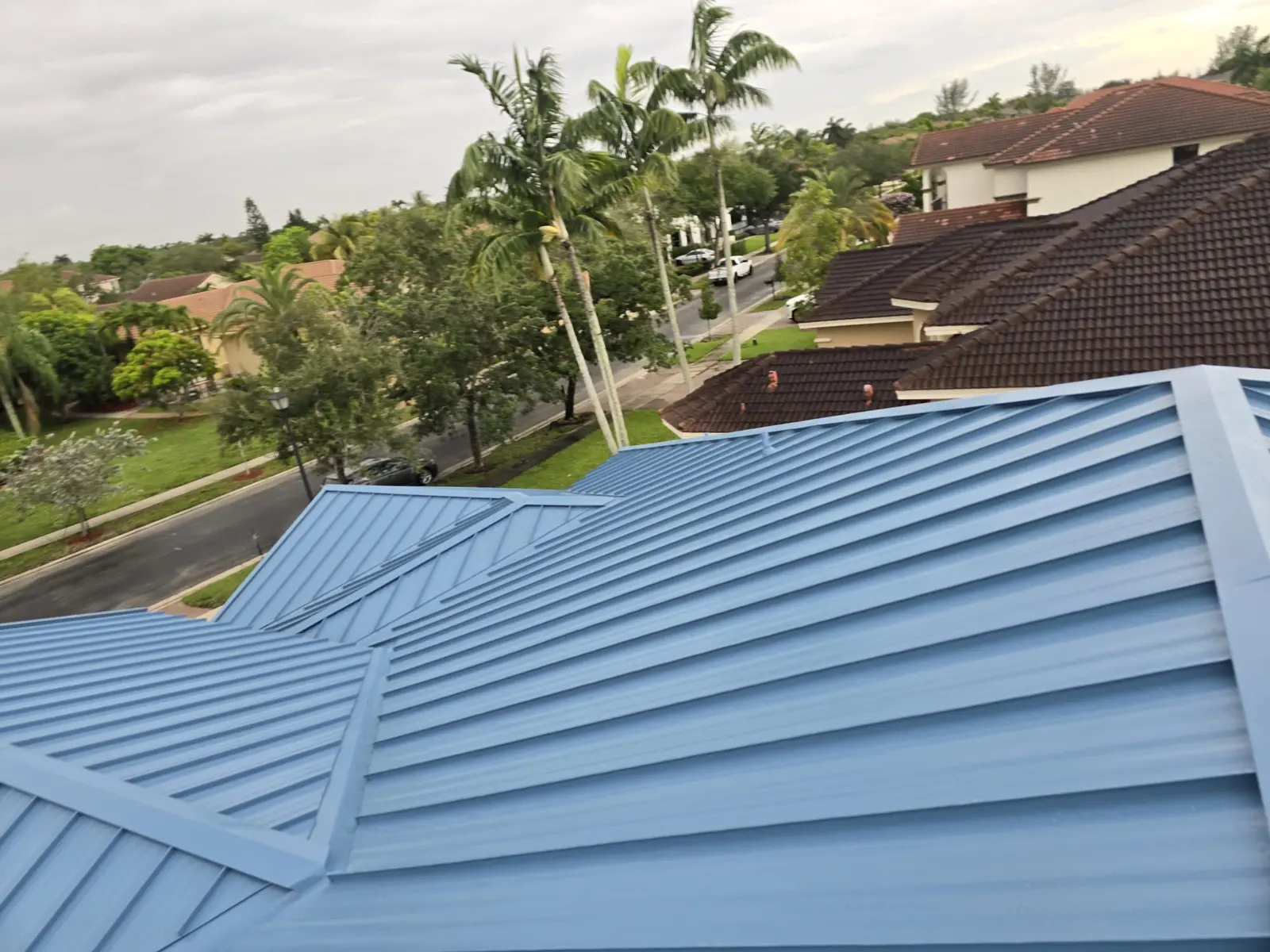
What Is the Best Metal Roof for a Broward County Home?
Published · Updated · Reviewed by M&M Roofing, Florida license CCC1332459
The short answer
For many Broward County homes, a concealed-fastener standing-seam roof is the strongest place to begin the comparison. A 1.5-inch mechanically seamed system may be a particularly good fit when seam engagement and a high-performance architectural assembly are priorities. The final answer, however, must come from the exact product approval, project design pressures, deck, roof geometry and installation details—not the profile name alone.
Broward County is part of Florida's High-Velocity Hurricane Zone (HVHZ). That makes a generic claim such as “this panel is hurricane-rated” incomplete. The permit package and selected assembly need to identify the roof system, approval, components and applicable design pressures.
M&M Roofing compares four residential metal-roof profiles: 1.5-inch mechanically seamed, 1.5-inch snaplock, 1-inch nailstrip and 5V crimp. The table below shows how to begin comparing them before a property-specific inspection and estimate.
Broward County Metal Roof System Comparison
| System | How it connects | Where it may fit | What must be verified |
|---|---|---|---|
| 1.5-inch mechanically seamed | Concealed clips; panel seams are closed with a seaming tool | A strong starting point for homeowners prioritizing seam engagement and an architectural finish | The exact panel approval, metal thickness, panel width, clips, spacing, deck and design pressures |
| 1.5-inch snaplock | Concealed clips; the adjoining seam snaps into place | Residential roofs where the selected approved assembly fits the slope, geometry and wind pressures | Minimum slope, clip schedule, panel dimensions and all limits in the applicable approval |
| 1-inch nailstrip | An integral fastening flange is covered by the next panel | A clean concealed-fastener appearance with a simpler installation sequence | Approved substrate, fastener pattern, panel length limits and provisions for thermal movement |
| 5V crimp | Exposed fasteners secure the panel through its surface | A traditional Florida profile and a generally lower initial-cost metal option | Fastener, washer, flashing and corrosion-maintenance requirements for the selected system |
This comparison is planning guidance, not an engineering determination. Learn how two concealed-fastener profiles differ in our detailed mechanical seam vs. nailstrip guide.
What “Best” Means in Broward County's HVHZ
The best roof is not simply the thickest panel or the most expensive profile. Before recommending a system, the contractor should reconcile the property with the limits and instructions of the applicable Florida Product Approval or Miami-Dade Notice of Acceptance.
- Manufacturer, panel profile, metal thickness and panel width
- Roof deck type, underlayment and all approved system components
- Fastener or clip type, spacing and perimeter/corner requirements
- Mean roof height, slope, geometry and project-specific design pressures
- Flashing, valley, ridge, eave, penetration and dissimilar-metal details
- Coastal exposure, finish warranty, maintenance needs and HOA requirements
Broward's official HVHZ roofing form calls for system and approval information in the permit documentation. Homeowners can also use the Florida Product Approval database and the Miami-Dade Product Control search to review documents for a proposed assembly.
Steel, Aluminum, Color and Coastal Exposure
Material and finish decisions should follow the selected system's approval, manufacturer instructions and warranty. Steel and aluminum assemblies can both be appropriate, but their available profiles, attachment details, finish systems, corrosion exposure and compatible accessories are not interchangeable.
Color also affects more than appearance. A metal roof is not automatically a cool roof: solar reflectance and thermal emittance vary by finish and color. If heat gain is a priority, compare published properties for the exact coating instead of relying only on the word “metal.”
Browse our metal roof color collection, then confirm the exact finish and sample for your selected panel system.
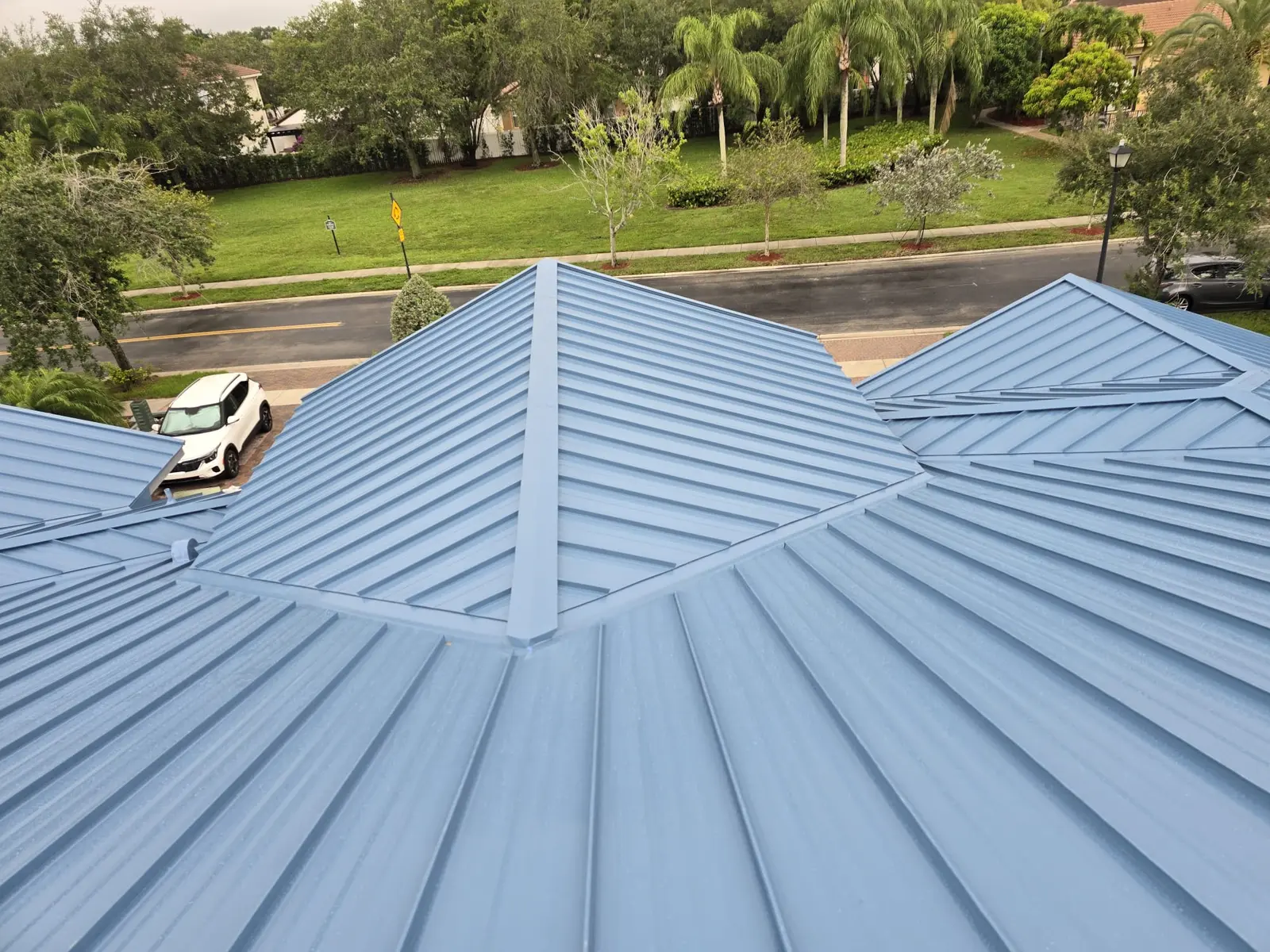
Real Miramar Project
Tile-to-Metal Standing Seam Roof Conversion
See the installation and finished results from a home on SW 24th Street in Miramar: 24-gauge Regal Blue metal, 1.5-inch mechanically seamed panels, and Polystick XFR underlayment.
View the Miramar case studyThis documented tile-to-metal conversion used 24-gauge Regal Blue panels, a 1.5-inch mechanically seamed profile and Polystick XFR. View the full installation sequence on the Miramar project page.
How M&M Roofing Narrows the Choice
- 1Measure the roof area, slope and geometry instead of using living-area square footage.
- 2Document the deck, existing roof, penetrations, drainage and likely repair conditions.
- 3Review the pressures and permitted assemblies that fit the property.
- 4Compare panel profiles, materials, finishes and underlayment as complete systems.
- 5Build a written scope that identifies inclusions, exclusions and unit prices for unknown deck repairs.
- 6Discuss appearance, HOA constraints, maintenance expectations, warranty terms and budget.
See our full metal roofing service and learn how pricing is assembled in the Broward County roof replacement cost guide.
Compare Metal Roof Systems for Your Home
Request a property-specific inspection and written scope from a licensed Broward County roofing contractor.
Frequently Asked Questions
What is the best metal roof for a Broward County home?
A concealed-fastener standing-seam system is a strong starting point for many homes, but there is no universal winner. The correct choice is the specific approved assembly whose panel, clips or fasteners, deck and allowable pressures fit the property.
Is a metal roof hurricane-proof?
No roof should be described as hurricane-proof. Wind performance depends on the complete tested assembly, the building's design pressures, roof geometry, deck, perimeter and corner details, and installation that follows the approval and permit documents.
Is mechanically seamed metal always better than nailstrip?
Not automatically. Mechanically seamed panels provide a different seam connection and are often selected for demanding applications, while an approved nailstrip or snaplock assembly can also be appropriate. Compare the actual approvals and project requirements, not only the profile name.
Does every metal roof reduce cooling costs?
No. Solar reflectance and thermal emittance vary by color, coating and product. A light-colored or rated cool-roof finish may reduce roof heat gain, but the expected result should be evaluated for the specific finish and building.
How should I compare metal-roof estimates?
Make sure each written estimate identifies the panel profile, metal thickness, finish, product approval, underlayment, deck assumptions, flashings, permit scope, cleanup, warranties and unit pricing for possible wood replacement.