
Polystick TU MAX vs MTS Plus vs XFR vs IR-Xe
Compare 4 Polystick underlayments M&M installs: the roof each one is listed for, 90 or 180 days of exposure, thickness, roll coverage and relative cost.
By M&M Roofing and Construction Corp · Florida Certified Roofing Contractor CCC1332459 · Published · Updated
Get the right underlayment priced
Free estimate. No obligation. Your written scope names the underlayment and the roof system it belongs to.
The short answer
Pick by roof covering first. In Miami-Dade NOA 25-0121.12, TU MAX is the only one of the four listed under foam-set tile, IR-Xe is for shingles and slate, and MTS Plus and XFR are listed for shingles and metal. M&M uses TU MAX on tile, IR-Xe on shingles and XFR or MTS Plus on metal, depending on the county.
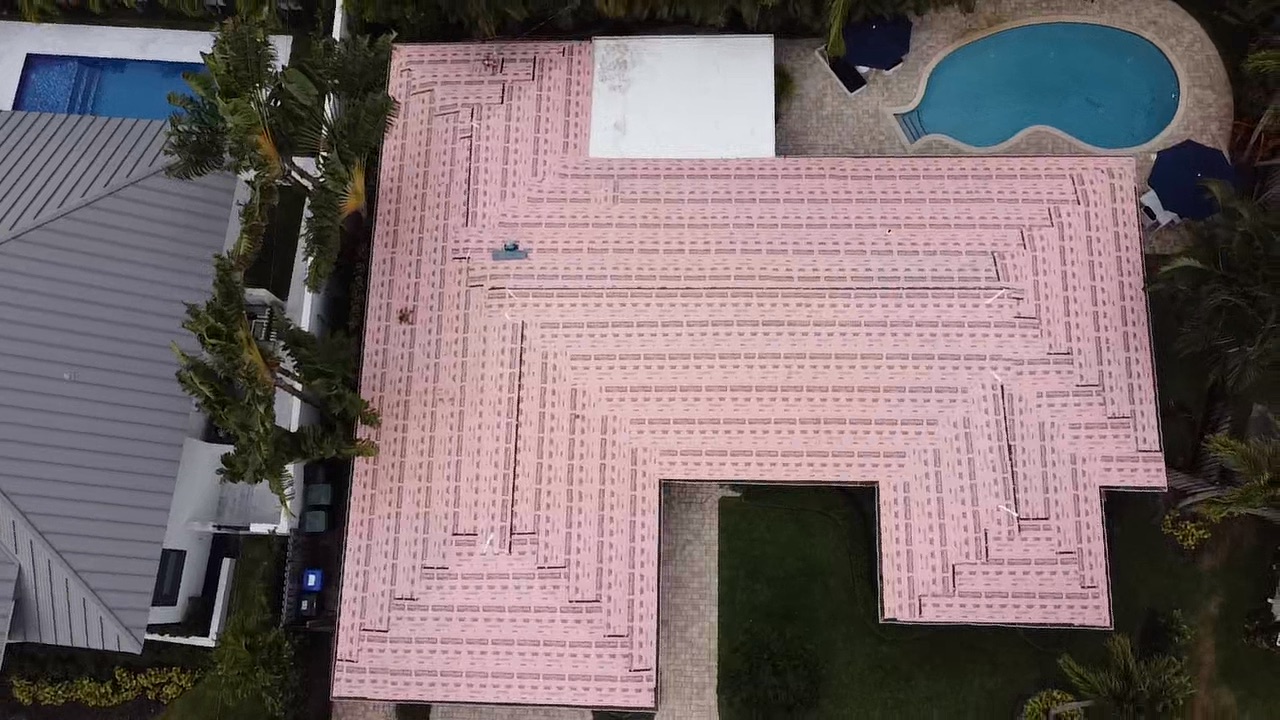
How do the four Polystick underlayments compare?
All four are self-adhered Polyglass membranes in the same Miami-Dade approval, NOA 25-0121.12 (opens in a new tab), valid through September 13, 2027. The NOA's general limitation 2 lists which roof coverings each one may go under, and that list settles most choices before price comes up. Each system in the NOA can narrow the list further, as the MTS Plus tile question below shows.
| Item | Polystick TU MAX | Polystick MTS Plus | Polystick XFR | Polystick IR-Xe |
|---|---|---|---|---|
| Roof coverings in NOA general limitation 2 | Non-structural metal, adhered (foam-set) tile, mechanically fastened tile | Asphalt shingles, wood shakes, non-structural metal, mechanically fastened tile, quarry slate | Asphalt shingles, wood shakes, non-structural metal, mechanically fastened tile, quarry slate | Asphalt shingles, wood shakes and shingles, quarry slate |
| Foam-set (adhered) tile | Yes, with 5 listed adhesives | No | No | No |
| Asphalt shingles | No | Yes | Yes | Yes |
| Maximum exposure | 180 days | 180 days | 180 days | 90 days |
| Thickness | 60 mils | 60 mils | 80 mils | 52 mils on the data sheet; 60 mils in the NOA row |
| Net coverage per roll | About 200 sq. ft. net | About 200 sq. ft. net | About 150 sq. ft. net | About 180 sq. ft. net |
| Where M&M uses it | Tile reroofs; all five tile case studies on this site | Metal roofs in Palm Beach, Martin and St. Lucie counties and farther north | Metal roofs in Broward and Miami-Dade, where the fire-rated assembly calls for it | Shingle roofs, direct to deck (Deerfield Beach and Fort Lauderdale case studies) |
Sources: NOA 25-0121.12 pages 2, 18 and 19; the TU MAX (opens in a new tab) and MTS Plus (opens in a new tab) data sheets; XFR and IR-Xe data from Polyglass as summarized in our reviews. M&M uses come from the projects and reviews on this site.
Which one is better for a tile roof?
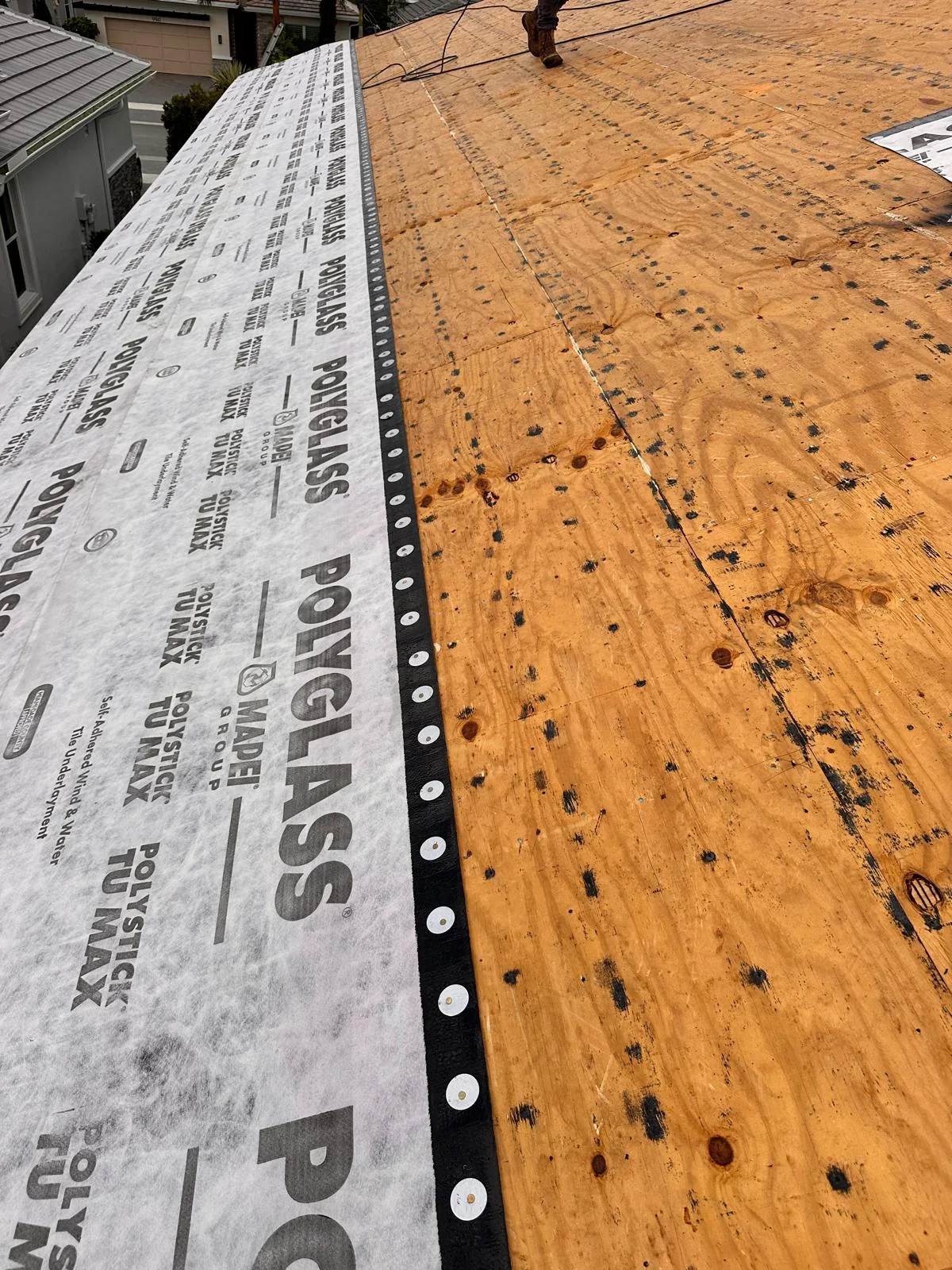
For foam-set tile, TU MAX is the only one of the four the NOA allows. Its adhesive table lists TU MAX with APOC Polyset RTA-1, APOC Polyset AH-160, DAP Storm Bond, DAP Storm Bond 2 and DuPont Tile Bond. MTS Plus and XFR are listed for mechanically fastened tile only, and IR-Xe is not listed for tile at all. M&M's tile reroofs use TU MAX, either directly on the deck or over taped seams and #30 felt, as the TU MAX review shows project by project.
Is one layer of MTS Plus enough under a concrete tile roof?
Not under the Miami-Dade NOA's listed systems. General limitation 2 names mechanically fastened tile for MTS Plus, but the individual systems decide what is approved. The single-layer direct-to-deck system that lists MTS Plus, System F(1), says tile roofing is not an approved roof covering for that assembly, and the same note appears on the base-sheet systems that end in MTS Plus. MTS Plus reaches the NOA's tile systems as the base ply under TU MAX (System F(3)) or TU Plus (System F(4)).
Roof pitch does not change that answer; the system does. Outside the High-Velocity Hurricane Zone, the non-HVHZ evaluation report for FL5259-R50 (opens in a new tab) and the tile's own approval govern, so ask your roofer which listed assembly the permit will use.
Which one is better under a metal roof?
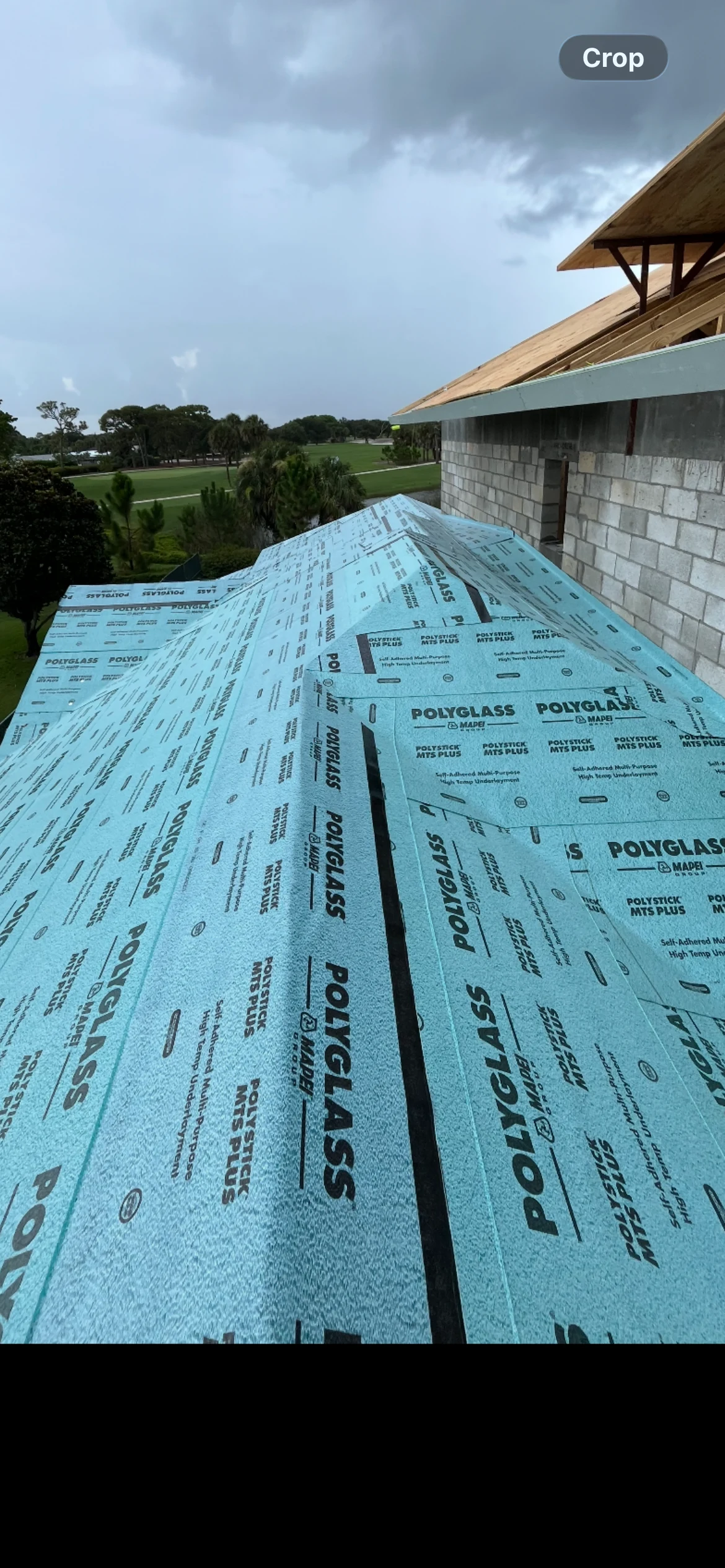
MTS Plus and XFR are both rated by Polyglass for 265°F, the heat that builds under metal panels. The choice between them is usually the fire-rated assembly. Fire classification is not part of NOA 25-0121.12, and Polyglass publishes specific Class A assemblies that use XFR. In Broward and Miami-Dade, M&M generally chooses XFR-based assemblies that meet the project's fire requirements; for suitable metal roofs in Palm Beach, Martin and St. Lucie counties, M&M primarily selects MTS Plus. Details are in the XFR review and the MTS Plus review.
Which one is better for shingles?
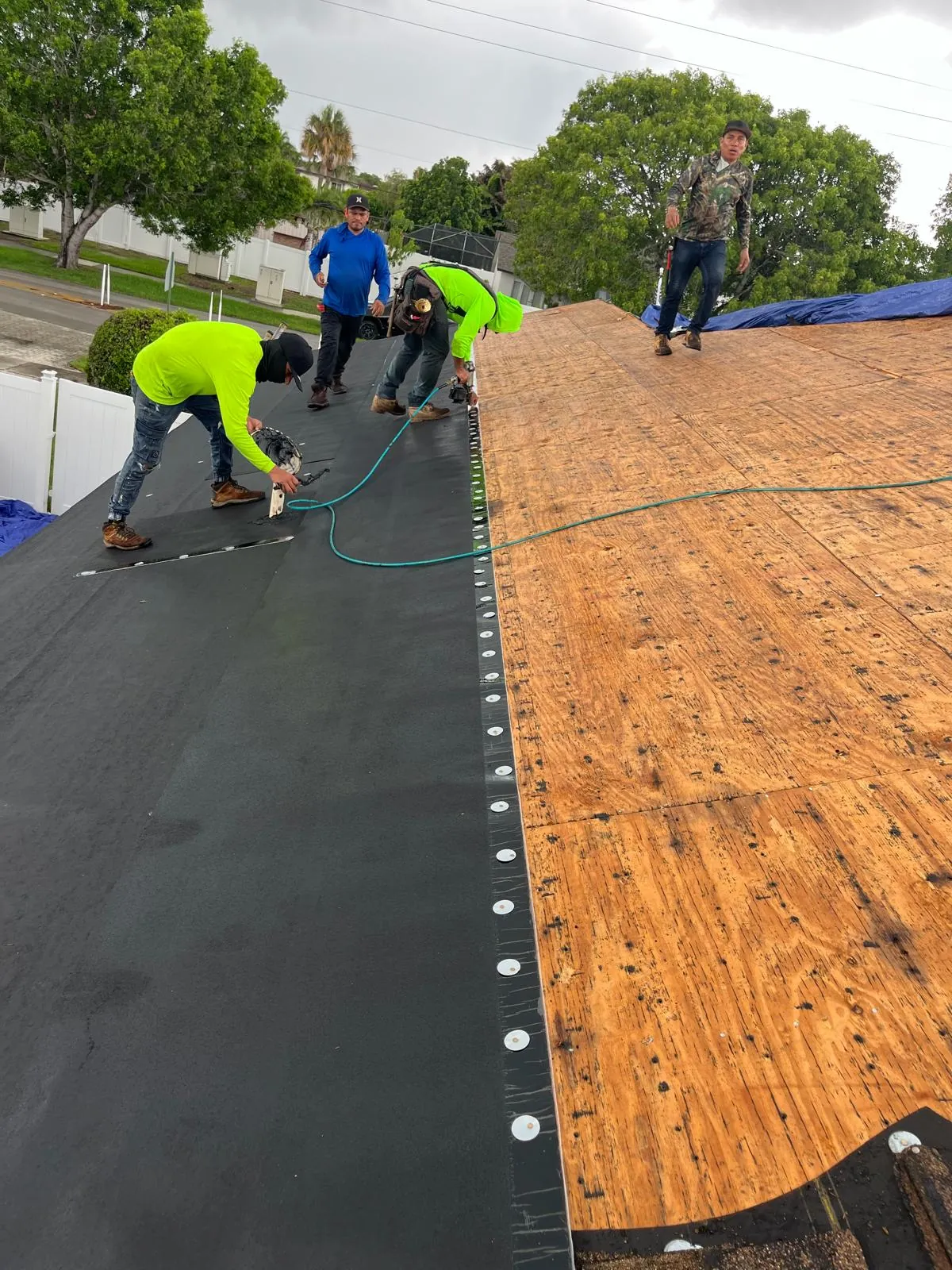
IR-Xe is the Polystick product built for shingles, and it is the one M&M installs directly on the deck under asphalt shingles, including the TAMKO Titan XT roof in Fort Lauderdale and the GAF Timberline roof in Deerfield Beach. MTS Plus and XFR are also listed for shingles, but their high-temperature rating is aimed at metal. IR-Xe's exposure limit is the shortest of the four, 90 days, so the shingles have to follow the dry-in on schedule. The IR-Xe review compares it with felt.
What is the price difference between them?
M&M quotes underlayment as part of the full roof, so this guide does not print roll prices. Two facts from our purchasing and the data sheets help you read a quote:
- MTS Plus generally costs less in material than XFR in M&M's purchasing experience.
- Rolls cover different areas. TU MAX and MTS Plus rolls cover about 200 sq. ft. net, IR-Xe about 180 and XFR about 150. Compare cost per roofing square and per required layer, not per roll.
Underlayment is one line of a replacement estimate, alongside the roof covering, tear-off, deck repairs and flashing. For whole-roof numbers, see the Broward roof replacement cost guide.
Can two Polystick layers be combined?
Yes, in the systems the NOA lists. System F(3) adheres MTS Plus to the deck as a base ply with TU MAX on top, both back-nailed at no more than 12 inches on center, and lists an underlayment uplift design pressure of −97.5 psf for product made in Winter Haven, Florida. For tile loading on that two-ply system, the NOA allows flat tile up to 7:12 and profiled tile up to 6:12 with six-tile stacks. The tile system's own NOA still sets the roof's design pressure.
To read these approvals yourself, start with our guide to checking a roofing product's NOA and FL approval.
Frequently asked questions
Which Polystick underlayment is best?
The one listed for your roof covering and your approved assembly. On M&M jobs that means TU MAX under tile, IR-Xe under asphalt shingles, XFR under metal in Broward and Miami-Dade when the fire-rated assembly needs it, and MTS Plus under metal farther north. A product outside its listed roof coverings is the wrong choice at any price.
Is MTS Plus cheaper than XFR?
In M&M's purchasing experience, MTS Plus generally costs less in material than XFR. Compare by the square, not by the roll: an MTS Plus roll covers about 200 sq. ft. net and an XFR roll about 150 sq. ft. net, and the required number of layers can differ.
Can I use TU MAX under shingles?
No. NOA 25-0121.12 lists TU MAX for non-structural metal roofing, adhered roof tile and mechanically fastened roof tile. Asphalt shingles are not on its list. IR-Xe, MTS Plus and XFR are the three in this comparison listed for shingles.
Can I use MTS Plus or XFR under foam-set tile?
Not under these approvals. The NOA lists MTS Plus and XFR for mechanically fastened roof tile, and its adhesive table names the tile underlayments approved for foam-set tile. TU MAX is on that table; MTS Plus and XFR are not. The NOA does list MTS Plus as a base ply beneath TU MAX in two-ply systems.
How long can each underlayment stay exposed?
Polyglass sets the limit by product. The NOA's exposure table lists 90 days for IR-Xe and 180 days for TU MAX, MTS Plus and XFR, and the building department can set a shorter limit for any of them. Plan the shingle delivery so the roof is covered inside the 90 days.
Do these underlayments qualify for a wind-mitigation credit?
Each one can support the secondary water resistance entry when it is fully adhered and meets ASTM D1970, which Florida's OIR-B1-1802 form (Rev. 04/26) lists as one method. The inspector documents the installed roof and the insurer decides the credit. No product guarantees a discount.
Are all four approved in Broward and Miami-Dade?
All four are in Miami-Dade NOA 25-0121.12, valid through September 13, 2027, which was written for the Florida Building Code including the High-Velocity Hurricane Zone. Each is approved only in the systems and roof coverings the NOA lists, so the full assembly still has to match.
Sources checked October 16, 2026
- Miami-Dade County, Florida NOA 25-0121.12, expires September 13, 2027 (opens in a new tab)Approved March 20, 2025. Product rows: page 2. Direct-deck systems F(1) to F(5): pages 15 to 17. Roof coverings by product: page 18, general limitation 2. Exposure days: page 19. Tile loading slopes: page 20.
- Polystick TU MAX product data sheet, edition 09/26 (opens in a new tab)Thickness, roll coverage and exposure for TU MAX.
- Polystick MTS Plus product data sheet, July 2025 (opens in a new tab)Thickness, roll coverage, 265°F rating and exposure for MTS Plus.
- Polyglass 2026 Polystick brochure (opens in a new tab)MTS Plus and XFR features, system roles and comparison table; pages 4 to 7.
- Polyglass XFR fire-assembly brochure (opens in a new tab)Assembly-dependent Class A configurations; verify the current UL listing for each project.
- Florida Product Approval FL5259-R50 (opens in a new tab)Approved February 10, 2026. Polyglass's statewide underlayment approval, with HVHZ (FL5259.1) and non-HVHZ (FL5259.2) reports.
- Florida OIR-B1-1802 wind-mitigation form, Rev. 04/26 (opens in a new tab)Section 8 lists fully adhered ASTM D1970 underlayment as one secondary water resistance method.
Product approvals are revised and renewed. Confirm the current document for the exact product, plant and roof system when your permit is prepared. This guide is general information for homeowners, not an engineering or permit determination for a specific roof.
Get a free roof estimate with the underlayment named
Tell M&M about your roof covering, county and roof age. Your written scope lists the underlayment, deck work and attachment method.
Call (754) 714-8445