
Polystick TU MAX Review: Tile Roof Underlayment
A dependable waterproofing layer beneath your tile roof. See why M&M Roofing uses Polystick TU MAX, with real project photos and advice for your reroof.

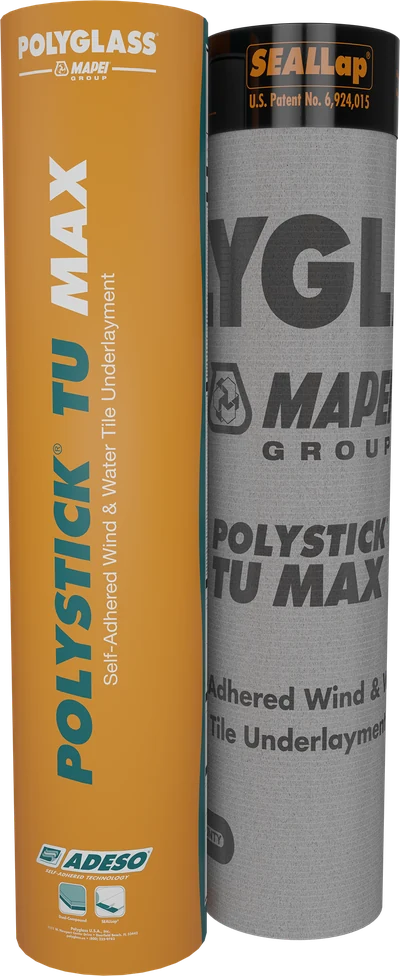
Polystick TU MAX
Underlayment for concrete and clay tile roofs
By M&M Roofing and Construction Corp · Florida Certified Roofing Contractor CCC1332459 · Published · Updated
Price a tile reroof with TU MAX
Free estimate. No obligation. Your written scope names the underlayment, the tile and the attachment method.
The short answer
Polyglass Polystick TU MAX is one of M&M Roofing's preferred underlayments for concrete and clay tile roofs. Its durable, 60-mil-thick, self-adhered underlayment provides reliable waterproofing beneath the tile. It holds Florida Product Approval and a Miami-Dade Notice of Acceptance, including approved assemblies for the High-Velocity Hurricane Zone, when installed according to the applicable approvals and manufacturer instructions.
Where has M&M installed TU MAX?
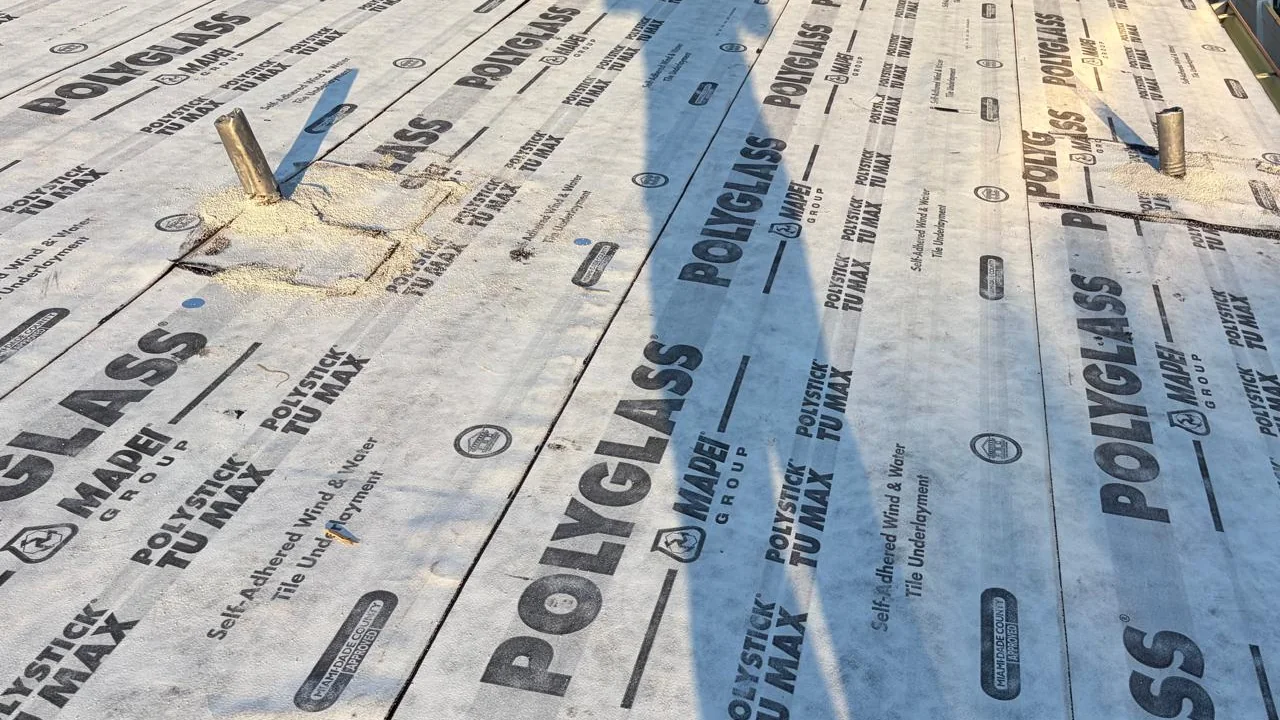
M&M Roofing has installed Polystick TU MAX on many roofs across Florida, beneath concrete tile and, in some situations, approved non-structural metal roof systems. Depending on the roof assembly, we install it directly to the deck or over 30-pound felt.
The five linked tile projects below are examples of our work with TU MAX, with jobsite photos you can explore. Four used TU MAX directly on the deck; the Parkland roof used it over taped seams and #30 felt.
| Project | How TU MAX was installed | Tile |
|---|---|---|
| Tile-to-tile reroof, West Palm Beach | Direct to deck, back-nailed at 12 in maximum; 30-pound felt separator under the drip edge and roll valley metal | Tile-to-tile reroof |
| Tile reroof dry-in, Miramar 33027 | Direct to the repaired plywood deck before the dry-in inspection | Concrete tile, in progress |
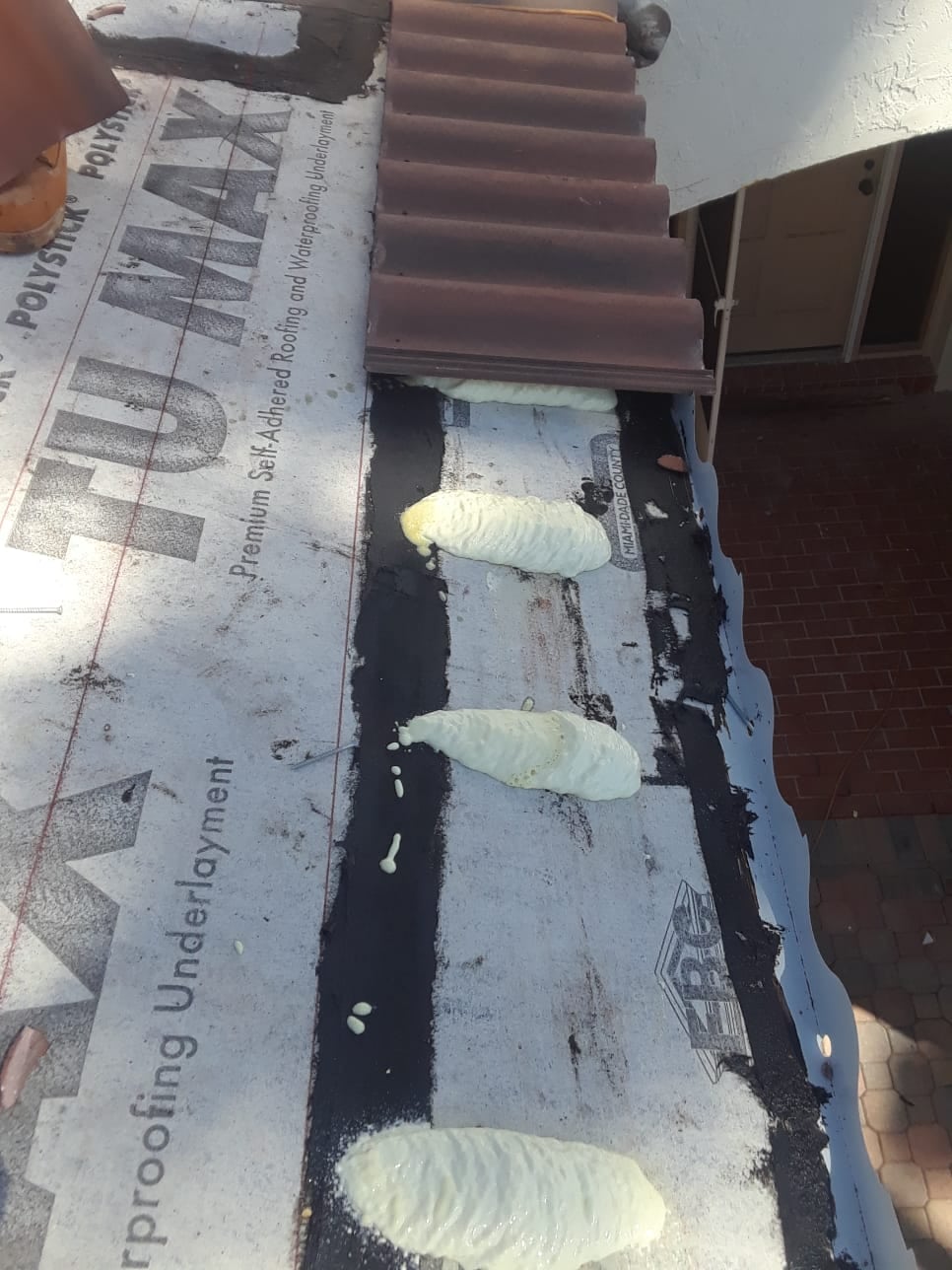
| Concrete tile replacement, Miramar | Direct to deck as the secondary water resistance layer, with ICP foam attachment | Crown Windsor Slate |
| Townhouse tile roof, Miramar 33029 | Direct to deck with APOC Polyset AH-160 adhesive | Westlake Villa 900, Gold Dust Blend |
| Concrete tile reroof, Parkland | Over taped deck seams and #30 felt, with APOC Polyset AH-160 foam | Westlake Barcelona 900, Avalon Beach Blend |
What is Polystick TU MAX?
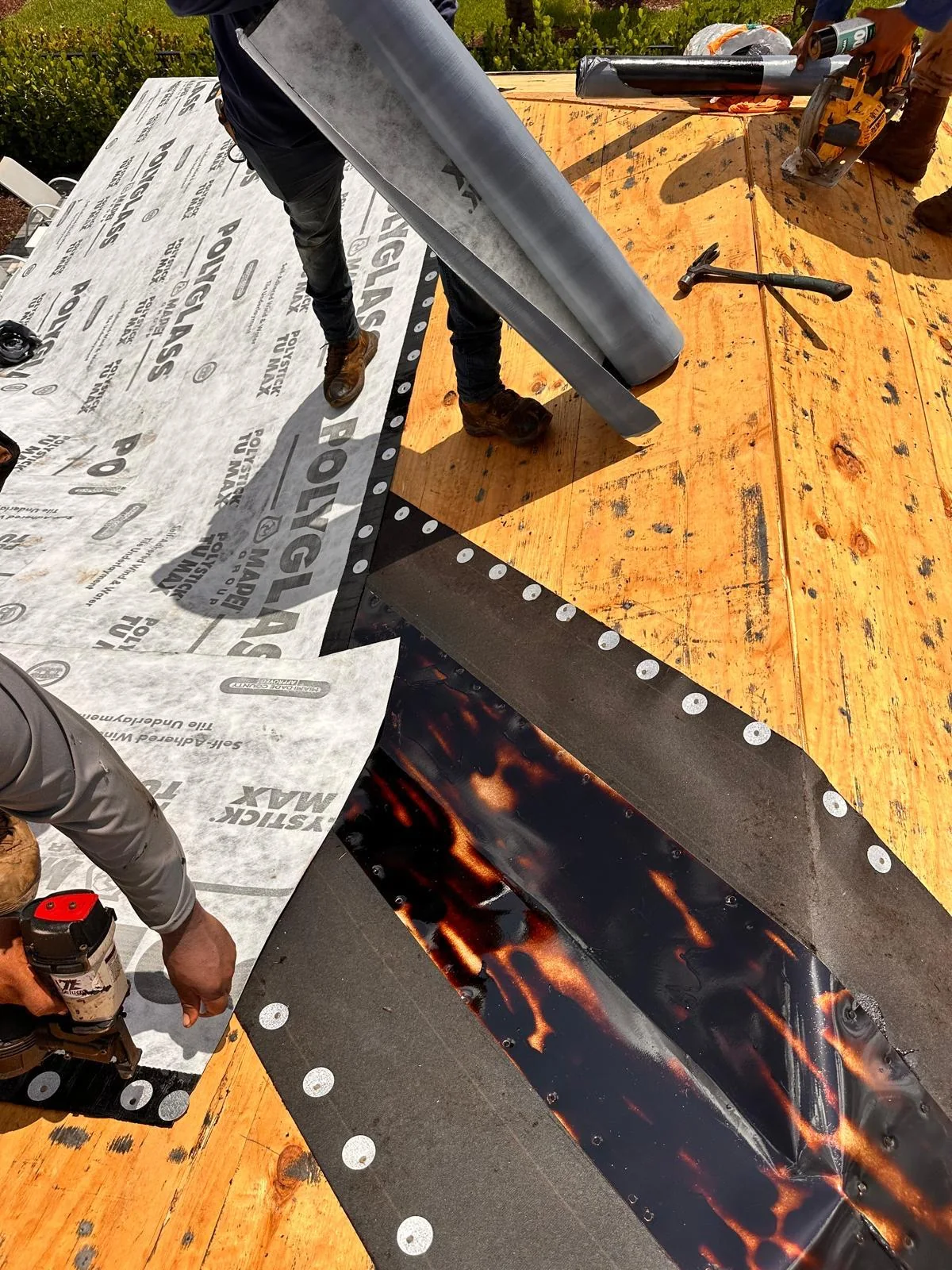
Polystick TU MAX is a self-adhered waterproofing underlayment that Polyglass designs for clay and concrete tile set in adhesive foam or fastened mechanically. A release film protects the sticky SBS bottom compound until the crew rolls the sheet onto the deck. The top is a polyester fabric that resists slipping underfoot and gives tile foam something to bond to. Polyglass makes it in Winter Haven, Florida, among other plants, and its headquarters is in Deerfield Beach.
| Property | Value |
|---|---|
| Membrane | Self-adhered, polyester-reinforced; modified bitumen top compound and SBS self-adhesive bottom compound |
| Nominal thickness | 60 mils (1.5 mm) |
| Roll size | 65 ft 8 in × 39⅜ in (20 m × 1 m) |
| Coverage per roll | About 200 sq. ft. net, 215 sq. ft. gross |
| Roll weight | About 55 lb (25 kg) |
| Rolls per pallet | 25 |
| Maximum exposure | 180 days, or less if the building department sets a shorter limit |
| Application temperature | Air, deck and membrane at 40°F and rising |
| Laps | Minimum 6 in end laps and 3 in side laps |
| Adhesion to plywood, minimum | 2.0 lbf/ft at 40°F; 12.0 lbf/ft at 75°F (ASTM D1970) |
| Vapor permeability, maximum | 0.1 perm (ASTM E96) |
| Standards on the data sheet | ASTM D1970, ICC ESR-1697, Florida Building Code, Miami-Dade County approved, Texas Department of Insurance, FORTIFIED Roof compliant |
| Manufacturer warranty on the data sheet | 1 year against manufacturing defects that directly result in leakage, unless a supplemental warranty applies |
Source: Polyglass TU MAX product data sheet, edition 09/26 (opens in a new tab). Earlier editions listed different thickness and weight values, so check the edition printed on the sheet you are given.
Is TU MAX approved for Broward and Miami-Dade?
Yes, as part of the systems its approvals list. TU MAX appears in Miami-Dade County, Florida NOA 25-0121.12 (opens in a new tab), approved March 20, 2025 and valid through September 13, 2027. The NOA says the products are designed to comply with the Florida Building Code, including the High-Velocity Hurricane Zone that covers Broward and Miami-Dade. TU MAX is also in Polyglass's statewide approval, FL5259-R50 (opens in a new tab), approved February 10, 2026, with separate HVHZ and non-HVHZ evaluation reports.
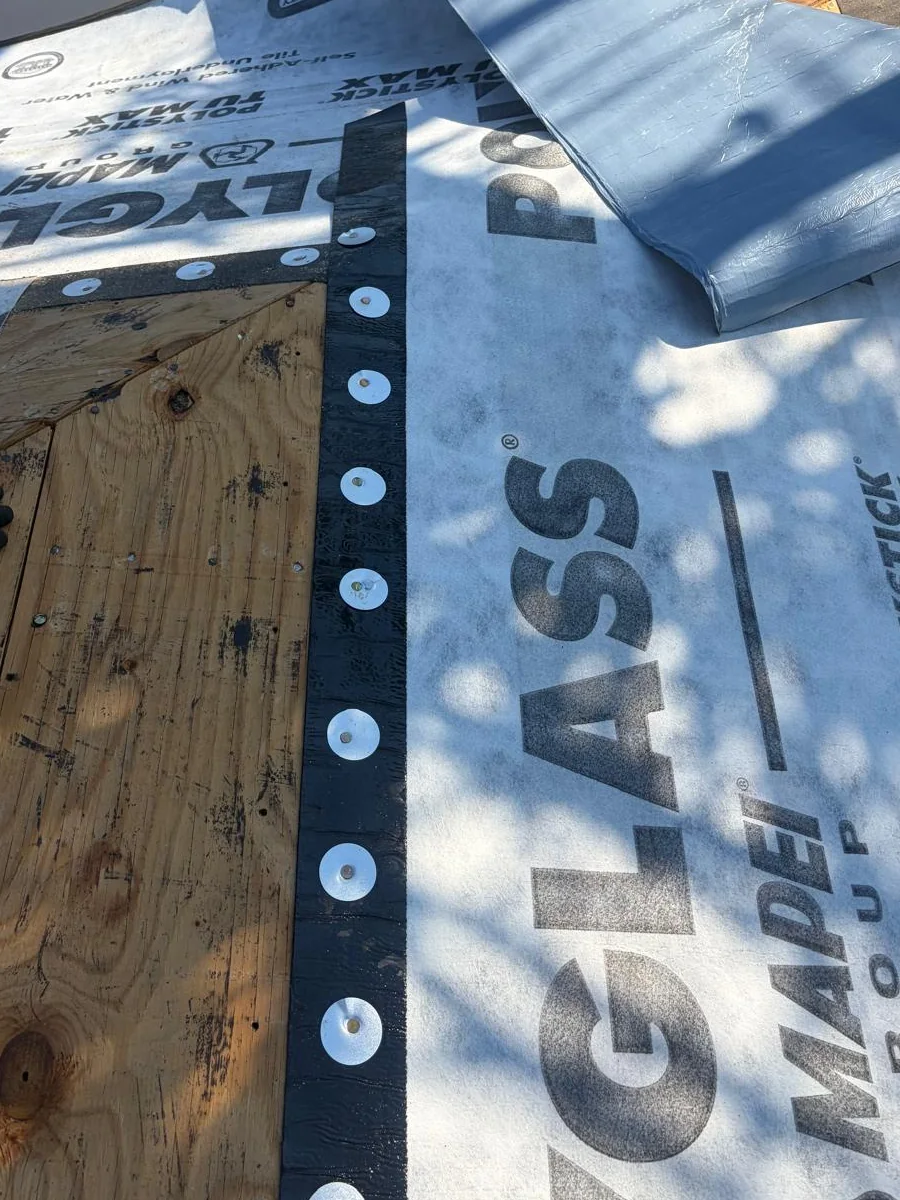
The NOA lists several TU MAX systems. In System F(5), TU MAX is the only membrane, adhered directly to a listed plywood deck and back-nailed with ring-shank nails and 1⅝-inch tin caps at no more than 12 inches on center. That system lists an underlayment uplift design pressure of −105 psf for TU MAX made in Winter Haven, Florida. The NOA notes that this number covers the underlayment assembly only; the tile system's own NOA sets the roof's design pressure.
To read an approval yourself, our guide to checking a roofing product's NOA and FL approval walks through the pages a Broward permit asks for.
Can TU MAX go under foam-set tile?
Yes. NOA 25-0121.12 lists TU MAX for adhered roof tile, mechanically fastened roof tile and non-structural metal roofing. Its adhesive table approves TU MAX with these five roof tile adhesives:
- APOC Polyset RTA-1
- APOC Polyset AH-160 (HFC)
- DAP Storm Bond Roof Tile Adhesive
- DAP Storm Bond 2 Roof Tile Adhesive
- DuPont Tile Bond Roof Tile Adhesive
M&M's foam-set jobs on this site use APOC Polyset AH-160, reviewed in our APOC Polyset AH-160 review. The underlayment approval does not set the foam pattern. The tile's NOA does: patty count, gram weight and placement differ between Barcelona 900, Villa 900 and Saxony 900.
How long can TU MAX stay exposed, and when can tile be loaded?
The data sheet and the NOA both allow up to 180 days of exposure, or less where the building department sets a shorter limit. That window matters on a tile reroof because the dry-in inspection, tile delivery and foam work rarely happen on the same day. Our Broward roof replacement timeline explains where those waits fall.
Two NOA rules shape the loading day. Polyglass calls for at least 48 hours of cure time after the membrane goes down before tiles are loaded onto it. For direct-to-deck tile assemblies, flat tile staged in six-tile stacks on TU MAX is limited to a 6:12 slope; steeper roofs need battens as the tile NOA and the code require.
What does a tile reroof with TU MAX cost?
M&M prices the underlayment inside the whole roof, so the useful number is the cost per roofing square (100 sq. ft. of roof surface) for the full tile system. These are M&M's August 2026 planning ranges for new concrete tile, from our Broward tile roof replacement cost guide:
| Underlayment scope | Planning range per square |
|---|---|
| Self-adhered underlayment such as TU MAX directly on the deck, foam-attached concrete tile | About $800 to $1,100 |
| #30 base layer plus peel-and-stick underlayment, foam-attached concrete tile | About $1,100 to $1,300 |
Clay tile, premium profiles or colors, deck replacement and complex flashing can push a quote higher. A written estimate for your roof replaces these ranges with a measured number.
What are TU MAX's limits?
- No asphalt shingles. The NOA's roof-covering list for TU MAX leaves shingles out. Shingle roofs get a shingle underlayment such as Polystick IR-Xe.
- No exposed use. The NOA's guidelines rule out Polystick membranes as the finished surface on crickets, exposed valleys or roof-to-wall details.
- No recover over an old membrane. The NOA says the membranes shall not be adhered over a pre-existing roof membrane.
- Fire rating comes from the full assembly. Fire classification is not part of NOA 25-0121.12.
- A 1-year product warranty on the data sheet. Polyglass's data sheet warrants TU MAX against manufacturing defects that directly cause leakage for 1 year unless a supplemental warranty applies. Workmanship is a separate question to ask your roofer.
- Primed metal. Metal flashings that receive the membrane need a compatible primer, per Polyglass's substrate bulletin (opens in a new tab).
Choosing between Polyglass products for a different roof? Compare them in TU MAX vs MTS Plus vs XFR vs IR-Xe, or see what a full job costs in the Broward tile roof replacement cost guide.
Frequently asked questions
Is Polystick TU MAX a good tile underlayment?
For foam-set and fastened concrete tile, it is the underlayment M&M uses on every tile reroof documented on this site. It bonds to the deck, carries a polyester top fabric that foam adhesive grips, and is listed in Miami-Dade NOA 25-0121.12 with the five tile adhesives in its approval table. It is the wrong product for an asphalt shingle roof.
Can TU MAX be installed directly on the roof deck?
Yes, where the code and the approved assembly allow it. NOA 25-0121.12 includes direct-deck systems, including System F(5), which lists TU MAX alone, back-nailed with 1⅝-inch tin caps at a maximum of 12 inches on center. The Parkland roof on this site used a different approved build-up: taped seams and #30 felt under TU MAX.
Can TU MAX be used under shingles or metal?
Not under asphalt shingles: the NOA lists TU MAX for non-structural metal roofing, adhered roof tile and mechanically fastened roof tile only. For shingles M&M uses Polystick IR-Xe, and for metal roofs M&M also uses XFR or MTS Plus depending on the county and the fire-rated assembly.
Does TU MAX qualify for a wind-mitigation discount?
It can support one. Florida's OIR-B1-1802 form (Rev. 04/26) lists fully adhered ASTM D1970 polymer-modified bitumen underlayment as a secondary water resistance method, and the TU MAX data sheet lists ASTM D1970. A qualified inspector has to document the installed roof, and the insurer decides any credit.
How much does TU MAX cost?
M&M prices TU MAX as part of the whole tile roof. M&M's August 2026 planning ranges are about $800 to $1,100 per roofing square for direct-to-deck self-adhered underlayment with foam-attached concrete tile, and $1,100 to $1,300 per square for a #30 base layer plus peel-and-stick underlayment with foam-attached tile. Deck repairs, flashing and the tile you choose move the final number.
What is the difference between TU MAX and TU Plus?
Both are Polystick tile underlayments in the same NOA. The NOA lists TU MAX at 60 mils and polyester reinforced, and TU Plus at 80 mils with glass-fiber and polyester reinforcement for metal and tile. M&M's documented tile roofs on this site use TU MAX.
Sources checked October 16, 2026
- Polystick TU MAX product data sheet, edition 09/26 (opens in a new tab)Polyglass U.S.A. Product description, physical properties, product data, standards and application instructions; pages 1 and 2.
- Polyglass Polystick TU MAX product page (opens in a new tab)Typical applications, features and the 180-day exposure rating.
- Miami-Dade County, Florida NOA 25-0121.12, expires September 13, 2027 (opens in a new tab)Approved March 20, 2025. TU MAX product row: page 2. Direct-deck system F(5): page 17. Roof coverings and listed tile adhesives: page 18. Exposure: page 19. Tile loading slopes: page 20. Application guidelines: page 22.
- Florida Product Approval FL5259-R50 (opens in a new tab)Approved February 10, 2026, for the 2023 Florida Building Code. FL5259.1 covers HVHZ use and FL5259.2 non-HVHZ use; the evaluation reports list TU MAX.
- FL5259-R50 non-HVHZ evaluation report (PEER-PLYG-002.A) (opens in a new tab)Revised December 11, 2025. Lists Polystick TU MAX as a nominal 60-mil ASTM D1970 underlayment.
- Florida OIR-B1-1802 wind-mitigation form, Rev. 04/26 (opens in a new tab)Section 8 lists fully adhered ASTM D1970 polymer-modified bitumen underlayment as one secondary water resistance method.
- Polyglass bulletin: suitable substrates for self-adhered membranes (opens in a new tab)Substrate preparation and priming of metal that receives Polystick membranes.
Product approvals are revised and renewed. Confirm the current document for the exact product, plant and roof system when your permit is prepared. This guide is general information for homeowners, not an engineering or permit determination for a specific roof.
Get a free estimate for your tile roof
Tell M&M about your roof. Ask for the underlayment, tile profile and foam or fastener method to be listed in your written scope.
Call (754) 714-8445