
M&M Product Review · South Florida
1.5-Inch Mechanically Seamed Metal Roof Review
Why we use 1.5-inch mechanically seamed metal roofing for South Florida homes—its benefits, specifications and the installation details that matter.
Published · M&M Roofing and Construction Corp
The short answer
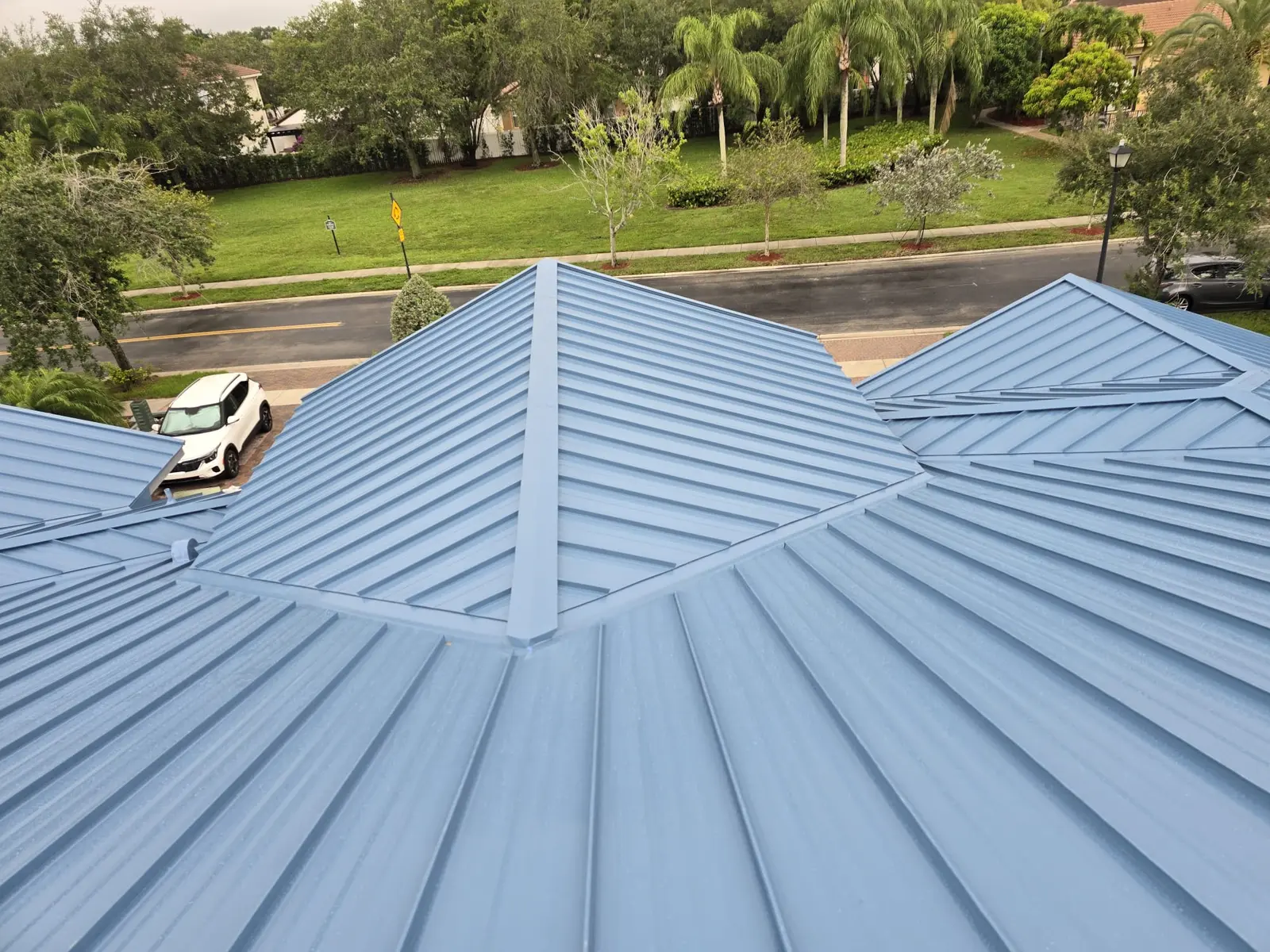
We prefer a 1.5-inch mechanically seamed roof—when the complete assembly fits the home.
For our metal roofing installations in South Florida, we value the combination of concealed field fastening, separate clips and a seam physically closed with a seaming tool. That preference is about the whole roof—not an assertion that a taller rib automatically wins every wind test.
01 / M&M’s preferred choice
1½-inch mechanical seam
Metal Alliance 150MS
Our first choice when the owner values concealed field fasteners, a mechanically closed seam and a carefully detailed standing-seam installation.
Tradeoff: More installation steps: separate clips, field seaming and close attention to trim and movement details.
02 / Concealed-fastener alternative
1-inch nailstrip
Metal Alliance 100SL
Worth comparing when the owner wants a standing-seam appearance with snap-together installation and no separate clips.
Tradeoff: Its integrated flange and exact approved fastening detail differ from a clip-attached system.
03 / Budget-focused alternative
5V exposed fastener
Metal Alliance 50AllV
A practical option when the owner likes the traditional profile and accepts visible, gasketed fasteners in the roof panels.
Tradeoff: Exposed screw heads and sealing washers add weather-exposed maintenance points. Obtain an actual installed quote.
This is M&M's editorial preference for homeowners prioritizing concealed fastening and mechanical seam closure, not a laboratory score, customer star rating or statewide ranking. Owner taste, home style, budget and project-specific engineering can change the recommendation.
Know exactly what you are buying
150MS dimensions and approved assembly specifications
“Mechanically fastened” and “mechanically seamed” are not interchangeable. All three roof types use fasteners; the clip-attached mechanical-seam system uses separate clips and field-closed seams. For specific dimensions and wind ratings, this review uses the Metal Alliance 150MS assemblies in the two supplied R5 reports. These values apply to those approved wood-deck assemblies—not every 1.5-inch mechanically seamed roof:
| Specification | Steel assembly | Aluminum assembly |
|---|---|---|
| Profile / rib height | 150MS mechanically seamed standing seam / nominal 1½ inches | 150MS mechanically seamed standing seam / nominal 1½ inches |
| Approval reviewed | FL31653.02–R5 | FL31653.04–R5 |
| Panel material | 24-gauge minimum steel; nominal 0.0239 inch; minimum yield 50 ksi | Nominal minimum 0.032-inch aluminum (or thicker, as described in the report) |
| Maximum panel width | 16 inches | 20 inches |
| Seam in these reports | 90° mechanical seam | 90° mechanical seam |
| Clip | Nominal 2-inch-long × 1½-inch-tall, 26-gauge clip | Nominal 2-inch-long × 1½-inch-tall, 26-gauge clip |
| Fasteners per clip | Two #10 × 1-inch pancake-style fasteners | Two #10 × 1-inch pancake-style fasteners |
| Minimum supporting deck | 15/32-inch plywood or ¾-inch wood plank; minimum specific gravity 0.42 | 15/32-inch plywood or ¾-inch wood plank; minimum specific gravity 0.42 |
Sources: FL31653.02–R5 steel report, pages 1–2 · FL31653.04–R5 aluminum report, pages 1–2.
How long are the panels?
Lengths are measured for the actual roof and confirmed with the fabricator. Fabrication, delivery, handling, thermal movement and end details limit continuous runs. The reviewed documents do not give one universal maximum length. The 16- and 20-inch dimensions above are widths, not lengths.
Product family ≠ one approval
The broader 150MS family lists 12-, 16- and 20-inch coverage; 22/24/26ga steel; .032/.040 aluminum; 16/20oz copper; and 90° or 180° seam options. Do not apply these two reports' pressures to every material, width, seam or support.
The numbers behind the system
150MS wind-uplift ratings: what −198.5 psf means
Both reviewed assemblies reach −198.5 pounds per square foot with their Method B attachment schedules. The negative sign means uplift, or suction away from the roof. These are allowable assembly pressures with a safety factor of 2 already applied—not ultimate test loads or a universal miles-per-hour rating.
| Panel assembly | Method | Clip spacing | Allowable uplift | Source |
|---|---|---|---|---|
| 24ga steel · 16-inch maximum width | A | 16 inches o.c. | −166 psf | FL31653.02–R5, p. 2 |
| 24ga steel · 16-inch maximum width | B | 8 inches o.c. | −198.5 psf | FL31653.02–R5, p. 2 |
| .032-inch aluminum · 20-inch maximum width | A | 13 inches o.c. | −156 psf | FL31653.04–R5, p. 2 |
| .032-inch aluminum · 20-inch maximum width | B | 10.5 inches o.c. | −198.5 psf | FL31653.04–R5, p. 2 |
The useful takeaway
Attachment spacing changes the result. The steel example goes from −166 to −198.5 psf when its clip spacing changes from 16 to 8 inches. You cannot order “150MS” and assume the highest row applies regardless of how it is installed.
Pressure is not wind speed
A qualified designer must compare these values against the roof's required allowable-stress-design (ASD) pressures. Building height, exposure, roof geometry and edge/corner zones matter. A headline such as “rated for 200 mph” cannot be inferred from this table.
The reports reference UL 580, UL 1897 and TAS 125 uplift testing, TAS 100 wind-driven rain testing, and ASTM E2140 static water testing. These tests address defined conditions; they do not guarantee a leak-free roof or validate unlisted substitutions. Deck attachment and supporting structure need separate design verification.
Comparing proposals? Ask M&M to identify the exact approval and attachment schedule in your metal-roof scope. Our Broward metal roof profile guide explains the broader options.
Three systems, different tradeoffs
1½-inch mechanical seam vs. 1-inch nailstrip vs. 5V
Nailstrip is also a concealed-fastener system; it should not be grouped with exposed-screw 5V. All three Metal Alliance product families have listed HVHZ assemblies. The difference is how their panels attach and close, and which complete assembly meets your roof's needs.
| Consideration | 150MS mechanical seam | 100SL 1-inch nailstrip | 50AllV / 5V |
|---|---|---|---|
| Panel attachment | Separate clips; adjacent panel covers clip fasteners | Integral nailstrip flange; next panel covers fasteners | Screws and sealing washers through the panels |
| Seam closure | Field mechanically seamed; 90° in the two R5 reports reviewed | Snap-together seam; no field mechanical seaming | Overlapping 5V panels; exposed fastening |
| Published coverage choices | 12, 16 or 20 inches (approval-specific) | 16 inches | 21 or 24 inches (approval-specific) |
| Manufacturer-stated minimum slope | 2:12; see the approval discrepancy below | 2:12 | 3:12 |
| Installation tradeoff | Clips and seaming add labor and equipment | No separate clips or seaming machine | Direct fastening; washer seating is important |
| Ongoing attention | Seams, flashing, penetrations, finish and drainage | Seams, flashing, penetrations, finish and drainage | Those items plus exposed screws and washers |
| Miami-Dade / Broward eligibility | Listed HVHZ assemblies exist | Listed HVHZ assemblies exist | Listed HVHZ assemblies exist |
Manufacturer sources: 150MS · 100SL · 50AllV. For more detail, see how mechanical seam and nailstrip attachments differ.
Can nailstrip or 5V have a strong wind rating? Yes.
These examples prevent an apples-to-oranges sales claim. They use different materials, attachments and test configurations, so they are not a controlled test of seam style alone.
100SL nailstrip · FL29523.03–R4
For the 26ga-minimum steel, 16-inch-wide assembly: #10 × 1-inch fasteners at 6 inches give −116 psf without sealant or −176 psf with the specified male-leg sealant. This particular detail fastens through the metal flange, not the prepunched slots.
50AllV / 5V · FL31652.01–R4
For the 26ga-minimum steel, 24-inch-wide assembly: #10 × 1½-inch screws with sealing washers in the specified 12–12 pattern give −117.75 psf at 16-inch spacing or −206 psf at 8-inch spacing.
Those allowable values also include a safety factor of 2. A more negative value means greater allowable suction for that listed assembly, not a better roof in every respect. M&M's 150MS preference is not a claim to the highest pressure number in every comparison.
Why we use it
Where a mechanically seamed roof earns its place
Concealed field fastening
The next panel covers the clip attachment. We like the clean appearance and avoiding rows of exposed washer-head screws across the panel faces. Clip screws still penetrate the underlayment and deck; “concealed” does not mean penetration-free.
A physically closed seam
A seaming tool folds adjoining panel edges together instead of relying on a snap-together joint. That gives our crew a defined seam-closing operation to inspect. Correct seamer setup, sealant where specified and intact flashing remain essential.
Movement is part of the detail
Metal expands and contracts. Clip selection, fixed points and end clearances must accommodate the design. We do not assume every clip is a floating clip or that a long panel can be fastened without movement planning.
A tailored architectural look
Straight standing seams, material choices and available surface options let the roof complement the house. Home style and owner preference matter: a traditional 5V profile or another roof material may fit the project better.
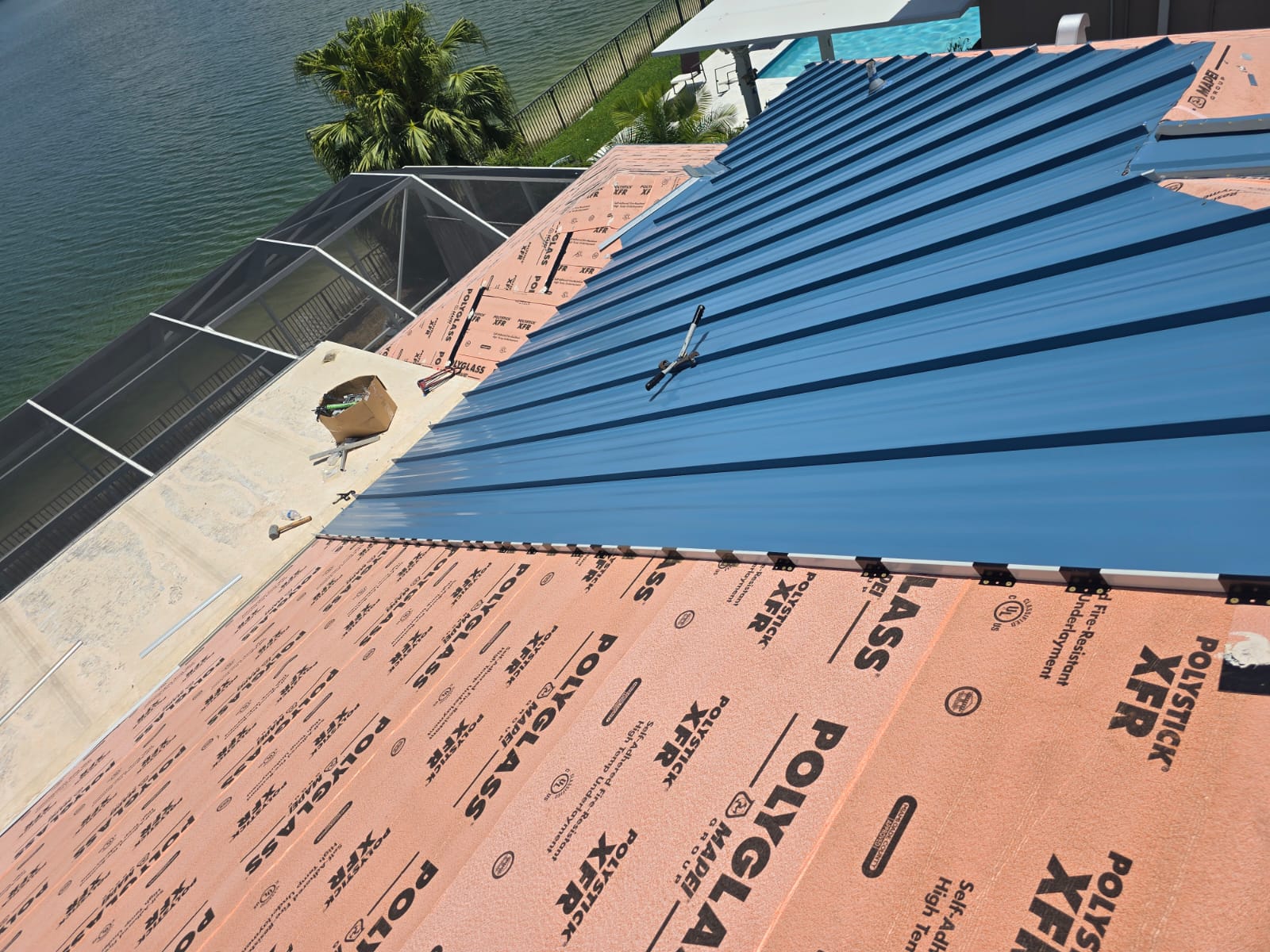
How concealed clips hold the panels
Look along the open panel edge near the bottom of this M&M installation photo: the row of clips holds the panel edge and fastens it to the roof deck. The next panel covers this attachment before the seam is mechanically closed, keeping the clip fasteners concealed beneath the finished roof.
The photo illustrates the attachment method, not a fastening schedule. Clip type, fasteners and spacing must follow the selected product approval and project requirements. The Polystick XFR underlayment remains a separate part of the roof assembly.
Explore our mechanically seamed roofing guide for Broward County, or compare metal roofing with concrete tile if you are still choosing the overall look.
The tradeoffs we discuss before you commit
Separate clips and mechanical seaming add work. Cost also depends on metal, finish, deck repairs, roof complexity and flashing—not only square footage. Use our roof replacement cost guide and roof budget calculator to start planning, then request a written scope. Broward County roofing financing information is available if useful.
Metal can show waviness known as oil canning. Surface finish, material compatibility, coastal exposure, installation and maintenance need attention. No panel is maintenance-free: plan inspections, clear drainage and prompt review of storm damage. Confirm material and finish warranty terms for the actual order; this review promises no fixed service life or residential weathertight warranty.
Manufacturer guide: movement, oil canning, maintenance and finish information
Miami-Dade & Broward
The panel is only one part of a code-compliant roof
The R5 reports include the High Velocity Hurricane Zone (HVHZ). They require traceable Metal Alliance material or an approved manufacturing partner and the correct panel, substrate and attachment. Similar-looking panels from another source are not automatically covered.
The underlayment, valleys, penetrations and perimeter details deserve the same attention as the visible metal. M&M uses Polystick XFR for appropriate metal-roof assemblies in Miami-Dade and Broward. Its use must match the selected roof assembly; the panel approval alone does not grant a Class A fire classification.
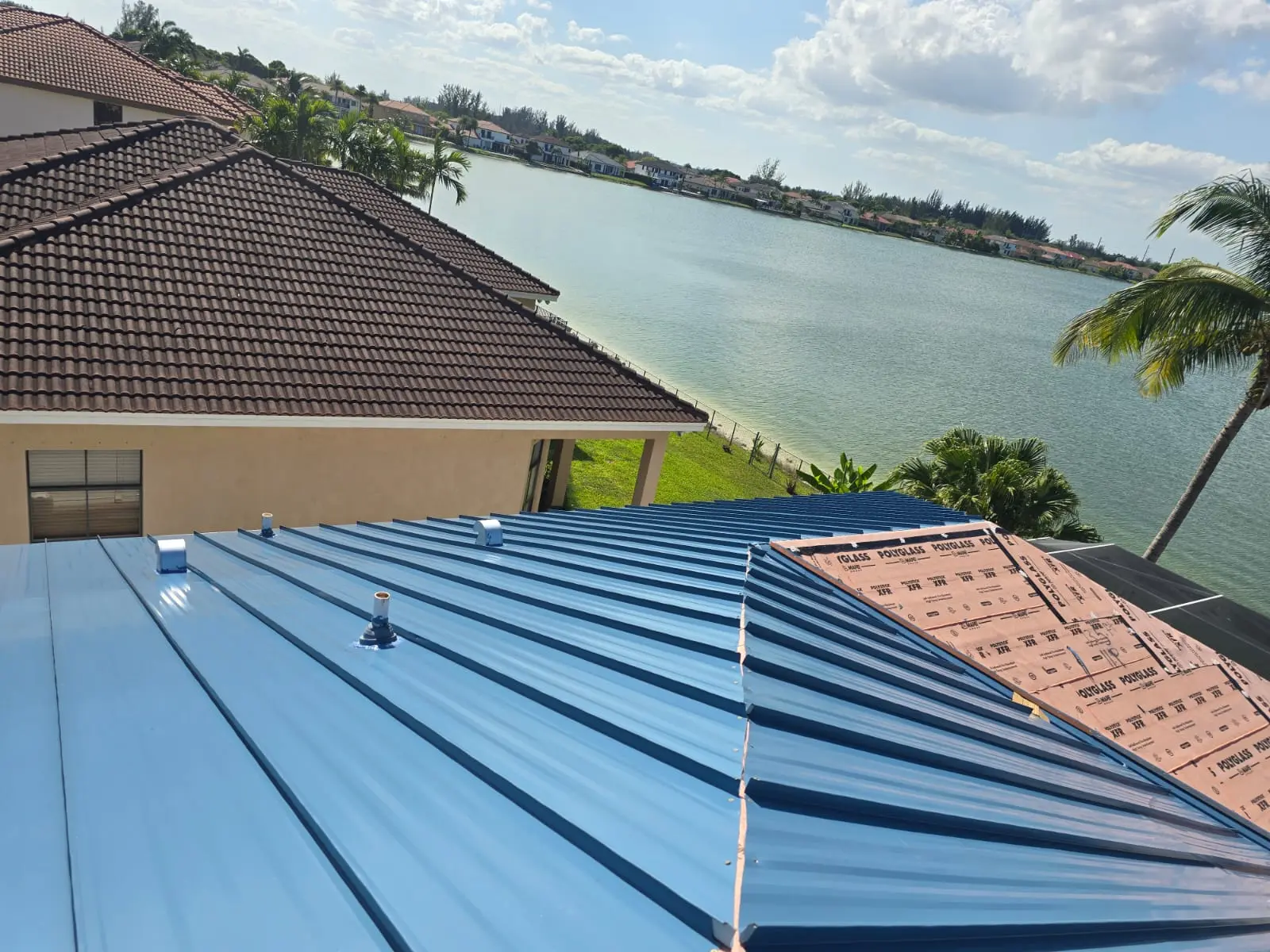
See the full Miramar tile-to-metal conversion for a real installation example, and browse more M&M roofing projects.
What should be in your proposal?
- Exact panel model, metal thickness, finish and width.
- Applicable approval, seam, clips and attachment schedule.
- Field-measured panel lengths and movement details.
- Deck condition, repairs and structural attachment review.
- Compatible underlayment and required fire-rated assembly.
- Flashings, penetrations, inspections and written warranty terms.
Keep researching your South Florida metal roof
150MS metal roofing frequently asked questions
What is the Metal Alliance 150MS panel?
It is a nominal 1.5-inch mechanically seamed standing-seam profile. Separate clips attach it to the supporting deck, and a seaming tool closes the adjacent panel edges. This review focuses on the steel FL31653.02–R5 and aluminum FL31653.04–R5 wood-deck assemblies supplied to M&M.
Is mechanically seamed the same as mechanically fastened?
Not exactly. All three systems compared here use mechanical fasteners. “Mechanically seamed” describes how the standing seam is closed. The 150MS uses clips and field seam closure; 100SL nailstrip snaps together; 5V uses exposed panel screws.
How long are the 150MS panels?
Panel lengths are field-measured and confirmed with the fabricator before production. The reviewed sources do not publish one universal maximum length. Fabrication, transport, handling, end details and thermal movement all affect the permitted continuous run. The 16- and 20-inch approval dimensions are panel widths, not lengths.
Is this a 90-degree or 180-degree mechanically seamed roof?
The product family offers both, but both supplied R5 assembly reports specify a 90-degree seam. Do not substitute a 180-degree seam or different clip and assume the same approval values apply; confirm the exact permitted system.
Is 150MS approved for Miami-Dade and Broward County?
The two R5 reports reviewed include the High Velocity Hurricane Zone, which covers Miami-Dade and Broward. The exact panel, source of manufacture, material, width, clip, fasteners, deck and spacing must match the approved and permitted assembly. Approval is not permission to use any configuration on any building.
Is 1.5-inch mechanical seam always stronger than nailstrip or 5V?
No. The published examples below include a 5V assembly at −206 psf and 150MS assemblies at −198.5 psf. These are different tested assemblies, not a controlled profile-only comparison. M&M’s preference also considers concealed fastening, seam closure, appearance and installation details.
Can 150MS be installed on a low-slope roof?
The current manufacturer page states a 2:12 minimum. The R5 reports discuss lower minima and additional sealant conditions. Because those documents differ, do not assume a lower slope is acceptable without written confirmation for the exact system from the manufacturer and the project’s design and permitting team.
Does the panel approval include a Class A fire rating?
No. Fire classification is excluded from the scope of the supplied R5 reports. The roof’s fire compliance requires a separately verified complete assembly, including its underlayment and any required fire barrier.
Does a 150MS metal roof automatically lower insurance premiums?
No particular discount or percentage is promised here. Product approval is not an insurance-credit determination. Ask your insurer and wind-mitigation inspector what documentation and completed roof features apply to your policy.
Which metal roof does M&M recommend?
For owners prioritizing a concealed-fastener, mechanically closed standing-seam roof, 150MS is our preferred option among these three. The final choice still depends on the home’s style, owner’s taste, budget, exposure and a complete assembly that meets the project’s requirements.
Sources and how this review was rated
We checked the supplied installation reports against Florida's current 2023-code record on September 10, 2026. FL31653–R5 is listed as Approved, dated October 14, 2025. Our ranking is an editorial assessment of attachment visibility, seam closure, installation demands and homeowner priorities; it is not a manufacturer endorsement or a normalized laboratory comparison.
- Florida Product Approval FL31653–R5: current application and assembly list
- FL31653.02–R5: 24ga steel 150MS installation report
- FL31653.04–R5: .032-inch aluminum 150MS installation report
- Metal Alliance 150MS product specifications
- 150MS installation guide: dimensions, fabrication and maintenance
- FL29523.03–R4: selected 100SL nailstrip assembly
- FL31652.01–R4: selected 50AllV exposed-fastener assembly
This homeowner review is not a fastening schedule, engineering design or permit approval. Use complete current documents and project-specific requirements. Fire classification, deck/structural attachment, coating durability and insurance credits are not established by the uplift numbers alone.