
Material review · Self-adhered underlayment
Roofnado AnchorDeck PSU Review: Where This Peel-and-Stick Fits a Florida Roof
Check where AnchorDeck PSU fits, where tile use is restricted, and what its pressure numbers describe.


Roofnado AnchorDeck PSU
Self-adhered underlayment
What belongs beneath your new roof?
Compare the underlayment and complete roof assembly for your home.
The short answer
AnchorDeck PSU can provide an adhered water-shedding layer beneath an approved shingle or metal roof. Its suitability for tile depends on location and attachment method: current Florida documents allow mechanically fastened tile outside the High-Velocity Hurricane Zone (HVHZ)—outside Broward and Miami-Dade, but do not list foam-set tile for this product. In Broward and Miami-Dade, the reviewed approvals do not list AnchorDeck PSU for tile. The exact assembly matters more than the name on the roll.
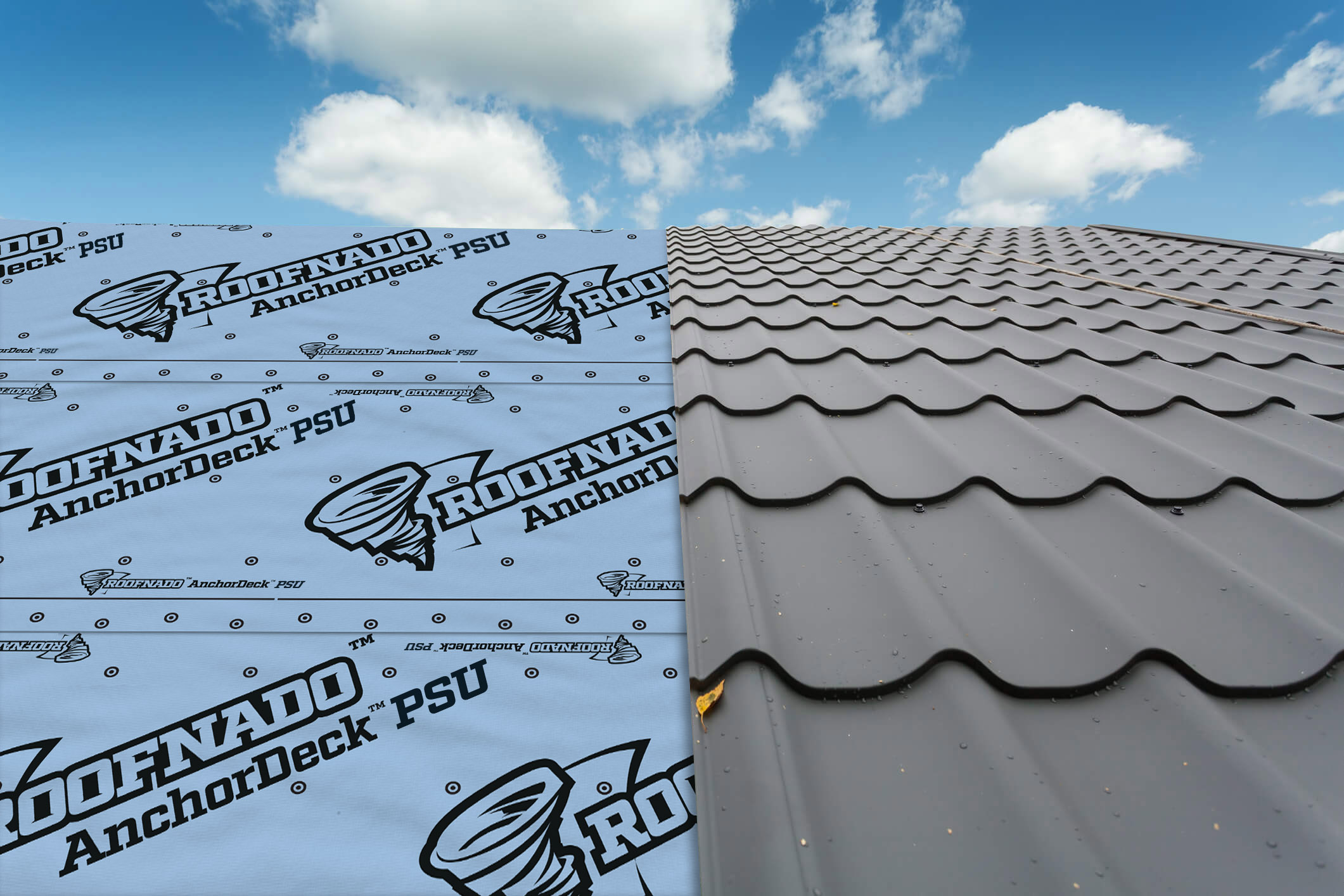
Beyond the name on the roll
What Roofnado AnchorDeck PSU brings to the roof
Check the PSU name
AnchorDeck PSU is the peel-and-stick membrane. Regular AnchorDeck is a different, mechanically fastened synthetic sheet. An estimate should name the exact product; similar branding does not make the approval or installation interchangeable.
Tile needs a closer look
The non-HVHZ Florida report lists mechanically attached tile, while the HVHZ report does not. Neither reviewed report lists adhesive-set tile for AnchorDeck PSU. For a foam-set tile reroof, ask for a different, specifically approved underlayment assembly.
More layers do not guarantee more uplift resistance
The NOA assigns different values to direct-to-deck and felt-plus-membranes installations. Each describes a tested combination of deck, fasteners and layers. Adding an unlisted layer does not automatically improve approved pressure.
Two useful specifications
Thickness and wind resistance at a glance
Material thickness
40 mils
Nominal thickness · 0.040 inch · about 1.02 mm
Both Florida evaluations identify the self-adhered AnchorDeck PSU membrane as nominally 40 mils thick.
Assembly wind resistance
−45 to −52.5 psf
Listed allowable design pressures
The −45 psf NOA row combines felt, AnchorDeck PSU and LapLock PSU HT. The −52.5 psf rows have their own direct-to-deck requirements.
See the assemblies, installation and sources →Pressure ratings apply to the specific deck and installation listed in each approval. They are not wind speeds or a rating for the entire roof. Thickness alone does not determine wind resistance.
Does it fit your roof and your location?
Broward and Miami-Dade are in Florida’s High-Velocity Hurricane Zone (HVHZ). Palm Beach and Martin County are outside that zone. The applicable approval, roof covering and installation must agree.
Broward & Miami-Dade · HVHZ
Listed shingle, non-structural metal, wood/shake and slate roof systems. Tile is not listed for AnchorDeck PSU.
Use the exact covering approval and assembly detail. FL21895.1-R13 Table 2 marks both mechanical and adhesive tile applications “No.”
Outside HVHZ
Listed shingles, metal, slate, wood and mechanically attached clay/concrete tile; no adhesive-set tile.
FL21895.2-R13 applies here. Wood coverings have additional underlayment conditions; the tile pressure row below specifically requires plywood.
Match the underlayment to the approved metal panel system. Metal roofing options →
What the approval actually measures
How much uplift can the approved assembly resist?
Negative psf describes resistance to upward suction. These are underlayment assembly limits, not wind-speed ratings or foam-bond strengths. The finished roof and the pressures calculated for the house must also comply.
Read these as assembly ratings, not wind speeds
These are allowable design pressures in pounds per square foot (psf), not miles per hour or a hurricane-category rating. A larger magnitude represents more allowable uplift for that listed assembly. It does not measure the entire roof or the tile foam alone. Your roof’s required pressures depend on its design and location.
HVHZ · Miami-Dade NOA 26-0223.02
Two different non-tile assemblies. The plywood versions are shown; retain every listed layer and fastening condition.
Select a bar to see the deck, installation and source.
−52.5 psf
Deck: 15/32-inch, APA 32/16, Exposure 1, PS1, CDX four-ply plywood. #8 wood screws at 6 inches on center; supports at most 24 inches apart and blocking at most 48 inches apart.
Installation: Self-adhered AnchorDeck PSU, back-nailed in 3.5-inch side laps at 12 inches on center. The NOA specifies 12-gauge annular ring-shank nails, 3/8-inch diameter, with 32-gauge, 1⅝-inch tin caps.
Limits: Listed non-tile coverings with current NOAs. This pressure excludes the finished roof system. See the source for exact fastener wording.
NOA 26-0223.02, p. 6 · F(1) — read the complete approval−45 psf
Deck: 19/32-inch, APA 40/20, Exposure 1, PS1, CDX four-ply plywood. #10 wood screws at 6 inches on center at supports no more than 24 inches apart and blocking.
Installation: G.A.P. #30 felt: 12-gauge ring-shank nails with 1⅝-inch tin caps, 6-inch spacing at 4-inch laps and 12-inch spacing in two equally spaced center rows. Add self-adhered AnchorDeck PSU, then LapLock PSU HT; back-nail each with the same nail/cap type at 12-inch spacing.
Limits: A three-layer assembly with a different cap product. Listed non-tile coverings only; not an AnchorDeck-only rating.
NOA 26-0223.02, p. 6 · E(5) — read the complete approvalBars show the magnitude of the listed negative design pressure. The minus sign denotes uplift. Different decks and installation methods are separate assemblies.
Outside HVHZ · FL21895.2-R13
A separate Florida approval path for mechanically attached tile. This does not extend tile permission into Broward or Miami-Dade.
Select a bar to see the deck, installation and source.
−52.5 psf
Deck: 15/32-category plywood, APA rated sheathing 32/16, Exposure 1, PS1; code-compliant deck design.
Installation: No primer, joint treatment or base ply in this row. AnchorDeck PSU self-adhered and back-nailed in minimum 3.5-inch side laps with approved nails and tin caps per FBC 1517.5, maximum 12 inches on center.
Limits: Mechanically attached tile only. Must meet the required FRSA/TRI Appendix A pressure or the critical/highest calculated design pressure. The evaluation already includes its 2:1 safety factor.
FL21895.2-R13, pp. 4–5 · UDL-1 — read the complete approvalBars show the magnitude of the listed negative design pressure. The minus sign denotes uplift. Different decks and installation methods are separate assemblies.
Choose the tile attachment and underlayment together. Tile roofing options →
Material testing · Source checked October 27, 2026
Beyond wind pressure: how does the sheet perform?
Tear resistance, tensile strength and vapor permeance describe different jobs. Here is what the reviewed documents actually report for Roofnado AnchorDeck PSU.
Tear resistance
Numeric specificationHow well the sheet resists a tear spreading. Test methods can pull or tear the material in very different ways.
ASTM D4533 · lb (force; source prints lbs)
Typical average · ±10%
These are typical averages in the two directions, with a stated ±10% variation. They use a different tear method from the Polystick and APOC figures.
Manufacturer technical data sheetSentry Roofnado AnchorDeck PSU spec sheet RN AD PSU SS SEP24 · p1
Tensile strength
Numeric specificationHow much pulling force the sheet carries before reaching its reported maximum load. This is a material test, not a roof uplift rating.
ASTM D5034 · lb (force; source prints lbs)
Typical average · ±10%
This grab-strength test reports total pulling force in pounds, not pounds per inch. The values are typical averages with ±10% variation.
Manufacturer technical data sheetSentry Roofnado AnchorDeck PSU spec sheet RN AD PSU SS SEP24 · p1
Vapor permeance
Numeric specificationHow readily water vapor passes through the sheet. A lower perm value means less vapor passes through; it does not automatically mean a better roof.
ASTM E96 · perms
Typical average · ±10%
The typical 0.027-perm value indicates low vapor passage. The stated ±10% variation applies; the sheet does not identify the E96 cup method or conditioning.
Manufacturer technical data sheetSentry Roofnado AnchorDeck PSU spec sheet RN AD PSU SS SEP24 · p1
What the NOA and Florida approval establish
Current NOA and both Florida evaluations identify ASTM D1970 compliance for AnchorDeck PSU, but do not publish its measured tear, tensile or vapor values. Florida 5.7-perm data belongs to Sahara AnchorDeck/BU15, not this self-adhered PSU product.
- Miami-Dade NOA 26-0223.02 · p2
- Florida FL21895-R13 HVHZ PEER-SBI-001.B.R7 · p3
- Florida FL21895-R13 non-HVHZ PEER-SBI-001.A.R13 · p3
The approval determines permitted uses and installation. Where it does not publish these laboratory values, the cards identify the original manufacturer sheet as the source. A manufacturer value is not relabeled as an NOA test result.
How to compare these numbers
MD means the direction along the roll; CD or XMD means across it. Match the method, units, direction, conditioning and whether a figure is a minimum, maximum or typical result. A published minimum is a floor—not proof of a product’s highest strength.
Use the exact approved assembly for wind-pressure comparisons. Vapor permeance is a roof-design consideration, and M&M’s installation experience adds context to the laboratory figures.
Compare underlayment options for your roof →The details worth discussing before installation
How long can it stay uncovered?
The current NOA limits AnchorDeck PSU exposure to 90 days. Treat that as a construction limit, not a target schedule or expected service life. Arrange the finished covering promptly and inspect damage before covering the membrane.
What matters on a hot metal roof?
The manufacturer publishes a 40–240°F temperature range. Clean, dry decking and proper rolling still matter to adhesion. Installation guidance calls for air and deck temperatures of 40°F and rising, and cooling rolls in shade above 100°F before removing the liner. These conditions do not replace the selected metal system’s approval.
Does a low roof pitch change the detail?
The NOA does not permit slopes below 2:12 and recommends double coverage below 4:12 using 19-inch side laps. Broader low-slope instructions elsewhere should not be treated as permission to bypass the approval used for the permit.
What should be named in your estimate?
A useful proposal identifies the materials and the installation that will be inspected—not simply “underlayment included.” Ask for:
- Exact AnchorDeck PSU product and approval number.
- Roof covering, attachment method and jurisdiction.
- Deck repairs, selected assembly and required design pressure.
- Dry-in date, exposure limit and flashing details.
Choose the layers together
M&M Roofing can help you compare underlayment options with the roof covering, deck condition and attachment your project needs.
Plan my roof replacement →Continue comparing roof materials
Tile roofing options
Choose the tile attachment and underlayment together.

Homeowner questions about Roofnado AnchorDeck PSU
Can AnchorDeck PSU go under foam-set tile?
The current Florida reports reviewed here do not list adhesive-set tile for AnchorDeck PSU. Do not transfer foam compatibility from another Roofnado membrane. The underlayment, foam and tile must all fit an approved assembly.
Does −52.5 psf mean my roof can handle a specific hurricane speed?
No. It is an underlayment assembly pressure limit. Roof shape, height, location and edge zones affect required pressures, and the finished covering has its own attachment requirements. A direct conversion to a hurricane category would be misleading.
Is regular AnchorDeck the same product?
No. AnchorDeck PSU has an adhesive backing and release liner. Regular AnchorDeck is a mechanically attached synthetic underlayment. Ask that the invoice, roll label and permit paperwork identify the same product.
Your roof, your approved assembly
Get a roof estimate with the details included
Tell M&M Roofing about your home and the roof covering you are considering.
Start with the approvals
The NOAs and Florida Product Approval reports are the primary evidence for the installation limits and ratings above. Manufacturer literature provides the additional product and warranty information. These documents describe approved conditions; they are not endorsements.
- Primary approval: NOA 26-0223.02 · approved April 16, 2026; expires June 10, 2031
Exact assemblies p. 6; slope and exposure pp. 8–9. - Primary approval: FL21895.1-R13 · HVHZ evaluation
Covering permissions p. 4; no AnchorDeck PSU tile use. - Primary approval: FL21895.2-R13 · non-HVHZ evaluation
Coverings p. 4; mechanical-tile assembly p. 5. - Manufacturer: Sentry AnchorDeck PSU product information
Product identity and installation conditions; current approvals above control permitted use.
Technical summaries help compare proposals. The full current documents and the project’s approved plans control installation.