
Material review · Self-adhered SBS underlayment
TileSeal HT Review: What Matters Beneath Your Tile Roof
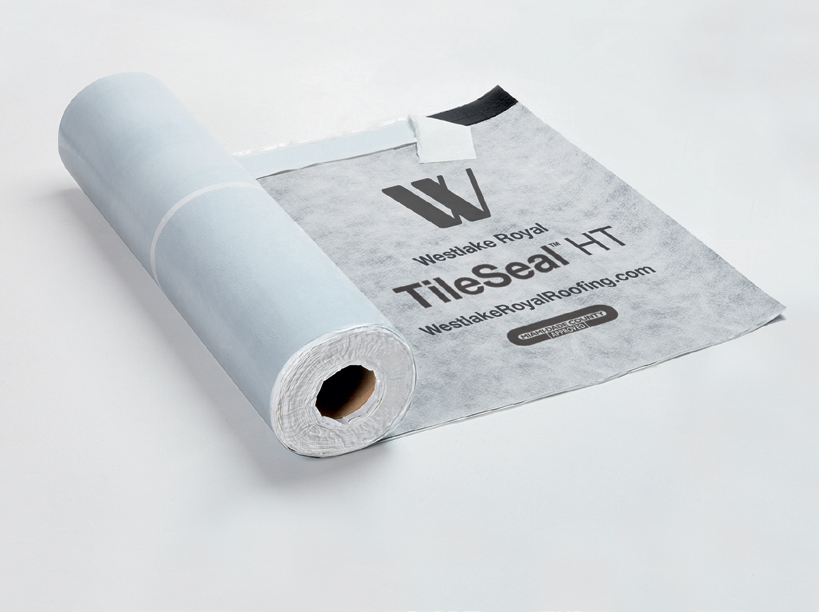
TileSeal HT protects the deck beneath your tile. Its approvals explain why the installed assembly matters more than the name on the roll.
Westlake Royal TileSeal HT
Self-adhered SBS underlayment
What belongs beneath your new roof?
Compare the underlayment and complete roof assembly for your home.
The short answer
TileSeal HT is worth considering for a Florida tile roof with an approved foam-set assembly. Its fabric surface, temporary exposure allowance and documented installation options are useful features. Ask which assembly is proposed: the same membrane has different uplift pressures depending on the deck, base sheet, primer and fastening. The highest number does not apply to every roof.
Beyond the name on the roll
What Westlake Royal TileSeal HT brings to the roof
Works with approved tile foams
The Florida evaluation lists AH-160, Tile Bond, StormBond and StormBond 2. The chosen tile and adhesive still need compatible attachment details. Listing a foam does not approve every paddy size or layout.
Extra protection below the tile
TileSeal HT bonds to an approved deck or base layer. Sealed laps and flashed openings help form a continuous secondary water barrier. Sound plywood and careful valley, wall and pipe details remain essential.
Heat resistance has limits
Westlake lists heat resistance up to 260°F. That does not establish a fire classification. Its current brochure excludes use in Wildland-Urban Interface and other designated wildfire-risk areas; confirm the property’s designation.
Two useful specifications
Thickness and wind resistance at a glance
Material thickness
64 mils
Nominal thickness · 0.064 inch · about 1.63 mm
The Florida evaluation lists 64 mils. Westlake’s brochure identifies this as nominal thickness; older 60-mil listings should not replace that value.
Assembly wind resistance
−97.5 to −210 psf
Listed allowable design pressures
The −210 psf Florida assembly requires its specified primed plywood construction. The NOA rows use different assemblies.
See the assemblies, installation and sources →Pressure ratings apply to the specific deck and installation listed in each approval. They are not wind speeds or a rating for the entire roof. Thickness alone does not determine wind resistance.
Does it fit your roof and your location?
Broward and Miami-Dade are in Florida’s High-Velocity Hurricane Zone (HVHZ). Palm Beach and Martin County are outside that zone. The applicable approval, roof covering and installation must agree.
Broward & Miami-Dade · HVHZ
NOA E(2)–E(8) and F(1) name TileSeal HT for mechanically fastened tile and listed foam-set tile assemblies, plus specified other coverings.
E(1) excludes tile. The covering approval and project design must also match.
Florida · inside and outside HVHZ
FL14317-R19 includes clay/concrete tile, metal and the other listed steep-slope coverings.
General substrate permission does not transfer a plywood pressure rating to OSB or ZIP sheathing.
See how M&M evaluates tile, underlayment, attachment and flashing together. Plan a complete tile roof →
What the approval actually measures
How much uplift can the approved assembly resist?
Negative psf measures allowable uplift suction. Compare the full construction beside each bar: these values do not rate the finished roof or predict hurricane wind speed.
Read these as assembly ratings, not wind speeds
These are allowable design pressures in pounds per square foot (psf), not miles per hour or a hurricane-category rating. A larger magnitude represents more allowable uplift for that listed assembly. It does not measure the entire roof or the tile foam alone. Your roof’s required pressures depend on its design and location.
Miami-Dade NOA · two approved tile-roof constructions
Different deck and base-sheet details. Use the complete selected system, without mixing approval rows.
Select a bar to see the deck, installation and source.
−97.5 psf
Deck: 19/32 in, PS1-19, 40/20 span rating, Grade C-D, Exposure 1, 4-ply or greater plywood or wood plank; supports 24 in o.c.; 0.113 in x 2-3/8 in ring-shank nails at 6 in o.c. along edges and intermediate supports.
Installation: SwiftAnchor base: one or more plies, minimum 4 in head/6 in end laps; approved nails/tin caps 6 in o.c. at laps and five field rows 6 in o.c. TileSeal HT: one or more plies, minimum 3 in head/6 in end laps; first course parallel to eave; roll fully. SBS mastic under end/non-selvage laps. Backnails: 0.120 in x 1-1/4 in annular ring-shank roofing nails, 32-gauge x 1-5/8 in tin caps, maximum 12 in o.c. No primer listed.
Limits: TileSeal HT only. The listed roof covering and attachment must be approved separately.
Miami-Dade NOA 25-0407.04, p. 10 — read the complete approval−172.5 psf
Deck: 19/32 in, PS2-18, 40/20 span rating, Grade C-D, Exposure 1, 4-ply or greater plywood or wood plank; supports 24 in o.c.; 0.113 in x 2-3/8 in ring-shank nails at 4 in o.c. along edges and intermediate supports.
Installation: Direct to deck, no base or primer listed. One or more TileSeal HT plies; minimum 3 in head/6 in end laps; first course parallel to eave; roll fully. SBS mastic under end/non-selvage laps. For tile, approved annular ring-shank backnails and tin caps at side laps maximum 12 in o.c., with none exposed.
Limits: TileSeal HT only. This deck has closer nail spacing than E(7). Roof-system capacity is separate.
Miami-Dade NOA 25-0407.04, p. 12 — read the complete approvalBars show the magnitude of the listed negative design pressure. The minus sign denotes uplift. Different decks and installation methods are separate assemblies.
Florida approval · a primed-plywood assembly
FL14317-R19 covers HVHZ and non-HVHZ use. D3 requires the specified plywood, primer and metal-cap backnailing.
Select a bar to see the deck, installation and source.
−210 psf

Deck: Minimum 15/32 in, 32/16 span-rated, 4-ply Exposure 1 plywood, DOC PS-1. Structural deck design is separate.
Installation: No base. Primer: Karnak #89 Sta-Tak Primer required. Selvage backnails 12 in o.c.: minimum No.12-gauge (0.105 in) corrosion-resistant ring-shank roofing nails, 3/8 in heads, 32-gauge x 1-5/8 in tin caps. Immediately steel-roll, minimum 75 lb; laps minimum 3 in side/6 in end.
Limits: Requires the named primer. This is not a rating for every primed deck.
FL14317-R19 / PRI ER 2458E01-FBC2023, p. 3 — read the complete approvalBars show the magnitude of the listed negative design pressure. The minus sign denotes uplift. Different decks and installation methods are separate assemblies.
Review attachment data separately from the underlayment pressure chart. Compare tile-foam approvals →
Material testing · Source checked October 27, 2026
Beyond wind pressure: how does the sheet perform?
Tear resistance, tensile strength and vapor permeance describe different jobs. Here is what the reviewed documents actually report for Westlake Royal TileSeal HT.
Tear resistance
Number not publishedHow well the sheet resists a tear spreading. Test methods can pull or tear the material in very different ways.
ASTM D1970 compliance only
No measured value in reviewed documents
Tear resistanceNot published in the reviewed sources
The approval confirms standards compliance, but the reviewed documents do not provide a measured tear result.
Florida Product ApprovalFL14317-R19 / PRI ER2458E01-FBC2023 · p1
Tensile strength
Number not publishedHow much pulling force the sheet carries before reaching its reported maximum load. This is a material test, not a roof uplift rating.
ASTM D1970 compliance only
No measured value in reviewed documents
Tensile / maximum loadNot published in the reviewed sources
The approval confirms standards compliance, but the reviewed documents do not provide a measured pulling-strength result.
Florida Product ApprovalFL14317-R19 / PRI ER2458E01-FBC2023 · p1
Vapor permeance
Number not publishedHow readily water vapor passes through the sheet. A lower perm value means less vapor passes through; it does not automatically mean a better roof.
Not stated for a numerical permeance measurement
No measured value in reviewed documents
Vapor permeanceNot published in the reviewed sources
The approval describes a vapor barrier, but the reviewed documents do not provide a measured perm value.
Florida Product ApprovalFL14317-R19 installation/ventilation provisions · p5
What the NOA and Florida approval establish
NOA 25-0407.04 and FL14317-R19 establish ASTM D1970/TAS103 compliance and assembly-specific wind resistance, without publishing numeric tear, tensile or permeance values. PRI ER1378E04 separately confirms physical-properties testing without results. No current official numerical fallback was found.
- Miami-Dade NOA 25-0407.04, product descriptions/evidence · p2
- FL14317-R19 / PRI ER2458E01-FBC2023 · p1
- PRI ER1378E04, physical properties · p6
The approval determines permitted uses and installation. Where it does not publish these laboratory values, the cards identify the original manufacturer sheet as the source. A manufacturer value is not relabeled as an NOA test result.
How to compare these numbers
MD means the direction along the roll; CD or XMD means across it. Match the method, units, direction, conditioning and whether a figure is a minimum, maximum or typical result. A published minimum is a floor—not proof of a product’s highest strength.
Use the exact approved assembly for wind-pressure comparisons. Vapor permeance is a roof-design consideration, and M&M’s installation experience adds context to the laboratory figures.
Compare underlayment options for your roof →The details worth discussing before installation


What should the installation plan include?
The Florida report requires minimum 2:12 slope, a clean, dry, sound substrate, and application at 40°F or above unless the manufacturer is consulted. The covering may require a steeper slope. The plotted Florida assembly requires immediate rolling with a minimum 75-pound steel roller.
Can the crew stack tile directly on it?
Only specifically listed Florida systems allow direct loading of ten-tile stacks through 6:12 slope. Other conditions require battens. Ask for a loading plan matching the selected assembly; the product’s general description is not the complete instruction.
What does the warranty tell me?
Westlake advertises a 30-year limited manufacturer warranty. Request the terms; it is not a promise of 30 leak-free years. Keep the approval, installation scope and workmanship warranty with the home’s records.
What should be named in your estimate?
A useful proposal identifies the materials and the installation that will be inspected—not simply “underlayment included.” Ask for:
- TileSeal HT approval number and exact assembly.
- Deck repairs, base sheet or primer, and fastening details.
- Tile/foam compatibility, flashing and loading plan.
- Manufacturer and workmanship warranty terms.
Choose the layers together
M&M Roofing can help you compare underlayment options with the roof covering, deck condition and attachment your project needs.
Plan my roof replacement →Homeowner questions about Westlake Royal TileSeal HT
Is TileSeal HT approved for AH-160 foam?
Yes, the current Florida evaluation lists AH-160. The tile profile, foam application and attachment design must also meet their approvals. Compatibility does not establish one universal bond strength.
Does 180 days mean I should leave it uncovered?
No. Complete the roof promptly and check the membrane before covering. The 180 days is a maximum temporary allowance. Citadel Pro, if used below it, has a separate 30-day limit.
Is TileSeal HT suitable for a wildfire-designated area?
Westlake’s September 2026 brochure says it is not approved or recommended for Wildland-Urban Interface or other designated wildfire-risk areas. Confirm the property’s designation before selecting it; a covering’s fire classification does not remove that exclusion.
Your roof, your approved assembly
Get a roof estimate with the details included
Tell M&M Roofing about your home and the roof covering you are considering.
Start with the approvals
The NOAs and Florida Product Approval reports are the primary evidence for the installation limits and ratings above. Manufacturer literature provides the additional product and warranty information. These documents describe approved conditions; they are not endorsements.
- Primary approval: Miami-Dade County NOA 25-0407.04 · approved November 27, 2025 · expires August 2, 2028
Assembly pages 4–12; limitations page 13. Current record reports File Approved. - Primary approval: Florida approval FL14317-R19 · approved July 18, 2025
2023 FBC; approved inside and outside HVHZ; current record is not archived. - Evaluation report: PRI ER 2458E01-FBC2023 · July 8, 2025
Pressure tables pages 2–4; installation and compatibility pages 5–6. - Manufacturer: Westlake Royal TileSeal HT product information
Product description and limited warranty; reviewed October 26, 2026. - Manufacturer brochure: TileSeal HT brochure · September 2026
Original product imagery; 260°F heat statement p. 3; WUI exclusion p. 4.
Technical summaries help compare proposals. The full current documents and the project’s approved plans control installation.