
Material review · Granulated self-adhered underlayment
APOC Weather-Armor SB-1: a closer look beneath the shingles
Where this self-adhered water barrier fits, what its −135 psf assembly rating means, and why tile and metal require different conversations.
APOC Weather-Armor SB-1
Granulated self-adhered underlayment
What belongs beneath your new roof?
Compare the underlayment and complete roof assembly for your home.
The short answer
At M&M Roofing, Weather-Armor SB-1 is one of the self-adhered underlayments we sometimes use beneath shingle roof systems. Our use of SB-1 is limited to shingle roofs. We install it directly to the wood roof deck, where it serves as a secondary water barrier beneath the shingles—an extra layer of protection if shingles are damaged or lost. Its performance depends on the approved deck, laps and installation. The −135 psf rating below applies to a specific underlayment assembly.
Planning a new shingle roof? Explore our shingle roofing service to see how the underlayment fits into the complete roof replacement.
What the approval actually measures
How much uplift can the approved assembly resist?
The NOA offers one numbered uplift-pressure assembly for SB-1. Other prescriptive systems in the same document should not be assigned this number automatically. The Florida evaluations separately list −135 psf assemblies with their own conditions.
Read these as assembly ratings, not wind speeds
These are allowable design pressures in pounds per square foot (psf), not miles per hour or a hurricane-category rating. A larger magnitude represents more allowable uplift for that listed assembly. It does not measure the entire roof or the tile foam alone. Your roof’s required pressures depend on its design and location.
Miami-Dade NOA 25-0910.02 · wood deck
System F(4), page 13. This is an underlayment assembly value, not a whole-roof rating.
Select a bar to see the deck, installation and source.
−135 psf
Deck: CAT 19/32, PS1-19, 40/20 span-rated, Grade C-D, Exposure 1, four-ply plywood. Attached to 2× wood supports at 24 inches on center with 0.113 × 2⅜-inch ring-shank nails at 4 inches on center along edges and intermediate supports.
Installation: SB-1 self-adhered with 3½-inch side laps. This system does not specify a separate anchor sheet or primer; all general limitations and applicable manufacturer instructions still apply.
Limits: Tile is excluded. The covering and complete roof system require their own approval. Do not substitute a different deck or attachment schedule while retaining this value.
NOA 25-0910.02, System F(4), p13 — read the complete approvalBars show the magnitude of the listed negative design pressure. The minus sign denotes uplift. Different decks and installation methods are separate assemblies.
For a metal project, compare a dedicated high-temperature underlayment and its approved assemblies. Polystick MTS PLUS review →
Material testing · Source checked October 27, 2026
Beyond wind pressure: how does the sheet perform?
Tear resistance, tensile strength and vapor permeance describe different jobs. Here is what the reviewed documents actually report for APOC Weather-Armor SB-1.
Tear resistance
Numeric specificationHow well the sheet resists a tear spreading. Test methods can pull or tear the material in very different ways.
ASTM D1970 · lbf/in
Manufacturer-reported lower limit
APOC reports more than 60 lbf/in in both directions. This is a published threshold, not the exact force at which the sheet tears. The source’s lbf/in unit is retained.
Manufacturer technical data sheetAPOC SB-1 technical data sheet (D26 filename; C25 printed footer) · p1
Tensile strength
Numeric specificationHow much pulling force the sheet carries before reaching its reported maximum load. This is a material test, not a roof uplift rating.
ASTM D1970 · lbf/in
Manufacturer-reported lower limit
APOC calls this maximum load. Both directions exceed the listed 50 lbf/in threshold; the sheet does not give the exact breaking load.
Manufacturer technical data sheetAPOC SB-1 technical data sheet (D26 filename; C25 printed footer) · p1
Vapor permeance
Numeric specificationHow readily water vapor passes through the sheet. A lower perm value means less vapor passes through; it does not automatically mean a better roof.
ASTM E96 · perms
Manufacturer-reported typical figure
The reported 0.05 perms indicates low vapor passage. The sheet does not identify the E96 cup method or test conditions, which matter when comparing products.
Manufacturer technical data sheetAPOC SB-1 technical data sheet (D26 filename; C25 printed footer) · p1
What the NOA and Florida approval establish
NOA 25-0910.02 and FL26482-R12 document product identity, standards/testing and installation/assembly-pressure requirements. They do not publish numeric tear resistance, tensile/maximum-load or vapor-permeance results for these products. The material values shown here come from currently linked official manufacturer technical data sheets, not from approval tables.
- Miami-Dade NOA 25-0910.02: product descriptions and evidence · p3
- FL26482-R12 HVHZ: standards, references and product descriptions · p2
- FL26482-R12 non-HVHZ: standards, references and product descriptions · p2
The approval determines permitted uses and installation. Where it does not publish these laboratory values, the cards identify the original manufacturer sheet as the source. A manufacturer value is not relabeled as an NOA test result.
How to compare these numbers
MD means the direction along the roll; CD or XMD means across it. Match the method, units, direction, conditioning and whether a figure is a minimum, maximum or typical result. A published minimum is a floor—not proof of a product’s highest strength.
Use the exact approved assembly for wind-pressure comparisons. Vapor permeance is a roof-design consideration, and M&M’s installation experience adds context to the laboratory figures.
Compare underlayment options for your roof →Beyond the name on the roll
What APOC Weather-Armor SB-1 brings to the roof
A secondary water barrier beneath the shingles
M&M installs SB-1 directly to the wood roof deck under our shingle systems. Fully bonded coverage helps keep water from reaching the sheathing if shingles are damaged or blown off. Properly sealed laps, edges and roof openings complete that backup layer.
Why M&M likes SB-1 for shingle roofs
At M&M Roofing, we consider APOC Weather-Armor SB-1 a high-quality, cost-efficient peel-and-stick underlayment for shingle roofs. It has both Miami-Dade NOA documentation and Florida Product Approval. We use it on shingle projects in the High-Velocity Hurricane Zone (HVHZ)—Broward and Miami-Dade counties—and outside that zone when it fits the approved roof assembly.
Not interchangeable with tile membranes
The approval explicitly excludes tile. Buying another APOC product or selecting a stronger tile foam does not change that restriction; a tile project needs an underlayment approved for that use.
Does it fit your roof and your location?
Broward and Miami-Dade are in Florida’s High-Velocity Hurricane Zone (HVHZ). Palm Beach and Martin County are outside that zone. The applicable approval, roof covering and installation must agree.
Broward & Miami-Dade · Miami-Dade NOA path
Shingles, wood shakes/shingles, quarry slate and specified metal applications; no tile.
System F(4) lists metal, and F(1) expressly lists non-structural metal. Confirm the panel system, heat compatibility and complete approved assembly before specifying SB-1 beneath metal.
Florida evaluation path · HVHZ and non-HVHZ
Shingles, slate and wood coverings; no tile or metal in Table 2.
The Florida tables differ from the newer NOA. An estimate should name the exact approval path; it should not mix the allowed uses of one document with the installation from another.
Replacing a shingle roof? Compare the water barrier with the complete roofing scope. Shingle roofing options →
The details worth discussing before installation
How thick is SB-1?
APOC Weather-Armor SB-1 has a nominal thickness of 60 mils—0.060 inch, or about 1.5 mm. Both Florida Product Approval evaluations, covering HVHZ and non-HVHZ areas, list this thickness in Table 1 on page 3.
FL26482-R12 HVHZ evaluation, Table 1, p3; non-HVHZ evaluation p3 also lists 60 mils
Why direct-to-deck installation matters
For the shingle roofs where we use SB-1, M&M adheres the membrane directly to the wood decking. This creates a secondary water barrier beneath the shingles, helping protect the home if the outer roof covering is damaged or lost. The membrane, laps and transitions must follow the selected approved installation.
Miami-Dade NOA 25-0910.02 identifies SB-1 as an ASTM D1970 polymer-modified asphalt membrane, and the Florida approval includes direct-to-deck installations. Florida’s current wind-mitigation inspection form lists fully adhered ASTM D1970 polymer-modified bitumen underlayment as a sealed roof deck/secondary water resistance (SWR) method. Together, these documents support that description for properly installed, full-deck SB-1 coverage. Keep installation photos and product records so a qualified inspector can document the feature; the insurer determines any applicable credit.
Florida OIR-B1-1802, revised April 2026, item 8; see NOA p3 and FL26482-R12 HVHZ pp5–6 below
What does the Florida pressure table add?
The HVHZ report calls its −135 psf installation UDL-1; the non-HVHZ report calls it UDL-2. Both specify 19/32-category APA 40/20, Exposure 1, PS1 plywood, no primer, no joint treatment, no base ply, and self-adhered SB-1 with 3½-inch side laps. Neither permits tile. These are allowable pressures with the report’s safety factor already applied.
How long can it stay uncovered?
The current NOA limits SB-1 exposure to 90 days. The Florida reports also give a 90-day ceiling, subject to the lesser manufacturer limit. Treat that as a maximum construction exposure—not a suggested delay or a promise that an unfinished roof is weatherproof for three months. Ask how the roofer will protect and inspect the dry-in before the shingles go on.
Is it a high-temperature metal underlayment?
The product name alone does not establish that. The NOA and Florida evaluation use different roof-cover lists. A metal proposal should identify the selected approval and panel assembly and confirm the product’s temperature compatibility. For a roof that specifically needs a high-temperature membrane, compare a dedicated metal-underlayment option instead of relying on a broad supplier description.
What should happen before the roll is installed?
APOC calls for a sound, clean and dry deck. A bonded membrane cannot repair rotten sheathing or make weak deck attachment adequate. Ask the contractor to document deck repairs, preparation and flashing details before the water barrier hides them. The manufacturer’s instructions supplement the approval; they do not remove its restrictions.
What should be named in your estimate?
A useful proposal identifies the materials and the installation that will be inspected—not simply “underlayment included.” Ask for:
- The full Weather-Armor SB-1 name and the approval system used for your roof covering.
- The deck type, deck fastening, membrane laps and any required preparation or backnailing.
- The proposed covering and its separate attachment requirements, especially on a metal roof.
- The planned dry-in duration and the actual product and workmanship warranty terms.
Choose the layers together
M&M Roofing can help you compare underlayment options with the roof covering, deck condition and attachment your project needs.
Plan my roof replacement →Continue comparing roof materials

Polystick MTS PLUS review
For a metal project, compare a dedicated high-temperature underlayment and its approved assemblies.
Homeowner questions about APOC Weather-Armor SB-1
Can SB-1 go beneath a tile roof?
The current NOA and Florida evaluations reviewed here exclude tile for SB-1. Do not use its −135 psf number as permission for tile. Select an underlayment whose approval includes the proposed tile and attachment method.
Does −135 psf mean a 135 mph wind rating?
No. Pounds per square foot measures pressure, not wind speed. The value describes one installed underlayment assembly. Required roof pressures also depend on the building geometry, exposure, location and roof zone.
Can I simply ask for “APOC peel-and-stick”?
Ask for the exact product and assembly. SB-1 and Eagle Armor have different surfaces, permitted coverings and attachment combinations. A brand name by itself does not tell you which system is being installed.
Your roof, your approved assembly
Get a roof estimate with the details included
Tell M&M Roofing about your home and the roof covering you are considering.
Start with the approvals
The NOAs and Florida Product Approval reports are the primary evidence for the installation limits and ratings above. Manufacturer literature provides the additional product and warranty information. These documents describe approved conditions; they are not endorsements.
- Primary approval: Miami-Dade NOA 25-0910.02 — approved March 5, 2026; expires March 28, 2028
Gardner underlayments; product-specific assemblies and limitations. Consult the full document. - Florida Product Approval: FL26482-R12 — HVHZ evaluation, August 20, 2025
Nominal 60-mil SB-1 thickness in Table 1, p3. Roof-cover options p4; pressure assemblies p5; exposure limits p6. - Florida Product Approval: FL26482-R12 — non-HVHZ evaluation, August 20, 2025
Nominal 60-mil SB-1 thickness in Table 1, p3. Roof-cover options p4; pressure assemblies pp5–6. Applies outside the HVHZ. - Official status record: FL26482-R12 — official approved application
2023 code cycle; application status Approved when checked October 26, 2026. - Official wind-mitigation guidance: Florida OIR-B1-1802 — revised April 2026, item 8, p3
Lists fully adhered ASTM D1970 polymer-modified bitumen underlayment as a sealed roof deck/SWR method. Documentation requirements appear on p1; insurance credits depend on the verified home and policy. - Manufacturer literature: APOC SB-1 technical data sheet, D26
Product construction, preparation and application guidance. - Manufacturer literature: APOC Weather-Armor SB-1 product page
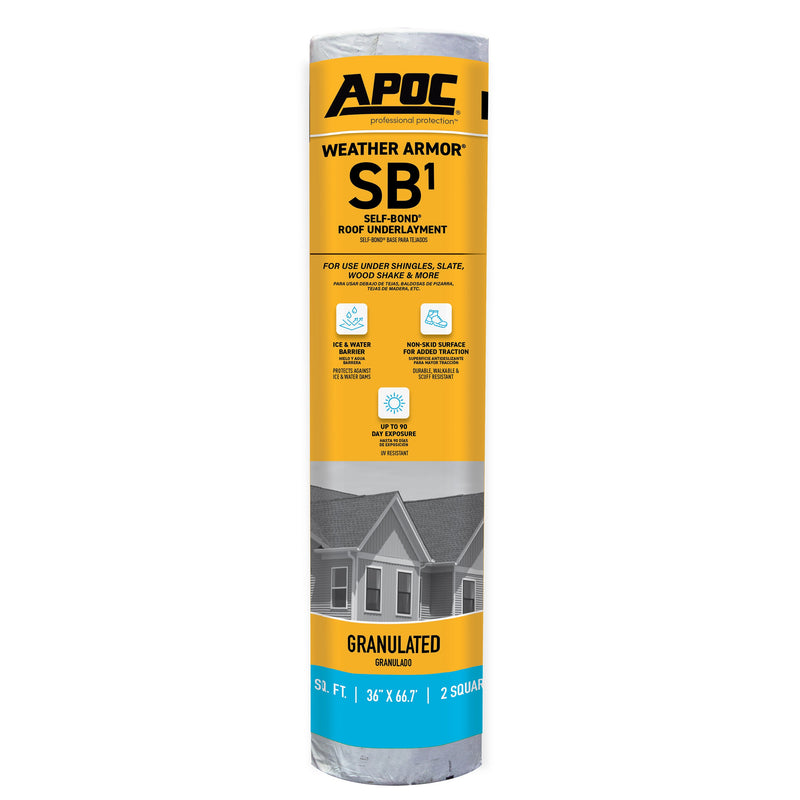
Original product photo and product identity.
Technical summaries help compare proposals. The full current documents and the project’s approved plans control installation.