
M&M contractor verdict
A dependable, budget-conscious option when the complete felt assembly is specified correctly
#30 felt remains a practical underlayment beneath compatible asphalt shingle roofs. In Florida, the meaningful choice is not simply “felt or no felt.” It is the approved system: qualifying double coverage, or taped roof-deck seams followed by one approved felt layer. We prefer full-deck peel-and-stick when the permitted assembly, deck and homeowner priorities support it, but properly installed felt remains a valid option.
- M&M verdict
- A practical shingle-roof underlayment when the full assembly is approved
- Florida felt paths
- Qualifying double coverage or taped deck seams plus one approved layer
- Attachment
- Roofing nails through approved caps; M&M commonly uses round metal tin caps
- SWR warning
- One untaped felt layer is not a Sealed Roof Deck/SWR method
Current Florida pathways
Double Coverage or Seam Tape Plus One Felt Layer
Florida's Eighth Edition code gives multiple underlayment routes for asphalt shingles. For #30 felt, these are the two methods a homeowner is most likely to see in a proposal; full-deck ASTM D1970 peel-and-stick is the principal alternative.
Deck-joint tape + one felt layer
Cover every roof-deck joint with qualifying self-adhering membrane strip or Level 3 flashing tape, then install one approved felt layer over the full roof.
May qualify as Sealed Roof Deck/SWR when the materials, installation and evidence meet the current form.
The joint tape is concealed by the felt, so photos before the field layer goes down are essential.
Double-layer felt coverage
Begin with a half-width starter course at the eave, then overlap successive full-width courses by roughly half their width plus the code-required allowance; end laps and fastening follow the approved assembly.
The current 04/26 form separately recognizes two qualifying felt or synthetic layers without seam tape.
Two layers do not mean two unrelated full dry-ins stacked at random; the staggered-course pattern is part of the method.
Full-deck ASTM D1970 peel-and-stick
Apply an approved self-adhering polymer-modified bitumen underlayment across the prepared deck under the shingles.
This is the fully adhered Sealed Roof Deck/SWR pathway when verified and documented.
This is the main alternative compared in this review, not a #30 felt installation.
See the Two #30 Felt Methods
These FEMA reference diagrams make the concealed layers easier to understand. The first shows tape over every sheathing joint with one felt layer above it; the second shows the staggered overlap pattern used to create double coverage.
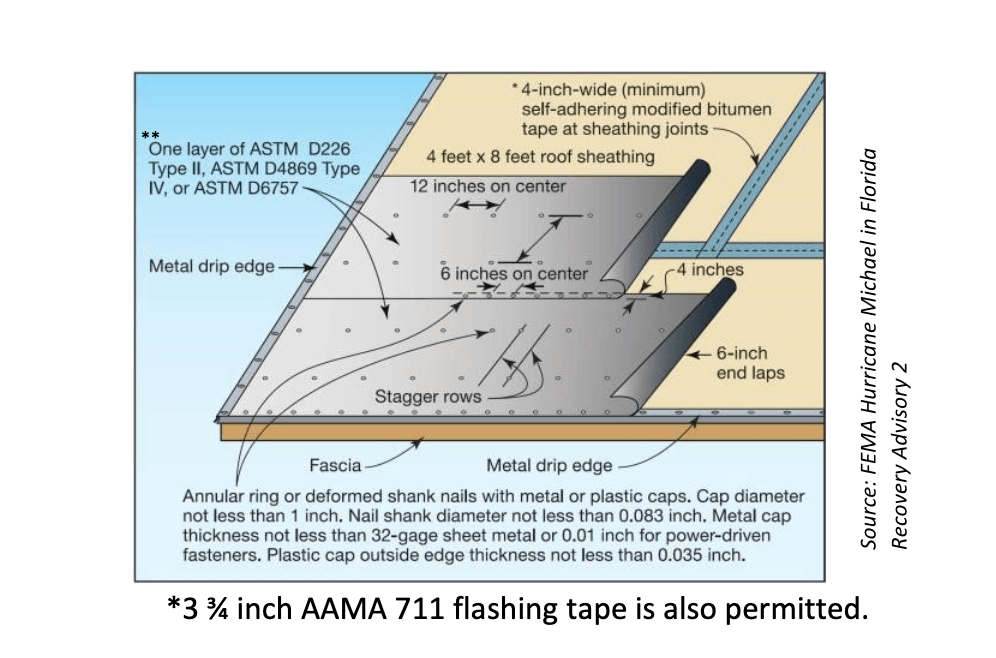
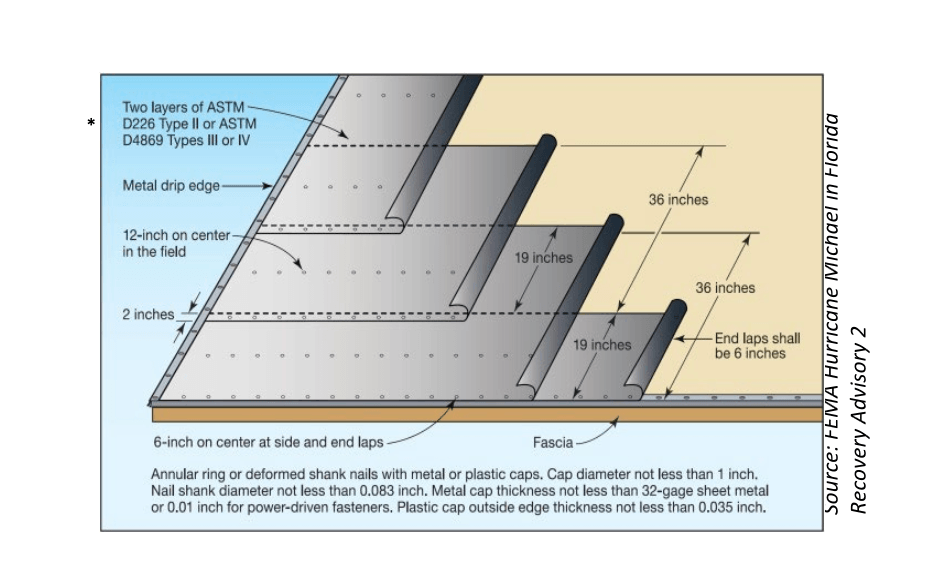
Reference: FEMA's Hurricane Michael in Florida Mitigation Assessment Team Report. The current permitted Florida assembly and product approvals still control the work.
One untaped felt layer is the key nonqualifying case
A single mechanically fastened felt layer with no qualifying tape over the roof-deck joints is not one of the Sealed Roof Deck/SWR methods on the current OIR-B1-1802 form. However, a qualifying double-layer felt system can now be recognized without seam tape. An authorized inspector documents the feature, and the insurer—not the underlayment manufacturer or roofer—determines any premium credit.
This summary is based on the Florida Building Code, Eighth Edition (2023), effective December 31, 2023, and insurance materials current on September 2, 2026. Miami-Dade and Broward are in the HVHZ; the applicable HVHZ provision, product approvals, roof-covering instructions and local authority having jurisdiction control each permit.
If the roof work follows storm damage, our Florida roof insurance claim guide explains how permits, photographs, estimates and inspection records fit into the broader claim process.
Mechanical attachment
Roofing Nails and Tin Caps Hold the Felt in Place
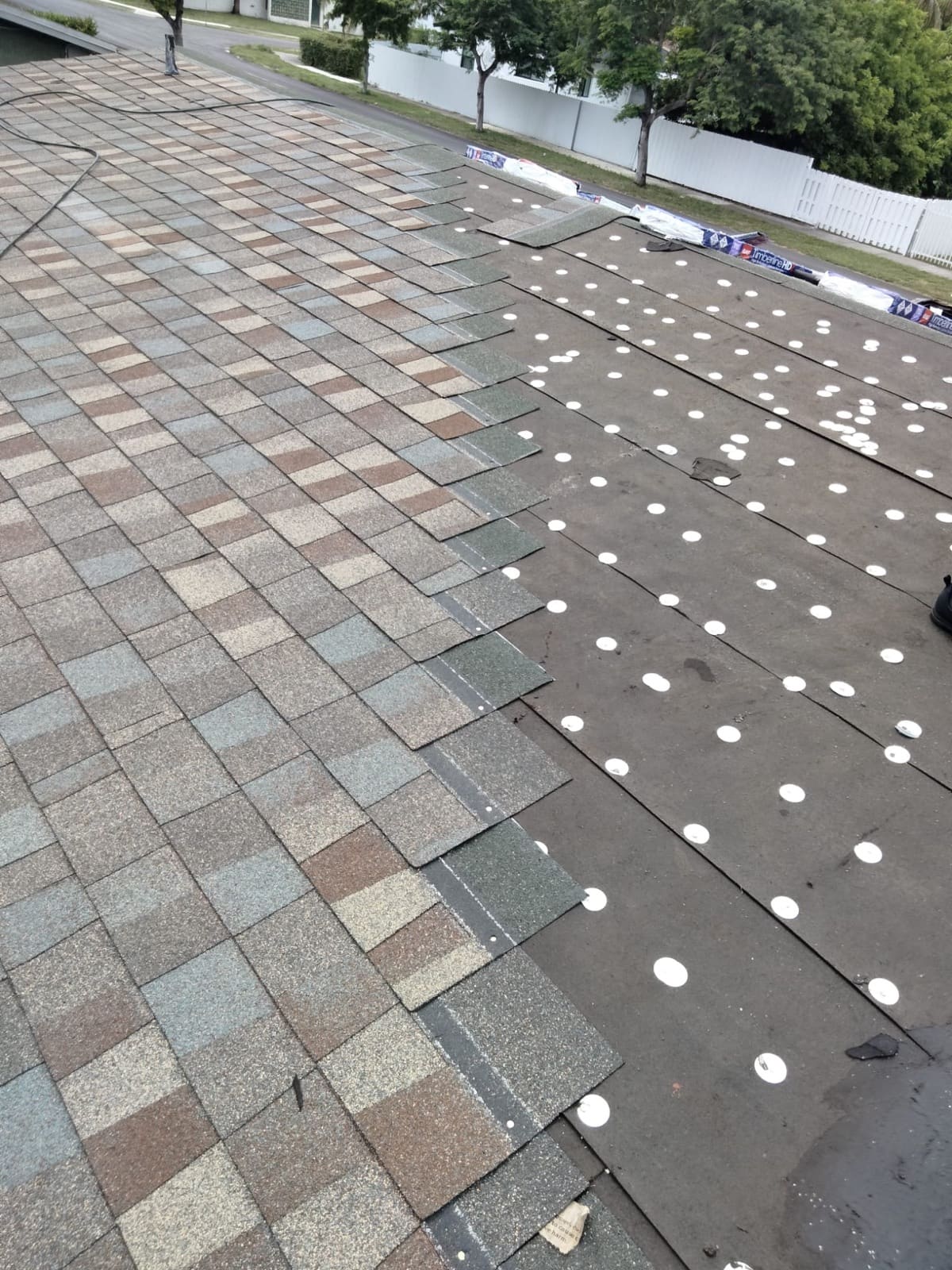
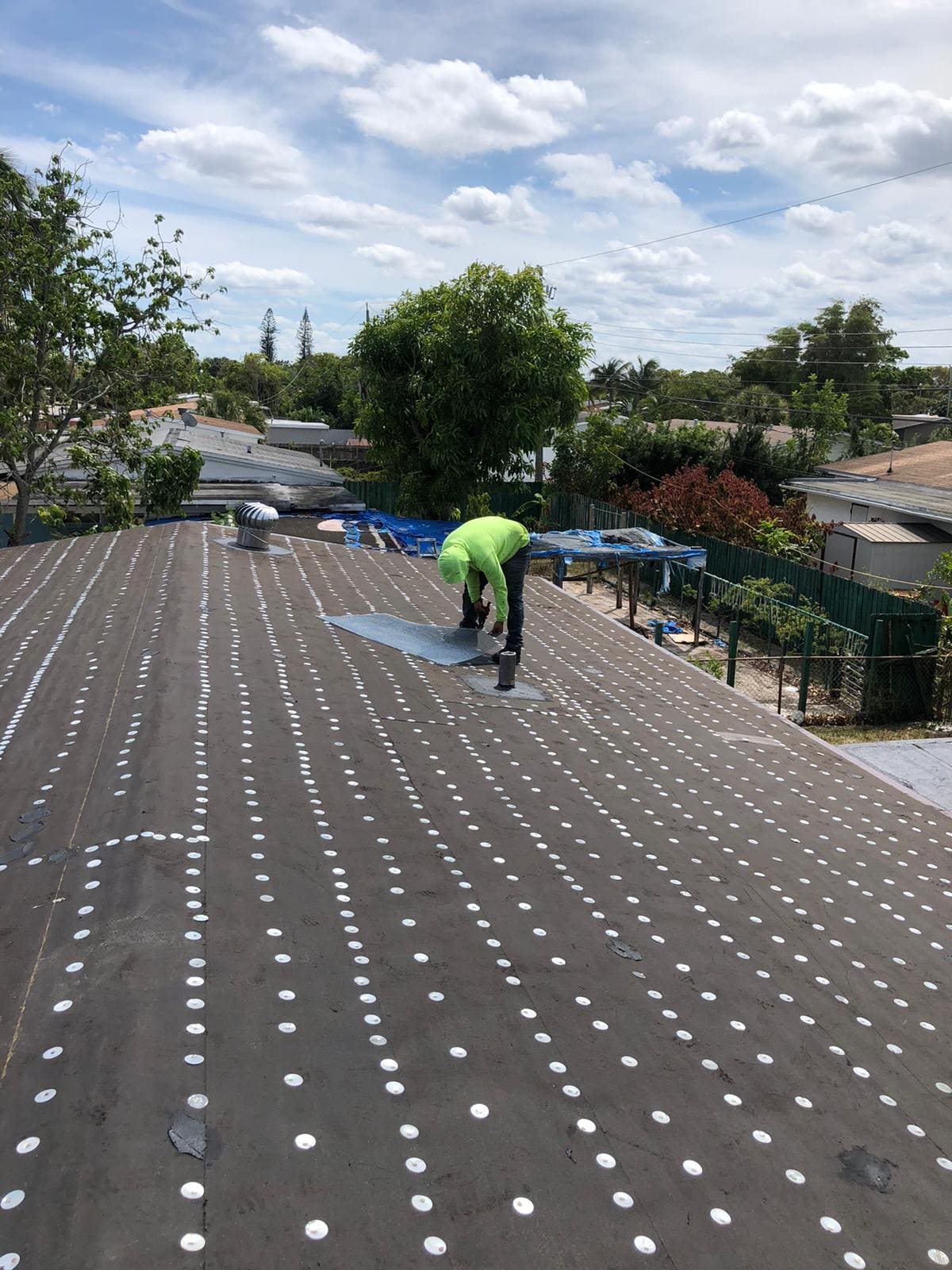
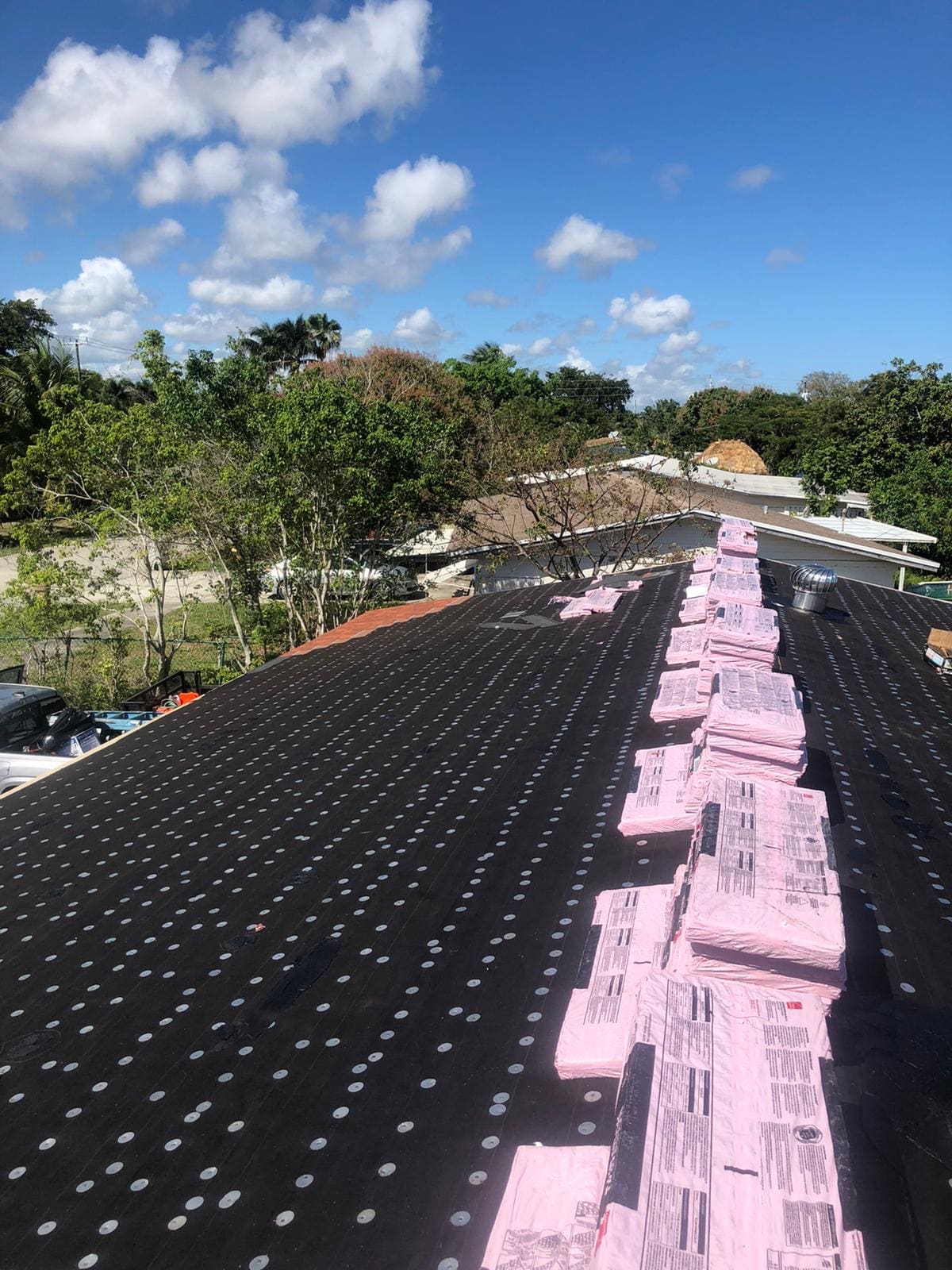
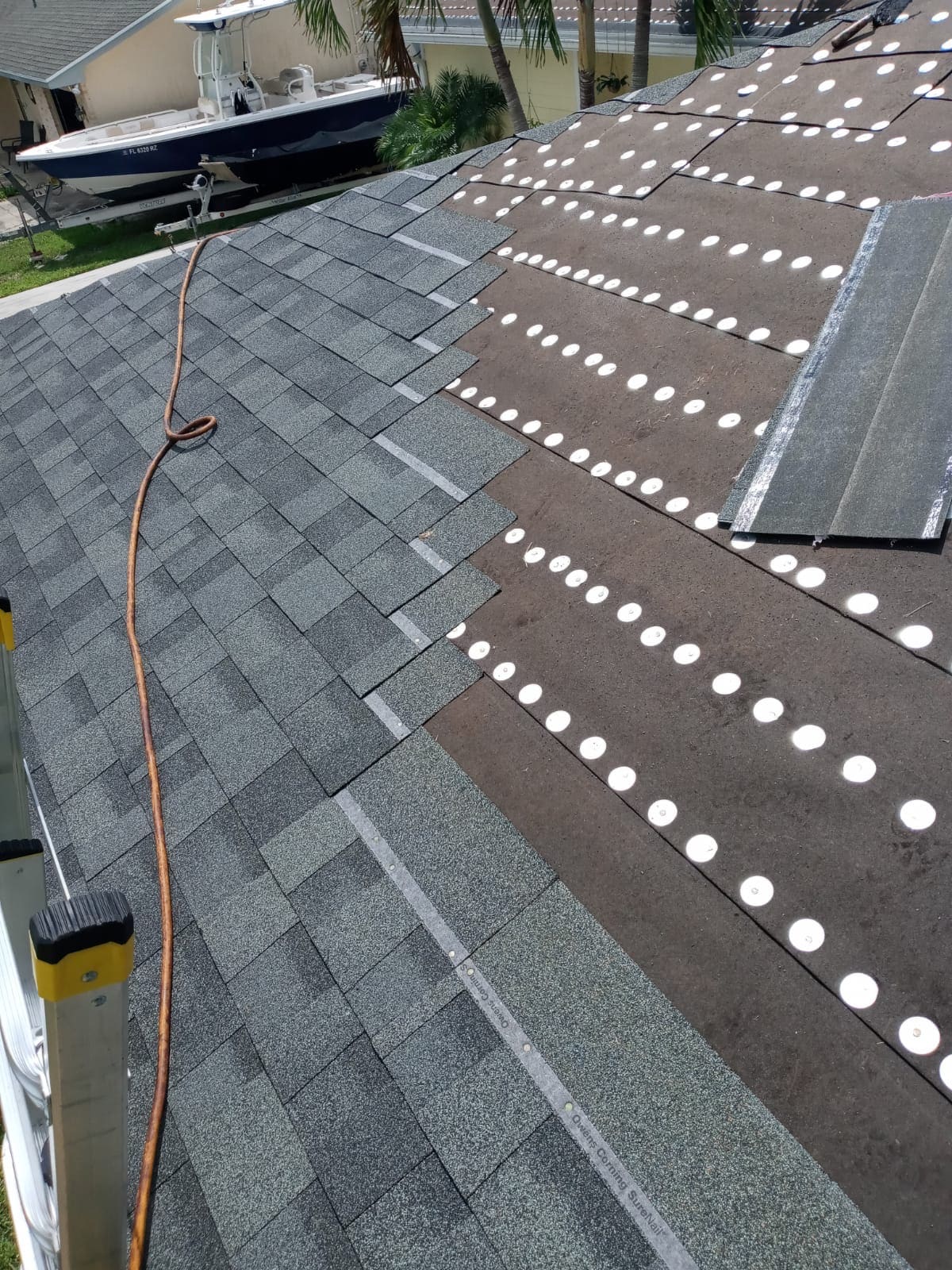
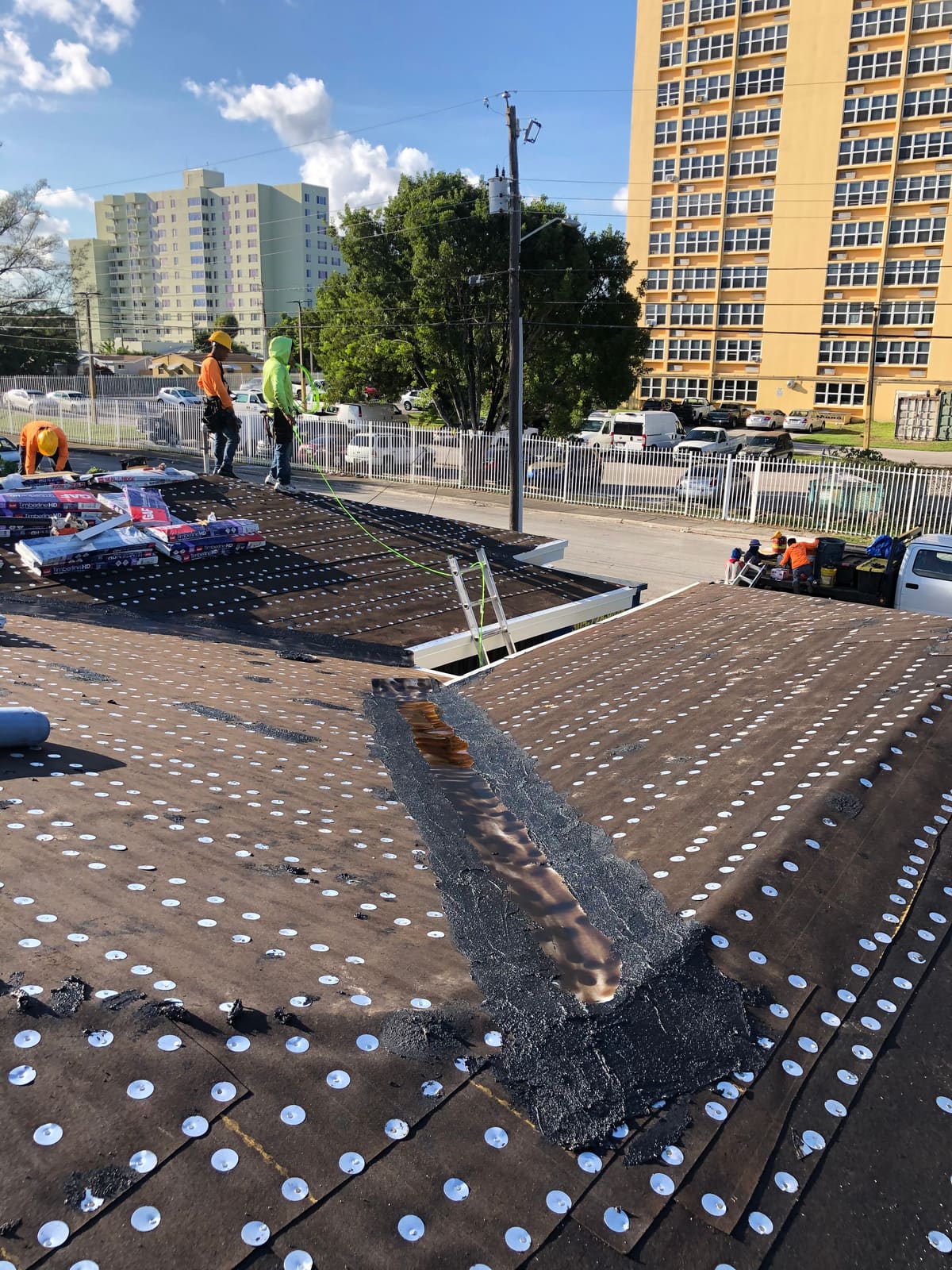
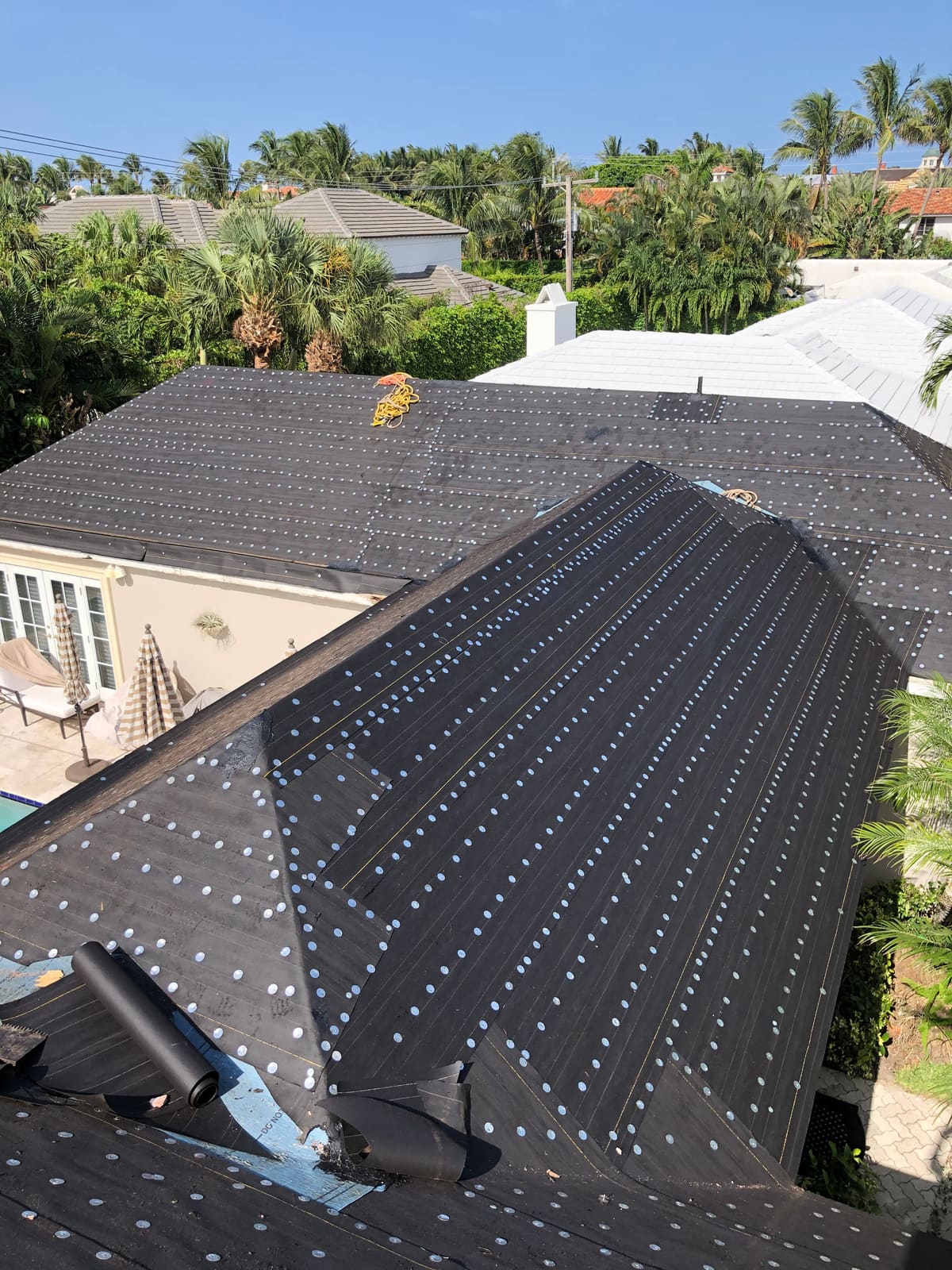
#30 felt is installed in overlapping courses with approved corrosion-resistant roofing nails driven through cap fasteners. The round metal “tin caps” visible in M&M's photos spread the holding force over a wider area than a nail head alone.
What the caps do
Approved caps distribute the clamping area and help keep the sheet from pulling over the fastener head. They are part of the tested or approved fastening system—not decorative washers.
What a photo cannot prove
A dense pattern does not automatically mean the assembly is compliant. Nail shank, cap gauge and diameter, deck penetration, field spacing, lap spacing and roof-slope rules must all match the approved system.
See how the underlayment and finished shingles come together in our Deerfield Beach asphalt shingle roof case study.
#30 Felt vs. Peel-and-Stick Under Asphalt Shingles
Neither label alone decides the quality of a roof. Compare the complete permitted assembly, the deck condition and ventilation, the documentation plan and the homeowner's priorities.
| Factor | #30 felt | ASTM D1970 peel-and-stick |
|---|---|---|
| Connection to the deck | Mechanically attached in lapped courses. The sheet is held by approved roofing nails and caps rather than bonded across its entire underside. | Adhesive bonds across an approved clean, dry deck after the release film is removed and pressure is applied. |
| Florida code pathway | Use the qualifying double-layer method or tape all deck joints and cover them with one approved felt layer. Product and assembly approvals still control. | An approved ASTM D1970 membrane can be installed across the entire deck under compatible asphalt shingles. |
| SWR treatment on the current form | Taped seams plus felt may qualify, and a qualifying two-layer felt system may also qualify. One untaped standard layer does not. | A fully adhered ASTM D1970 system is a listed SWR method when the installed condition is documented and verified. |
| Fastener penetrations | The installation intentionally uses many capped fasteners. Correct nail, cap, spacing, laps and deck penetration are critical. | The membrane is self-adhered, though shingles and some approved assemblies still introduce mechanical fasteners through it. |
| Deck preparation | The deck must still be sound and properly prepared, but the field sheet is not dependent on full-surface adhesive contact. | Full contact depends heavily on a clean, dry, smooth and compatible substrate and the manufacturer's temperature limits. |
| Typical project tradeoff | Usually the lower material-cost option, but compliant double coverage or seam taping adds labor and materials. | Usually higher material cost and more demanding preparation, with a continuous bonded water-resistive layer at the deck. |
| Future reroof considerations | Mechanically fastened felt is generally easier to separate from wood decking during tear-off. | A fully bonded membrane can be more difficult to remove; the next permitted reroof assembly must address the existing condition. |
M&M field evidence
What #30 Felt Looks Like During a Shingle Roof Installation
These are authentic M&M jobsite photos. They show the felt, tin-cap fastening, roof transitions and shingles in progress; they are not substitutes for the permit documents or concealed seam-tape photos needed to verify a specific SWR method.
Benefits and Tradeoffs
Where #30 felt makes sense
- Long-established and familiar installation method for asphalt shingle assemblies
- Mechanically fastened courses allow the installer to see and correct laps as work progresses
- Usually lower material cost than full-deck peel-and-stick
- Can support a current SWR pathway when installed as qualifying taped-seam or double-layer coverage
- Generally less bonded to the deck for a future tear-off
Where the assembly needs care
- A single untaped layer does not qualify as a Sealed Roof Deck/SWR method on the current form
- It relies on many nail-and-cap penetrations and exact fastening discipline
- It is a concealed water-shedding layer, not a finished waterproof roof
- Wind, slope, HVHZ and product-approval rules can change the required laps and fastening
- The words #30 felt alone do not prove the roll meets ASTM D226 Type II or the permitted assembly
Underlayment is only one part of choosing a roofing system. Compare material lifespan, appearance and maintenance in our South Florida roof-material guide and review how long each roof type typically lasts.
Installation controls
What a Good #30 Felt Installation Requires
The visible felt is only one component. The labeled product, roof-deck preparation, chosen Florida pathway, laps, capped fastening and flashing details must work together.
- 1Confirm that the exact felt is labeled to a qualifying standard—such as ASTM D226 Type II—and is listed for the permitted shingle assembly.
- 2Repair or renail unsuitable decking and complete any required deck-joint tape before the tape is concealed.
- 3Start at the eave and install each course shingle-fashion so upper courses shed water over lower courses.
- 4Maintain the side laps, end laps and stagger required for the roof slope and selected code method.
- 5Use approved corrosion-resistant roofing nails and caps; in M&M's pictured installations, round metal tin caps spread the holding force over the felt.
- 6Follow the assembly-specific field and lap fastening pattern instead of estimating spacing from a photo.
- 7Complete valleys, penetrations, flashing and transitions with their own approved details before the shingles conceal the dry-in.
- 8Photograph product labels, deck joints, every SWR layer and the finished dry-in for the permit and future insurance inspection.
Insurance distinction
Code Compliance and an SWR Credit Are Different Questions
A roof can meet its permitted code assembly without producing the evidence needed for a Sealed Roof Deck/SWR entry. Conversely, the underlayment method still has to satisfy code even when it matches a category on the insurance form.
The current OIR-B1-1802 recognizes taped deck seams with felt or synthetic, qualifying double-layer felt or synthetic, and fully adhered ASTM D1970 membrane as separate SWR methods. It does not promise a fixed discount. The authorized inspector verifies the feature, and the insurer applies its filed rating plan.
Homeowners preparing for storm season can also use our hurricane roof-damage checklist to document the roof before and after severe weather.
Save evidence before shingles hide the work
Underlayment and deck-joint tape are hard to verify after the roof is complete. Create a clear record while each layer is open.
- Photos of the exposed deck before underlayment
- Photos of qualifying tape over every deck joint, if using the taped-seam method
- Photos clearly showing both felt layers and the staggered installation, if using double coverage
- Product wrappers or roll labels identifying the material standard
- Roof permit, product approvals, final inspection and contract or invoice
- A completed current OIR-B1-1802 inspection from an authorized inspector
Still budgeting the complete replacement? Compare Broward pricing in our roof replacement cost guide and review available Broward County roof-financing options.
#30 Felt Underlayment FAQs
Is #30 felt allowed under asphalt shingles in Florida?
Yes, when the exact product and installation comply with the current Florida Building Code, the roof-covering instructions and any applicable product approval. The statewide code identifies ASTM D226 Type II and certain equivalent classifications for the felt pathways. A roll marketed only as 30-pound felt should not be assumed compliant without checking its label and approval.
What are the Florida installation methods for #30 felt?
For the asphalt-shingle assemblies discussed here, the two practical felt pathways are a qualifying double-layer system or qualifying tape over every roof-deck joint followed by one approved mechanically fastened felt layer. Roof slope, laps, fasteners, wind design, product approvals and local requirements still control the exact installation.
Does one layer of #30 felt qualify for a secondary water resistance discount?
One standard mechanically fastened felt layer without qualifying deck-joint tape is not a Sealed Roof Deck/SWR method on Florida's current OIR-B1-1802 form. One approved felt layer over qualifying seam tape may qualify when documented and verified. The insurer determines any premium credit.
Can double-layer #30 felt qualify as SWR without seam tape?
Potentially. The OIR-B1-1802 form effective April 1, 2026 separately recognizes two qualifying layers of ASTM D226 Type II, ASTM D4869 Type III or IV, or ASTM D8257 underlayment as a Sealed Roof Deck/SWR method. The installed condition and supporting records must be verified by an authorized inspector, and the insurer controls the credit.
How is #30 felt attached to a wood roof deck?
It is mechanically attached in lapped courses with approved corrosion-resistant roofing nails driven through cap fasteners. M&M's photos show round metal tin caps. The approved assembly, roof slope and design wind speed determine nail dimensions, cap type and spacing; metal caps are required by the statewide provision at Vult of 170 mph or greater and HVHZ approvals can impose their own requirements.
Is #30 felt better than peel-and-stick under shingles?
It depends on the permitted assembly and project priorities. Felt is familiar, mechanically fastened and often less expensive in material cost. ASTM D1970 peel-and-stick bonds across the prepared deck and provides a more direct fully adhered SWR pathway, but it requires careful deck preparation and can make future tear-off more involved.
Is #30 felt waterproof?
Treat it as a water-shedding underlayment within a complete roof assembly, not as a permanent exposed waterproof roof. Laps, penetrations, caps, valleys, flashing and the finished shingles all matter, and the primary roof covering should be installed within the product's approved exposure limits.
Do Miami-Dade and Broward follow the same felt rules?
They are in Florida's High-Velocity Hurricane Zone, where the HVHZ code provisions, current product approvals and the local authority having jurisdiction control. A statewide summary should not be used as a substitute for the exact permitted assembly in either county.
What records should a homeowner keep for an SWR inspection?
Keep photos of the bare deck, every taped joint or the double-layer installation, product labels, the contract or invoice, permit and final inspection records, and the applicable product approvals. Because the underlayment is concealed by shingles, clear installation records are especially important.
Official Sources
Reviewed September 2, 2026. Always confirm the current permit, product approval and local requirements before construction.