
Material review · Fleece-top self-adhered underlayment
Eagle Armor by APOC: a tile-roof underlayment worth comparing
A fleece surface, listed tile-foam combinations and several approved assembly pressures. Here is what those details mean for a homeowner choosing a tile roof.

Eagle Armor by APOC
Fleece-top self-adhered underlayment
What belongs beneath your new roof?
Compare the underlayment and complete roof assembly for your home.
The short answer
Eagle Armor is a practical option to compare for a tile roof because its approvals include both mechanically attached tile and listed foam-set systems. The fleece-top surface is part of that compatibility. Its current NOA shows several pressure values, reaching −150 psf in a specific direct-to-plywood assembly. The useful question is which assembly fits your home—not which number looks largest on a product page.
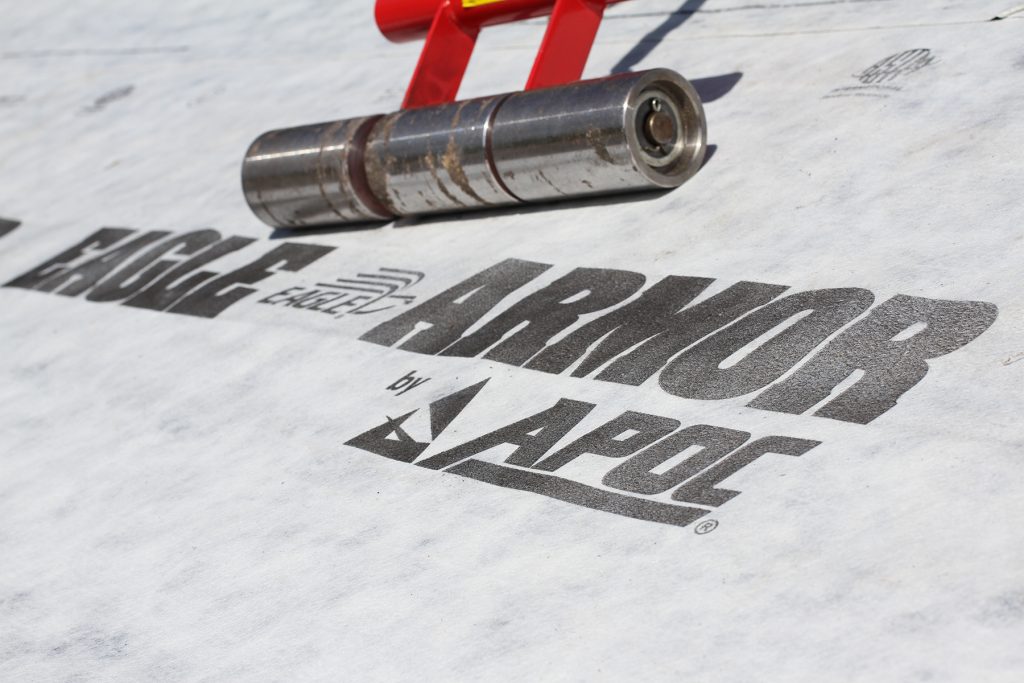
Beyond the name on the roll
What Eagle Armor by APOC brings to the roof
Made to work beneath tile
Eagle Armor appears in the approval’s tile-covering tables. That gives you a documented starting point for choosing the membrane, exact tile and attachment together.
More than one installation option
The NOA includes both an adhered membrane over a nailed anchor sheet and direct-to-deck assemblies. Those choices have different fastener schedules and pressure values; one cannot inherit the rating of another.
Heat and construction exposure matter
The manufacturer describes a 265°F temperature-resistant membrane, while the current NOA allows up to 180 days of exposure. Heat resistance, exposure time and wind resistance are different properties, and each has its own conditions.
Two useful specifications
Thickness and wind resistance at a glance
Material thickness
60 mils
Nominal thickness · 0.060 inch · about 1.52 mm
Both the HVHZ and non-HVHZ Florida evaluations describe Eagle Armor as nominally 60 mils thick.
Assembly wind resistance
−45 to −150 psf
Listed allowable design pressures
The NOA rows cover different felt, direct-to-deck and deck-fastening arrangements. Match the complete listed assembly.
See the assemblies, installation and sources →Pressure ratings apply to the specific deck and installation listed in each approval. They are not wind speeds or a rating for the entire roof. Thickness alone does not determine wind resistance.
Does it fit your roof and your location?
Broward and Miami-Dade are in Florida’s High-Velocity Hurricane Zone (HVHZ). Palm Beach and Martin County are outside that zone. The applicable approval, roof covering and installation must agree.
Broward & Miami-Dade · NOA and HVHZ report
Listed tile systems, metal, shingles, quarry slate and wood coverings.
Use the applicable assembly and covering approval. For foam-set tile, verify the exact adhesive and tile approval; the underlayment list alone is not the complete attachment design.
Outside the HVHZ · Florida evaluation
Mechanically attached tile, listed adhesive-set tile and other Table 2 coverings, including metal.
The report offers additional non-HVHZ assemblies. Do not carry an outside-HVHZ deck or fastening detail into Broward or Miami-Dade without the matching approval.
Explore how tile, underlayment and attachment fit into a complete replacement. Tile roofing service guide →
What the approval actually measures
How much uplift can the approved assembly resist?
These four NOA assemblies show why the installation belongs in the conversation. Both the supporting deck attachment and the membrane/anchor-sheet fastening can change the approved pressure.
Read these as assembly ratings, not wind speeds
These are allowable design pressures in pounds per square foot (psf), not miles per hour or a hurricane-category rating. A larger magnitude represents more allowable uplift for that listed assembly. It does not measure the entire roof or the tile foam alone. Your roof’s required pressures depend on its design and location.
Miami-Dade NOA 25-0910.02 · wood-deck assemblies
Selected complete assembly conditions appear below each bar. This is a within-product comparison, not a ranking of competing membranes.
Select a bar to see the deck, installation and source.
−45 psf
Deck: CAT 19/32, PS1-19, 40/20 span-rated, Grade C-D, Exposure 1, four-ply plywood sheathing.
Installation: APOC Tuff Felt ASTM D226 #30 anchor sheet: 1¼ × 0.120-inch ring-shank nails through 1⅝-inch-diameter, 32-gauge tin caps; 6 inches on center in the 2-inch side lap and 6 inches on center in four evenly spaced, staggered field rows. Eagle Armor: 3-inch side laps, backnailed at 12 inches on center with the same specified nail/cap type.
Limits: Listed roof coverings include mechanically fastened tile and the specifically listed adhesive-set tile combinations. The NOA states this pressure is for the underlayment assembly only; it excludes the complete roof system.
NOA 25-0910.02, p9 — read the complete approval−75 psf
Deck: CAT 19/32, PS1-19, 40/20 span-rated, Grade C-D, Exposure 1, four-ply plywood sheathing.
Installation: Same listed APOC #30 felt and nail/cap specifications as E(6), but anchor-sheet field fastening is 4 inches on center in four evenly spaced, staggered rows; side-lap fastening remains 6 inches on center. Eagle Armor has 3-inch side laps and backnailing at 12 inches on center.
Limits: Listed roof coverings include mechanically fastened tile and the specifically listed adhesive-set tile combinations. The NOA states this pressure is for the underlayment assembly only; it excludes the complete roof system.
NOA 25-0910.02, p8 — read the complete approval−112.5 psf
Deck: Minimum 19/32-inch APA 40/20, Exposure 1, CDX, four-ply plywood or wood plank over No.2 structural wood double-joisted supports at maximum 24-inch spans. Deck attached with 0.113 × 2⅜-inch ring-shank nails at 4 inches on center along edges and intermediate supports.
Installation: Eagle Armor self-adhered with 3-inch side laps. Backnail side laps at 6 inches on center using 0.120 × 1¼-inch galvanized ring-shank nails and 32-gauge, 1⅝-inch-diameter steel tin caps before adhering laps. No separate anchor sheet specified.
Limits: Listed roof coverings include mechanically fastened tile and the specifically listed adhesive-set tile combinations. The NOA states this pressure is for the underlayment assembly only; it excludes the complete roof system.
NOA 25-0910.02, p11 — read the complete approval−150 psf
Deck: CAT 19/32, PS1-19, 40/20 span-rated, Grade C-D, Exposure 1, four-ply plywood sheathing. Deck attached to 2× wood supports at 24 inches on center using #8 × 2-inch bugle-head deck screws at 4 inches on center along edges and intermediate supports.
Installation: Eagle Armor self-adhered with 3-inch side laps. The system does not specify an anchor sheet or a separate backnailing schedule; do not import the F(2) deck fastening. All general limitations and applicable manufacturer instructions remain in force.
Limits: Listed roof coverings include mechanically fastened tile and the specifically listed adhesive-set tile combinations. The NOA states this pressure is for the underlayment assembly only; it excludes the complete roof system.
NOA 25-0910.02, p12 — read the complete approvalBars show the magnitude of the listed negative design pressure. The minus sign denotes uplift. Different decks and installation methods are separate assemblies.
Compare another approved tile underlayment using its own installation-specific pressure chart. Polystick TU PLUS review →
Material testing · Source checked October 27, 2026
Beyond wind pressure: how does the sheet perform?
Tear resistance, tensile strength and vapor permeance describe different jobs. Here is what the reviewed documents actually report for Eagle Armor by APOC.
Tear resistance
Numeric specificationHow well the sheet resists a tear spreading. Test methods can pull or tear the material in very different ways.
ASTM D1970 · lbf/in
Manufacturer-reported lower limit
The sheet reports more than 60 lbf/in, without specifying direction or test conditions. It uses lbf/in; this should not be compared with tear results reported in pounds alone.
Manufacturer technical data sheetEagle Armor by APOC technical data sheet, D20 · p1
Tensile strength
Numeric specificationHow much pulling force the sheet carries before reaching its reported maximum load. This is a material test, not a roof uplift rating.
ASTM D5147 · lbf/in
Manufacturer-reported lower limit
Eagle lists a maximum-load threshold above 25 lbf/in under ASTM D5147. Direction and conditioning are unspecified, and this is not the same test listing used by SB-1.
Manufacturer technical data sheetEagle Armor by APOC technical data sheet, D20 · p1
Vapor permeance
Clarification neededHow readily water vapor passes through the sheet. A lower perm value means less vapor passes through; it does not automatically mean a better roof.
ASTM E96
Unit missing from the source
Reported vapor result (unit unspecified)<0.1 (unit not stated)
The sheet prints “<0.1” but leaves out the unit. We need that detail confirmed before this value can go on a perm scale or into a comparison.
Manufacturer technical data sheetEagle Armor by APOC technical data sheet, D20 · p1
What the NOA and Florida approval establish
NOA 25-0910.02 and FL26482-R12 document product identity, standards/testing and installation/assembly-pressure requirements. They do not publish numeric tear resistance, tensile/maximum-load or vapor-permeance results for these products. The material values shown here come from currently linked official manufacturer technical data sheets, not from approval tables.
- Miami-Dade NOA 25-0910.02: product descriptions and evidence · p3
- FL26482-R12 HVHZ: standards, references and product descriptions · p2
- FL26482-R12 non-HVHZ: standards, references and product descriptions · p2
The approval determines permitted uses and installation. Where it does not publish these laboratory values, the cards identify the original manufacturer sheet as the source. A manufacturer value is not relabeled as an NOA test result.
How to compare these numbers
MD means the direction along the roll; CD or XMD means across it. Match the method, units, direction, conditioning and whether a figure is a minimum, maximum or typical result. A published minimum is a floor—not proof of a product’s highest strength.
Use the exact approved assembly for wind-pressure comparisons. Vapor permeance is a roof-design consideration, and M&M’s installation experience adds context to the laboratory figures.
Compare underlayment options for your roof →The details worth discussing before installation

Which tile foams are listed?
The current NOA’s tile assemblies name TILE BOND, APOC Polyset AH-160 (HFC), APOC Polyset RTA-1, StormBond and StormBond 2, subject to their current approvals and the approved tile system. The Florida R12 tables list four of those—StormBond 2 is not in that table. Keep the selected approval path consistent.
Foam bond data and underlayment design pressures answer different questions. The tile’s attachment resistance, foam placement and required roof-zone loading must also work with the chosen membrane assembly.
How do the Florida pressure assemblies differ?
The HVHZ Florida report lists direct-to-plywood UDL-2 at −150 psf, with Eagle Armor backnailed within 3-inch side laps at maximum 12 inches on center. Its nailed-felt assemblies UDL-3 and UDL-4 are −45 and −75 psf. The non-HVHZ report additionally lists −52.5 psf on 15/32-category plywood. A shared number does not mean the Florida and NOA installation details are identical.
How long can it remain exposed?
The NOA’s ceiling is 180 days. The Florida reports use that same ceiling, subject to any shorter manufacturer limit. Installation damage, unsealed transitions or weather events can still require inspection and repair well before that date. The finished covering should follow the construction plan, not the maximum exposure allowance.
Does a 30-year warranty mean 30 years without leaks?
No. Eagle’s website links to a 30 Year Protection Plus limited warranty with registration and eligibility conditions. It addresses manufacturing defects and excludes installation/labor costs and water damage. The older technical sheet also describes a standard limited warranty, so ask which written coverage applies to your purchase. Keep that separate from M&M’s workmanship terms.
APOC 30 Year Protection Plus limited warranty linked by Eagle
What should be named in your estimate?
A useful proposal identifies the materials and the installation that will be inspected—not simply “underlayment included.” Ask for:
- Eagle Armor by APOC, the selected NOA or Florida system number, and required roof-zone design pressures.
- Deck thickness and fastening, any anchor sheet, and the membrane’s lap/backnailing details.
- For foam-set tile: the exact tile, adhesive, application pattern and supporting approvals.
- The construction exposure plan and the specific product warranty registration and workmanship coverage.
Choose the layers together
M&M Roofing can help you compare underlayment options with the roof covering, deck condition and attachment your project needs.
Plan my roof replacement →Continue comparing roof materials

Polystick TU PLUS review
Compare another approved tile underlayment using its own installation-specific pressure chart.
Tile foam comparison
Review tile-attachment data separately from the membrane’s assembly pressure.
Homeowner questions about Eagle Armor by APOC
Is Eagle Armor the same as SB-1?
No. They are distinct products with different surfaces and permitted applications. Eagle Armor is listed for tile, including specific foam-set combinations. SB-1 is not listed for tile in the approvals reviewed here.
Can any tile foam go over Eagle Armor?
No. Use a foam listed by the selected underlayment approval, with its current component approval and the exact tile approval. The NOA and Florida report do not have identical adhesive lists.
Does the −150 psf option automatically make my roof better?
It gives that specific underlayment assembly a higher allowable uplift pressure than the other charted assemblies. Whether it is appropriate depends on your roof’s required pressures, deck and complete roofing design. Installing a different deck or fastener schedule changes the comparison.
Your roof, your approved assembly
Get a roof estimate with the details included
Tell M&M Roofing about your home and the roof covering you are considering.
Start with the approvals
The NOAs and Florida Product Approval reports are the primary evidence for the installation limits and ratings above. Manufacturer literature provides the additional product and warranty information. These documents describe approved conditions; they are not endorsements.
- Primary approval: Miami-Dade NOA 25-0910.02 — approved March 5, 2026; expires March 28, 2028
Gardner underlayments; product-specific assemblies and limitations. Consult the full document. - Florida Product Approval: FL26482-R12 — HVHZ evaluation, August 20, 2025
Roof-cover options p4; pressure assemblies p5; exposure limits p6. - Florida Product Approval: FL26482-R12 — non-HVHZ evaluation, August 20, 2025
Roof-cover options p4; pressure assemblies pp5–6. Applies outside the HVHZ. - Official status record: FL26482-R12 — official approved application
2023 code cycle; application status Approved when checked October 26, 2026. - Manufacturer literature: Eagle Armor technical data sheet, D20
Product construction, 265°F temperature statement and installation guidance. - Manufacturer literature: Eagle Armor product page
Original manufacturer installation photo and linked warranty. Older approval links on this page are superseded by the current primary documents above. - Manufacturer warranty: 30 Year Protection Plus limited warranty
Registration, remedies, exclusions and coverage conditions.
Technical summaries help compare proposals. The full current documents and the project’s approved plans control installation.