
Tile roofing · South Florida
Can You Replace Tile Roof Underlayment and Keep the Existing Tiles?
Keeping your existing tiles may sound like a way to save on a new roof. The real question is whether those savings survive the labor, equipment, breakage and approval requirements involved in removing and reinstalling them.
By M&M Roofing and Construction Corp · Florida Certified Roofing Contractor CCC1332459 · Published · Updated
Get Your Free Roof Estimate
Tell us about your roof and the decisions you are considering.
The short answer
Sometimes technically, but keeping the tile is not automatically a cost-efficient choice. Careful removal, lowering tiles for storage, loading them back onto the roof and reinstalling them can absorb the savings from buying fewer new tiles. The existing attachment, tile condition and approval requirements also need to be resolved. Compare the complete job with a new-tile replacement before assuming reuse is worthwhile.
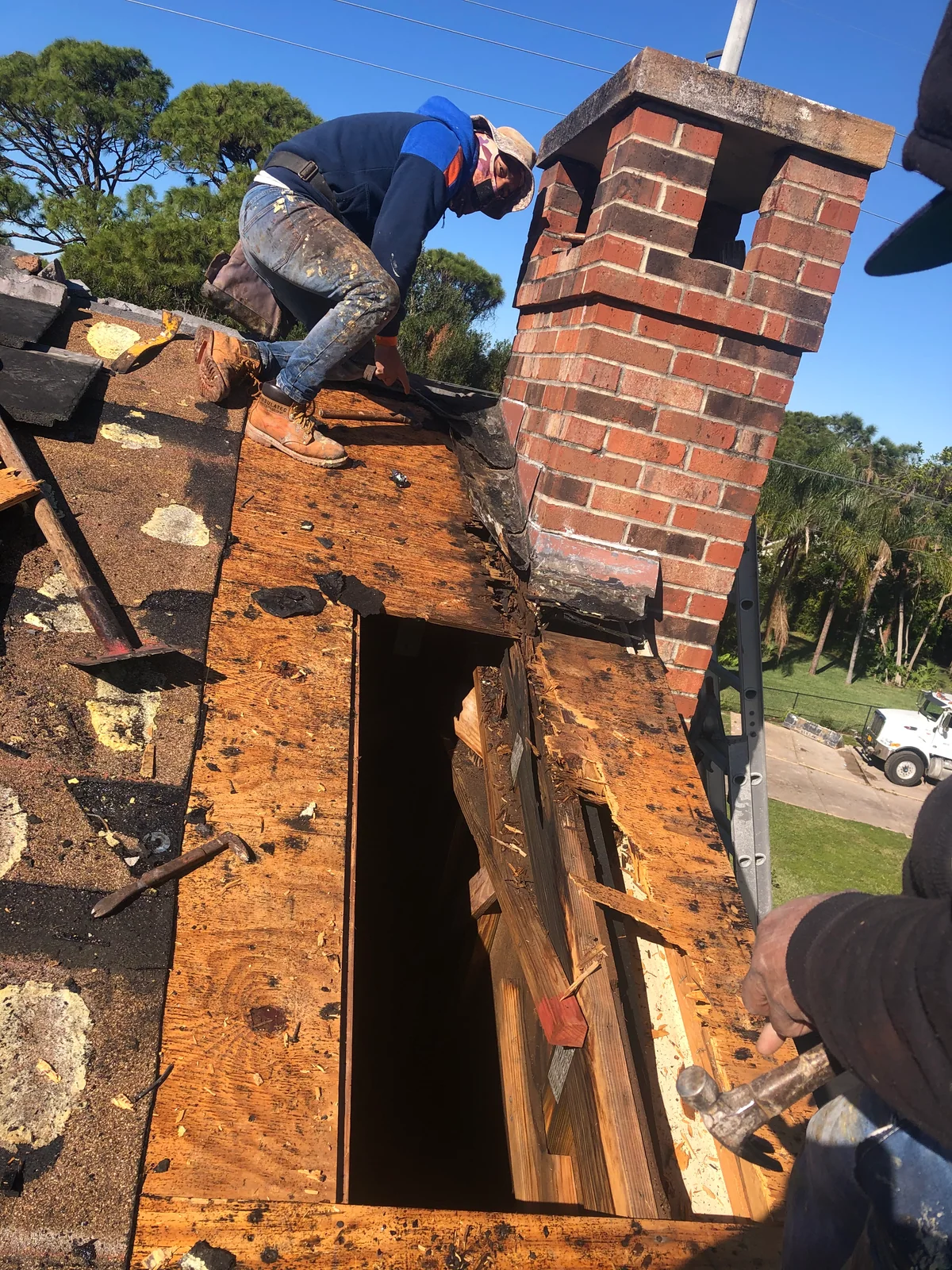
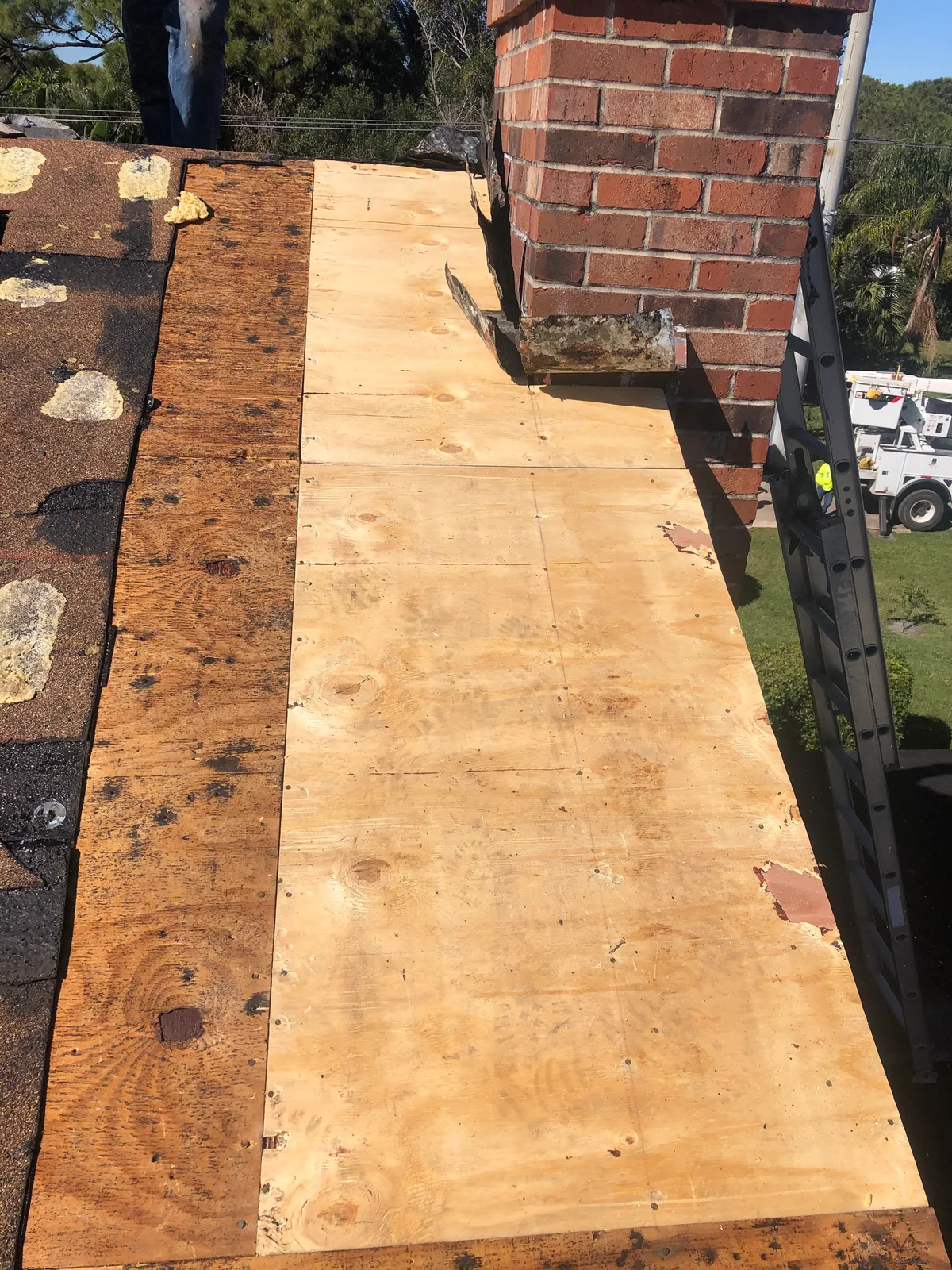
Start with what is leaking, not what the tiles look like
Tile sheds water and protects the layers below; underlayment provides waterproofing beneath that surface. The tiles alone are not the complete roof. Flashing at walls and penetrations, the deck, and attachment also matter. A leak can involve a small detail or broader deterioration that cannot be judged from the street.
The photos above show a localized M&M repair: damaged wood was exposed beside a chimney and replaced. The next photo shows new underlayment. They illustrate why the layers below the tile matter; they do not document a full-roof lift-and-relay. See the complete tile repair-versus-replacement discussion.
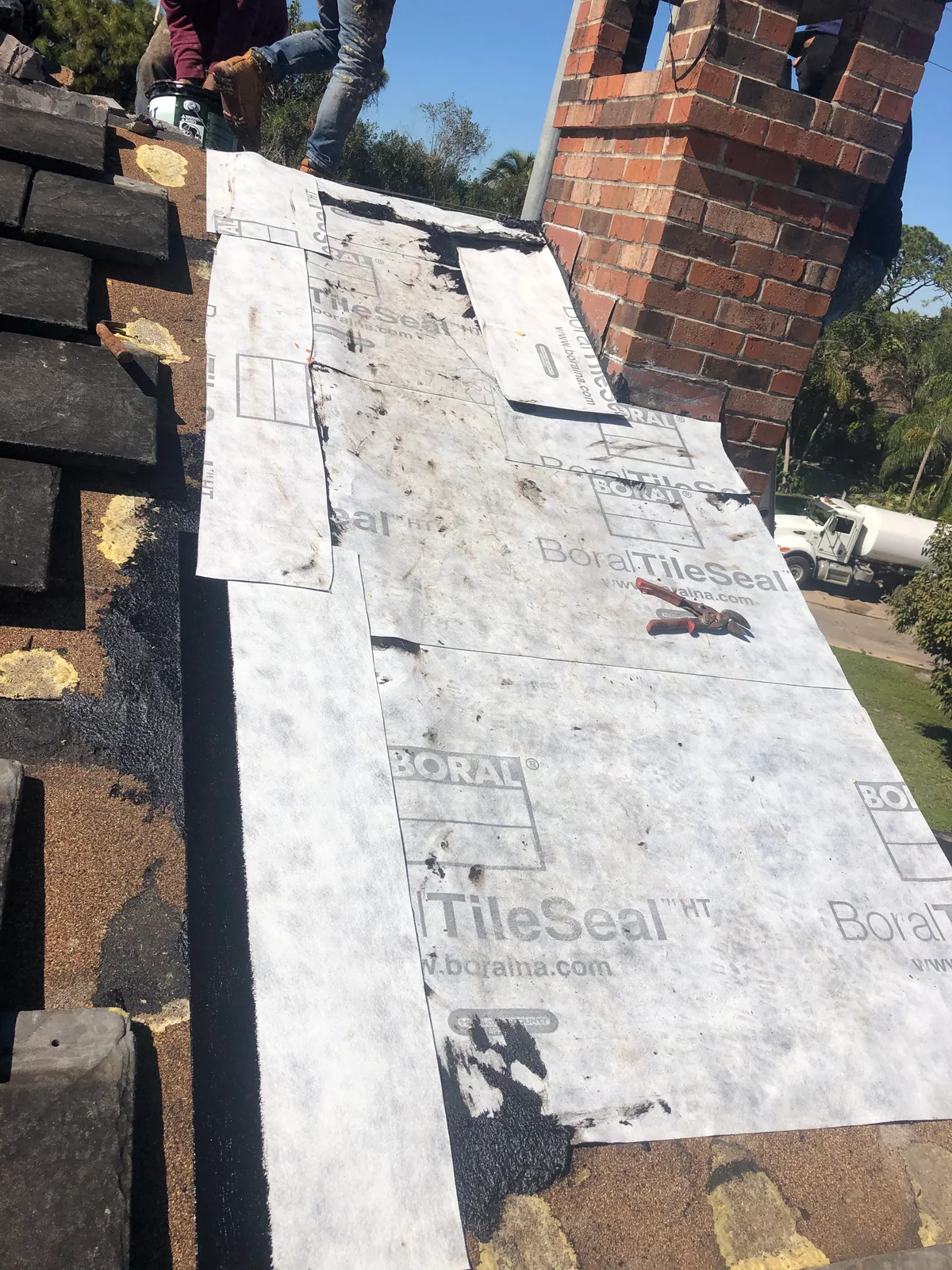
Why keeping old tile may not save much

M&M’s main concern with a full-roof lift-and-reset is the amount of handling it adds. A crew must recover usable tiles carefully instead of simply removing the old covering. Preserving those tiles may also mean lowering them to the ground, arranging storage, and returning later with equipment and labor to load them back onto the roof.
After the deck, underlayment and flashing work, the crew still has to reinstall the tile. Sorting, damaged pieces and replacement stock add further costs. Eagle’s lift-and-relay guidance also cautions that substantial labor savings should not be assumed.
Saving the purchase price of some new tile does not remove those other costs. Whether the final price is lower—and by enough to justify keeping an older covering—requires two complete written scopes for the same roof. We would not promise a percentage saving or assume reuse is the better value.
Use our Broward tile-roof replacement cost guide as background for new-tile work. Its new-tile planning ranges are not prices for tile reuse.
| Work to include | Why it affects the comparison |
|---|---|
| Careful removal and sorting | Recovering suitable tiles takes handling; damaged pieces cannot be counted as usable stock. |
| Lowering and ground storage | Allow for labor, lifting equipment, site access and a place to keep the recovered material. |
| Reloading and reinstallation | Bringing the tiles back up is a separate handling stage before they are set again. |
| Breakage and replacement stock | Identify compatible pieces and who pays if more tile is lost than expected. |
| The work beneath the tile | Deck repairs, new underlayment, flashings, attachment and required inspections still need to be included. |
Compare three different scopes of work
“Fix my tile roof” can mean very different things. Ask which of these the inspection supports, and which parts of the existing roof would remain.
Our tile-roofing guide explains how the covering and the rest of the assembly fit together. A proposal should describe that assembly, not just name a roll of underlayment.
| Option | What it addresses | What to clarify |
|---|---|---|
| Localized repair | A defined problem within an otherwise serviceable roof. | Why the surrounding roof can remain and where the repair stops. |
| Underlayment replacement with tile reuse | Broader work below tiles considered suitable for reinstallation. | Removal feasibility, replacement pieces, flashing, deck repairs and reattachment. |
| Full replacement with new tile | A new roof covering and the specified underlying system. | New tile selection, assembly, complete scope and warranty terms. |
Can the existing attachment be released without ruining the tile?
Screw-fastened tile may be particularly difficult to recover intact; the condition of the fasteners and the tile around the fixing point matters. Some foam-attached tiles may release, but being able to lift a few pieces does not establish that an entire roof can be recovered economically. Mortar and other existing attachments add their own limitations.
Eagle Roofing’s concrete-tile guidance frames lift-and-relay as an option in some regions where the original installation did not require every tile to be mechanically or adhesively attached. It is not blanket approval for South Florida roofs. Have the contractor address these points before pricing a job on the assumption that the old tile will survive:
- Condition: Which tiles are sound, and how will cracked or damaged pieces be identified and excluded?
- Removal: How will existing fasteners, adhesive or mortar affect the chances of recovering usable tiles?
- Replacements: Are enough compatible pieces available for existing damage and losses during handling?
- Fit and appearance: Will replacement pieces seat correctly, and how noticeable might their color be?
- Reinstallation: Can the retained tile be incorporated into the proposed attachment and underlayment assembly?
Can an expired NOA prevent you from reusing the tiles?
Yes—product approval can stop a reuse proposal even when the tiles look serviceable. In Broward and Miami-Dade’s High-Velocity Hurricane Zone, the Florida Building Code requires current, valid product approvals for roofing components, systems and assemblies. Its reroofing provisions also require compliance with the hurricane-zone rules.
An expired NOA is not an active approval. However, an old document does not by itself prove that the product has no newer approval. Miami-Dade’s approval-status definitions distinguish expired records from approvals that have been superseded by newer ones.
A newer NOA does not automatically establish that your existing tiles qualify for reuse. The contractor needs to identify the actual manufacturer, profile and available product markings, and check the proposed tile, underlayment and attachment against the applicable approval. The building department must accept the proposed scope and supporting documents.
Do not treat a limited tile repair as permission to remove and reset an entire roof. If the proposed reuse cannot be supported by applicable approval and accepted by the building department, it should not be offered as a ready-to-permit alternative. Our NOA and Florida product-approval guide explains what to look for in those documents.
Choose the new underlayment as part of a complete system

Polyglass’s tile-system literature distinguishes tile’s water-shedding role from the waterproofing beneath it. Its Polystick TU MAX is a self-adhered underlayment for adhesive-foam or mechanically fastened tile applications. That product description is a starting point, not approval for every deck, attachment method or roof.
Ask for the exact membrane, required layers, deck preparation, flashing details and tile-attachment method in writing. Our TU MAX review shows documented M&M applications, while the Polystick comparison explains why similar product names do not make the systems interchangeable.
The contractor should identify the applicable approved assembly and its limitations. You can follow our guide to checking an NOA or Florida product approval to understand the supporting documents.
Get a roof-specific answer before choosing a scope
Bring previous repair invoices, any known installation date, leak photos and available permit records to your roof assessment. Explain whether leaks recur in one area or appear in different parts of the home.
Ask the contractor to distinguish what is visible from what remains concealed. If opening an area is needed to evaluate attachment or hidden damage, agree on that investigation and how the opening will be protected before work begins.
Keeping the tile does not automatically remove permit or inspection requirements. Fort Lauderdale’s permitting guidance includes reroofing; confirm the requirements for the actual property jurisdiction and proposed scope. Ask about HOA review when appearance may change.
Before signing, settle the tile-replacement allowance, weather protection, flashing scope, inspection responsibilities and warranty coverage. The recommendation should explain what the work will solve and what existing materials will remain.
Frequently asked questions
Can roof underlayment be replaced without removing the tiles?
The tiles covering the area being worked on generally have to be removed to access the underlayment. An isolated repair may involve a limited section; replacing underlayment across the roof is a much broader project. Ask the contractor to show the proposed work area and explain how it connects to the roof that will remain.
Does one leak mean all the tile underlayment needs replacing?
No. A single leak may come from a specific flashing, penetration or damaged area. The assessment should identify the likely cause and consider conditions beyond that spot. Recurring leaks, previous repairs and deterioration across multiple areas can justify a broader discussion, but the number of ceiling stains alone does not establish the right scope.
Can foam-attached tiles be lifted and reused?
Some foam-attached tiles may release, but that cannot be assumed for the whole roof. Condition, the adhesive bond and damage during removal all matter. Even if tiles can be recovered, careful handling, lowering, storage, reloading and resetting still have to be priced. Screw-fastened tiles may be especially difficult to remove intact; attachment feasibility needs its own assessment.
What if my concrete tile profile is discontinued?
Availability becomes an important part of the decision. A replacement needs to fit the retained tile correctly, not merely resemble it from the street. Ask the manufacturer or supplier about compatible options and obtain an allowance for replacement pieces. If adequate matching material cannot be secured, compare a new-tile scope before committing to reuse.
Does an expired tile NOA automatically mean I need new tiles?
An expired NOA cannot serve as an active approval. Check whether a newer applicable approval exists and whether it supports the actual retained tile and proposed work. A renewal is not automatic permission to reinstall an older roof. If the reuse proposal cannot obtain the necessary approval, compare a replacement scope using an approved new-tile system.
Does the same advice apply to clay tile?
Clay tile also needs a roof-specific assessment, but concrete-tile manufacturer guidance should not be treated as approval for every clay product. Identify the clay tile manufacturer, profile, condition and existing attachment. Ask for the applicable installation and replacement guidance, then evaluate whether the proposed work can preserve usable tile and provide a suitable finished assembly.
Will tile reuse give me a new-roof warranty?
Ask for separate written terms covering retained tile, new materials and installation workmanship. Reinstalling an existing product does not mean you receive the same manufacturer coverage offered with a newly purchased tile roof. Clarify exclusions, who handles a future leak and whether the warranty covers the complete proposed work or only specified components.
Will replacing underlayment reset my roof age for insurance?
Do not assume an insurer will treat retained tile with new underlayment the same way it treats a complete new-tile roof. Describe the proposed scope to your insurer or agent before relying on an insurance benefit. Ask what records, inspections and completion documents it requires and how it will assess the roof under your policy.
How should I compare reuse with choosing new tile?
Compare complete written scopes for the same roof. Include careful removal, equipment for lowering and reloading, storage, tile breakage, deck repairs, underlayment, flashings and reinstallation. Then compare the finished appearance and written coverage. Reuse can lose its apparent advantage once those costs are included. Our tile profiles and color samples can help you evaluate the new-tile alternative.
Related roofing guides
Sources checked November 16, 2026
- 2023 Florida Building Code, Building, Eighth Edition: Chapter 15 (opens in a new tab)Sections 1501.1, 1512.2.1 and 1521.1–1521.2; current text checked November 16, 2026. General tile-reuse language in Section 1511.5 is not a substitute for the HVHZ provisions.
- Miami-Dade County: NOA file-status definitions (opens in a new tab)
- Eagle Roofing: lift-and-relay considerations for concrete tile (opens in a new tab)
- TRI Alliance: Tile Replacement Considerations, April 2021 (opens in a new tab)
- Eagle Roofing: matching replacement tiles (opens in a new tab)
- Polyglass: Polystick TU MAX (opens in a new tab)
- Polyglass: tile underlayment system brochure (opens in a new tab)
- City of Fort Lauderdale: permitting services (opens in a new tab)
Start with the condition of your roof
Tell M&M about the leaks, previous repairs and what you hope to preserve. Request a free roofing estimate and ask what findings support the recommended scope.
Call (754) 714-8445